Russia shut down airports and temporarily cut mobile internet access for many users in Moscow on Tuesday, as it tightened security before the 9 May Victory Day parade marking the defeat of Nazi Germany. The parade, Russia's foremost national celebration, has already been scaled back and will proceed without heavy military hardware for the first time in nearly two decades, amid fears of long-range Ukrainian drone strikes.
Ukraine has recently demonstrated its ability to penetrate Moscow's dense air defence systems: on Monday morning a drone struck a high-rise apartment building just a few miles from the Kremlin. In what appeared to be an effort to shield the military parade, Moscow earlier this month declared a unilateral ceasefire with Ukraine for 8-9 May and warned of a 'massive missile strike' on central Kyiv if it were violated.
Victory Day has been central to Vladimir Putin's vision of Russian identity throughout his more than 25 years in power. Since the full-scale invasion of Ukraine, the Kremlin has intensified its use of the annual celebration, with Putin deploying the occasion to frame and justify the current war. Ukraine dismissed the proposal as a cynical ploy to protect the parade from drone attacks. Volodymyr Zelenskyy, Ukraine's president, responded by announcing a separate truce from 6 May, saying it was 'not serious' to expect Kyiv to observe a ceasefire tied to a Russian military holiday.
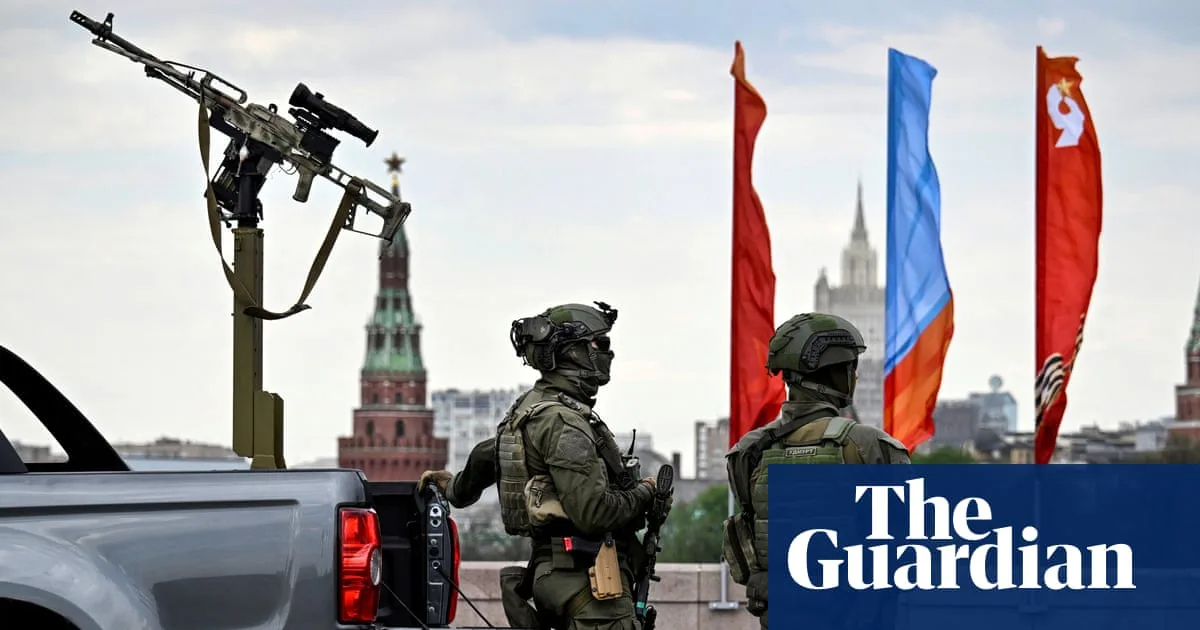
Security in the Russian capital has been visibly tightened in the run-up to the parade, with checkpoints set up across the city and snipers and machine-gun crews deployed on Kremlin towers. Residents on Tuesday awoke to dead mobile signals across Moscow, hitting workers hardest. By midday, access appeared to have been largely restored, but more outages are expected in the coming days. Russian officials have previously justified such shutdowns as necessary to protect the capital from drone attacks and acts of sabotage.
All four of Moscow's airports suspended operations on Tuesday over unspecified security concerns. Last year, Ukraine sought to disrupt the lead-up to the event by launching swarms of explosive-laden drones at Moscow, causing travel chaos. Alongside the heightened security presence, Russia has also stepped up personal protection for Putin in recent months, according to a European intelligence report. The president is said to be spending more time in underground bunkers, and his staff are banned from travelling on public transport amid fears of a possible assassination attack.