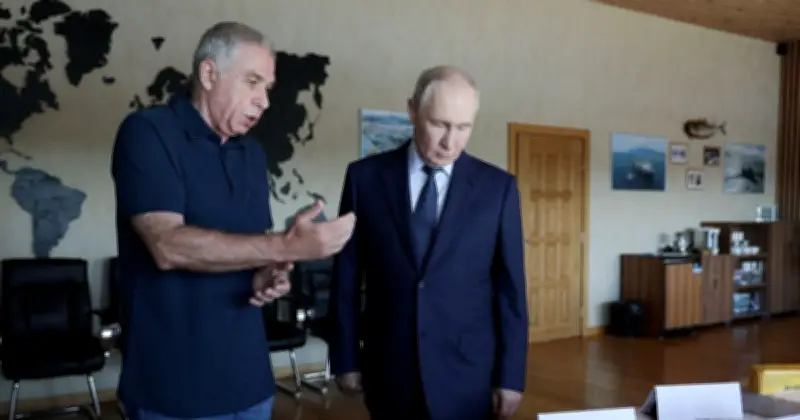
Russia's Foreign Ministry summoned the Japanese ambassador following Tokyo's criticism of President Vladimir Putin's trip to the Kuril Islands, the Moscow-controlled Pacific archipelago claimed by both countries. Last week, Putin visited Iturup, one of the four southernmost islands of the chain, which Japan calls the Northern Territories.
Historic visit and Japanese reaction
The Soviet Union took the territories from Japan in the final days of World War II, and the dispute has kept the countries from signing a peace treaty formally ending their hostilities. Japan's Prime Minister Sanae Takaichi said: "The Northern Territories are inherently part of Japan's territory, both historically and under international law. This visit has further hardened anti-Russian sentiment within Japan and has made the restoration of relations over the medium- to long-term more difficult."
She added that the visit further fractured the already strained ties between the two countries over Ukraine, and that Moscow should understand the consequences. Along with other G7 countries, Japan has sanctioned Russia and given financial and non-lethal defence aid to Ukraine, which recognises Japan's claim over the disputed islands.

Diplomatic protests and response
Japanese Foreign Minister Toshimitsu Motegi said Tokyo "strongly protests" Putin's visit to Iturup, which Japan calls Etorofu, noting that "the Northern Territories, including Etorofu Island, are Japan's inherent territory both historically and from the perspective of international law." Russian Foreign Minister Sergey Lavrov said on Monday that Takaichi's comments on Putin's visit had "crossed the line of decency" and criticised Tokyo's "militaristic line".
Japan's ambassador to Moscow left the meeting at Russia's Ministry of Foreign Affairs on Tuesday after 25 minutes without making any comment.
Strategic importance of the islands
Control of the islands gives Russia year-round access to the Pacific for its fleet based in Vladivostok, because the strait between the southern islands does not freeze in winter. The disputed territories also give access to rich fishing grounds and potentially valuable mineral deposits. Japan paid Russia for the right to fish there until the agreement broke down in 2022. Russia has bolstered its military presence on the isles, which sit astride the line between the Sea of Okhotsk and the Pacific Ocean.