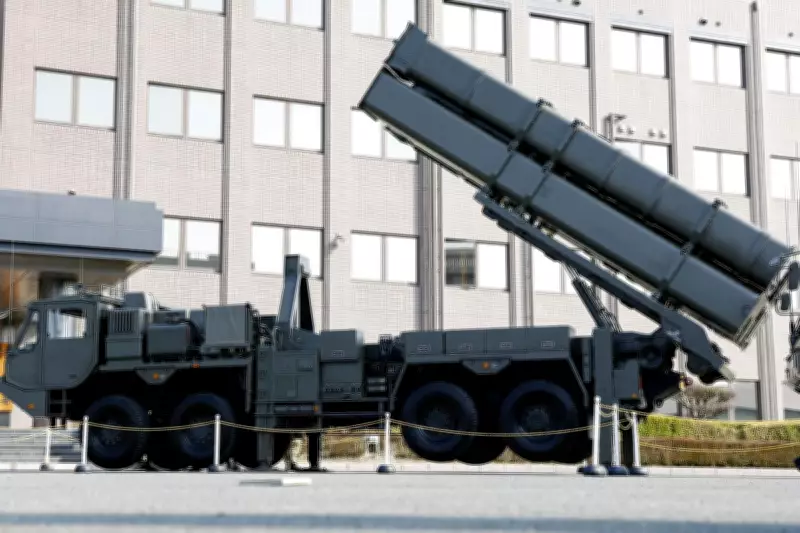
Japan has officially deployed its first long-range missile at a southwestern army camp, accelerating its offensive capabilities in response to mounting global challenges, particularly from an increasingly assertive China. The deployment represents a pivotal moment in Japan's post-war defense strategy.
Enhanced Missile Capability Operational
Officials confirmed on Tuesday that upgraded Type-12 land-to-ship missiles, developed and manufactured by Mitsubishi Heavy Industries, are now operational at Camp Kengun in Kumamoto prefecture. These missiles boast a range of approximately 1,000 kilometers (620 miles), a substantial increase from the original 200-kilometer (125-mile) range, enabling them to reach mainland China.
Defense Minister's Statement
Defense Minister Shinjiro Koizumi emphasized the critical nature of this deployment, stating, "As Japan faces the most severe and complex security environment in the postwar era... it is an extremely important capability to strengthen Japan’s deterrence and responsiveness." He added that it demonstrates Japan's firm determination and capability to defend itself.

Shift in Defense Policy
The deployment grants Japan a "standoff" capability, allowing it to strike enemy missile bases from a distance. This marks a significant departure from the self-defense-only policy long upheld under Japan's pacifist constitution, reflecting a more proactive military stance.
Local Opposition and Protests
Residents near Camp Kengun have staged protests against the deployment, expressing concerns that it escalates regional tensions and increases the risk of the area becoming a target for potential enemies. Despite this opposition, the government has proceeded with the installation.
Expansion of Weapons Systems
In a related development, a hypersonic glide vehicle designed for island defense was deployed to Camp Fuji in Shizuoka prefecture. Additional deployments of upgraded Type-12 missiles and hypersonic glide vehicles are planned at other locations across Japan, including Hokkaido in the north and Miyazaki in the south, by March 2028.
Future Missile Plans
Japan also intends to deploy U.S.-made Tomahawk cruise missiles, with a range of 1,600 kilometers (990 miles), on the Japanese destroyer JS Chokai later this year. These missiles will eventually be installed on seven other destroyers, further enhancing Japan's naval strike capabilities.
Regional Security Concerns
Japan considers China its primary regional security threat and has been fortifying its southwestern islands near the East China Sea. In December, Prime Minister Sanae Takaichi's Cabinet approved a record defense budget exceeding 9 trillion yen ($58 billion) for the fiscal year starting in April, aimed at bolstering strike-back capabilities and coastal defense with cruise missiles and unmanned arsenals.
Recent Incidents and Tensions
Last June, Japan detected two Chinese aircraft carriers operating near its remote Pacific islands simultaneously for the first time, raising alarms in Tokyo about Beijing's expanding military reach. In response, the defense minister announced the establishment of a new office dedicated to studying China's Pacific activities.
Tensions have intensified since Prime Minister Takaichi stated in November that any Chinese military action against Taiwan could justify a Japanese military response, underscoring the heightened stakes in the region.