Iran's 'Ghost' Submarines Lurk in Hormuz Strait as US Warships Approach
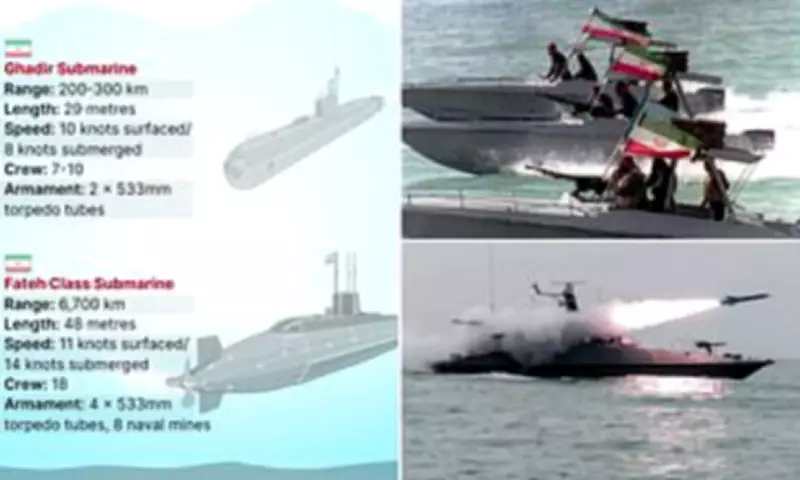
In the temperate waters of the Strait of Hormuz, small but deadly Iranian submarines are lying in wait, with Donald Trump's warships firmly in their crosshairs. These Ghadir-class mini subs, adapted from a North Korean model, slip through sonar blind spots to silently shadow their prey before despatching underwater anti-ship cruise missiles or homing torpedoes and vanishing without trace.
Not for nothing are they known as the 'Ghosts in the Gulf.' One such submarine is said to have photographed an aircraft carrier up close during a surveillance mission before slinking away undetected. Tehran has previously claimed that 'on several occasions' these submarines 'caught US Navy vessels off guard by surfacing unexpectedly near them.'
A Deadly Arsenal Awaits in the World's Busiest Oil Shipping Channel
Submarines are far from the only lethal hardware in Iran's naval arsenal. From torpedo-firing speedboats and kamikaze drones to mines of every description and unmanned explosive-laden craft disguised as wooden fishing boats, enough fiendish weaponry for a 007 film awaits the US Navy in this critical waterway.

Certainly enough to give the 2,000 marines aboard USS Tripoli pause for thought. Next week, the 50,000-ton amphibious assault ship, en route from Japan, will enter the war zone and prepare for a confrontation that may yet decide the conflict's outcome.
Whether there is a part to play for Britain in the Battle of Hormuz remains to be seen. Last week, Sir Keir Starmer offered UK bases as launchpads for US strikes to restore freedom of navigation to the strait, which Iran effectively closed, causing a surge in oil and gas prices. Military sources claimed on Saturday night that nuclear-powered submarine HMS Anson was in the region, but so far the Royal Navy is said to be unwilling to send warships because the threat posed by Iran means the situation is 'too fluid.'
The Strategic Importance of Hormuz Strait
Just 24 miles wide at its narrowest point, Hormuz joins the Gulf with the rest of the world. Bounded by Iran to the north and Oman to the south, it is the only route by which ships – including oil and gas tankers – can travel from the ports of Iraq, Kuwait, Bahrain, Qatar, the east coast of Saudi Arabia and most of the United Arab Emirates to the world's energy markets.
To the Islamic regime, Hormuz represents its best opportunity for inflicting symbolic damage on the US. And Iran has much to avenge, having not forgotten the loss of the warship Iris Dena, torpedoed by a US submarine off the southern coast of Sri Lanka in the early days of the war.
Sinking a US ship in retaliation might seem unthinkable, but as one defence expert said, even if the Iranians hit just one and it required rescue, the result would be 'catastrophic for the image of Donald Trump in the American political theatre.'
Iran's Blockade and Asymmetric Warfare Capabilities
Iran's blockade of Hormuz includes a threat to 'set on fire' any vessels that dare cross it. Usually, about a fifth of global oil and gas passes through the narrow corridor connecting the Gulf with the Arabian Sea. But Iran's General Sardar Jabbari says Tehran will now 'not let a single drop of oil leave the region.'
In response to Iran's threats, Mr Trump promised to grant tankers and other commercial ships a navy escort. As he has learned since making his pledge, that is easier said than done. Though Iran's regular navy suffered heavy losses in the first wave of US attacks, the country's second navy run by the Islamic Revolutionary Guards Corps (IRGC), which is responsible for the strait, is thought to be largely intact.
The rugged mountainous coastline to the east of the strait gives the Iranians a key advantage. They can dig into the hills and launch over-the-horizon strikes that are difficult to spot. And drones can be despatched undetected from anywhere. Some of Iran's deadly vessels are thought to be hiding in an underground cove on a tiny island in the strait.

Coordinated Attack Scenarios and Advanced Weaponry
A 2020 report by Farzin Nadimi, a senior fellow at the Washington Institute, outlined how this might play out in the strait. It said: 'Iran could theoretically launch a coordinated attack involving explosives-laden remote-controlled boats and remotely operated underwater vehicles, swarming speedboats, semi-submersible torpedo boats, kamikaze [drones], midget attack submarines, and shore-based antiship missile and artillery fire.'
Elsewhere the report says Iran's network of islands, inlets and coves along the strait provide 'excellent hiding places' and allow for 'staging precision mining operations, sneak missile and swarming attacks.' Iran has also bored tunnels into rocky islands 'from where boats can launch directly into shipping lanes.'
Other firepower at the IRGC's disposal includes armed replicas of the British-built Bladerunner 51, hailed as among the fastest speedboats in the world. A senior IRGC commander said when it was launched: 'The Bladerunner is a British ship that holds the world speed record [80mph]. We got a copy [on which] we made some changes so it can launch missiles and torpedoes.'
The Submarine Threat and Mine Warfare
The regime is estimated to have 17 submarines garrisoned at Bandar Abbas, which sits on the northern bend. US forces appear to have disabled only one of them since the attacks began last week. That submarine – a 500-ton Fateh-class vessel with at least four 533mm torpedo tubes – was Iran's 'most operational' sub-surface boat, according to US military officials.
Ryan Ramsey, a former captain of the Royal Navy submarine HMS Turbulent, said: 'Having operated submarines in the Gulf region, the Iranian submarine force should be taken seriously.' As well as Ghadir-class, he said Iran also operated Russian-made Kilo-class submarines, which are larger, longer-range boats and have greater firepower.
According to the report, the IRGC considers sea mines essential to what it calls its 'smart control' of the Strait of Hormuz. To that end, it is said to have acquired some of the world's deadliest, including 'influence' mines which rest on the seabed. Triggered not by physical contact, they instead use sensors to detect when a vessel is nearby.
Potential US Military Options and Strategic Dilemmas
The Marine Expeditionary Unit on board the USS Tripoli could take part in an invasion of Iran's Kharg Island, located 15 miles off its mainland. It is the country's main oil export terminal and critical to its fragile economy. The Tripoli could be joined by another amphibious assault ship the USS Boxer, which left San Diego earlier last week, bringing the number of marines units in the region to three.
Blockading or occupying the five-mile strip of land might give Washington leverage in talks to reopen the Strait and allow Mr Trump to end the war on his terms. However, such an operation – which would leave US troops exposed to Iranian missiles and drones – would only be launched once Iran's coastal military capabilities have been further degraded.
Sascha Bruchmann, a military analyst at the International Institute for Strategic Studies, said US marines could deploy from the Tripoli using Osprey tilt-rotor aircraft, which can transport squads of 20 troops to positions up to 400 miles away. They could land using smaller amphibious assault boats.
Another target is Qeshm Island in the strait. 'It's a bit like an unsinkable aircraft carrier,' Mr Bruchmann told The Times. 'There's natural salt caverns and mines, which are used as underground storage facilities for the [drones] that now hold shipping hostage. So marines as fighters and as amphibious raiders, would be the ideal option to... try to neutralise these facilities.'
In short, the President faces an inescapable dilemma. Inaction risks global trade chaos, but taking action could entangle the US in a conflict with no obvious end in sight. Even if the US feels it could counter all Iranian threats, the operation would be enormously complex, expensive and would last as long as Iran chooses to keep threatening ships – something beyond Donald Trump's control.