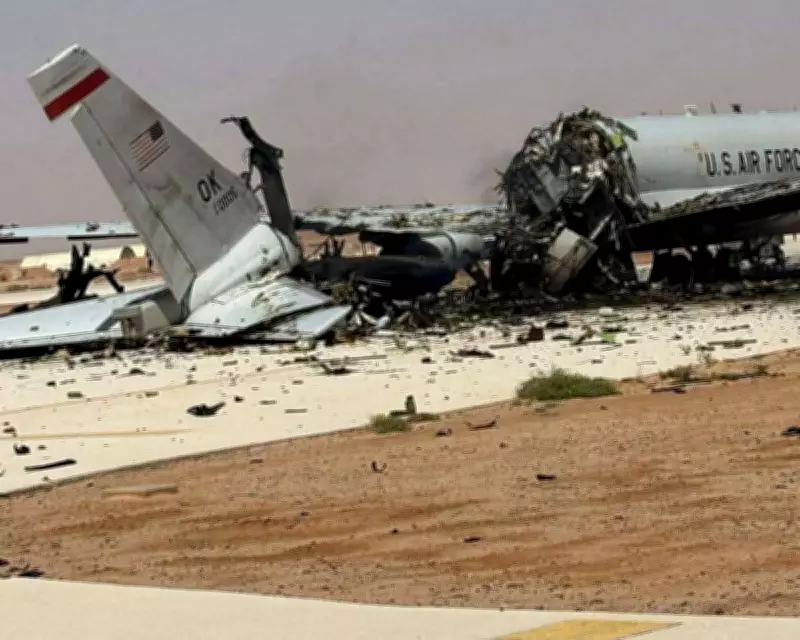
US E-3 Sentry AWACS Destroyed in Iranian Strike at Saudi Base, Raising Security Alarms
The destruction of a US E-3 Sentry airborne warning and control system (AWACS) aircraft in an Iranian strike on a Saudi Arabian airbase has ignited serious concerns over the protection of critical surveillance assets and Iran's persistent ability to execute precise attacks in the Middle East. The incident, which occurred on 27 March 2026 at Prince Sultan airbase, also resulted in injuries to US servicemen and damage to several in-flight refuelling aircraft, underscoring the escalating tensions in the region.
Details of the Attack and Aircraft Capabilities
The targeted E-3 Sentry was one of only 16 operational aircraft of its kind, first produced in the 1960s and equipped with sophisticated monitoring technology. These planes are designed to warn of airborne threats like missiles and surveil battle spaces, tracking communications, troop movements, and air defence sites. Images from the attack reveal a direct hit on the aircraft's radar dome near the tail, indicating a high degree of accuracy in the strike.
This ageing fleet has long faced maintenance challenges, with reports suggesting that in 2024, the US air force's E-3s had a mission-capable rate of approximately 56%, meaning just over half were operational at any given time. Despite these issues, the E-3 can monitor up to 600 targets simultaneously over vast areas, serving as essential eyes and ears for fighter pilots.

Intelligence and Regional Implications
Ukrainian President Volodymyr Zelenskyy has claimed that Ukrainian intelligence obtained information showing a Russian spy satellite photographed the base three times prior to the attack, on 20 March, 23 March, and 25 March. Zelenskyy suggested that such repeated imaging typically signals an imminent assault, raising suspicions about Moscow's involvement. This aligns with earlier reports that Russia has been providing intelligence to Iran on US force locations in the Middle East, though Russian Foreign Minister Sergei Lavrov has denied these allegations.
The attack highlights Iran's continued capacity to strike high-value targets despite ongoing US and Israeli air raids. Experts note that while there has been a decrease in Iran's missile launches recently, Tehran may be strategically conserving resources to prolong the conflict and leverage its impact on the global economy. Some analysts believe Iran is deliberately targeting key enablers of US airpower, such as radar systems and support aircraft, as part of a broader campaign following initial successes by the US and Israel in controlling Iranian airspace.
Expert Analysis and Broader Concerns
Heather Penney, a former F-16 pilot and director at the Mitchell Institute for Aerospace Studies, emphasized the significance of the loss, stating that E-3s are crucial for airspace deconfliction, targeting, and providing lethal effects in battle spaces. The destruction of this asset not only compromises US military operations but also raises alarms about the security protocols at allied bases in volatile regions.
As tensions simmer, the incident at Prince Sultan airbase serves as a stark reminder of the evolving threats in the Middle East and the need for enhanced protective measures for critical military infrastructure. The ongoing conflict continues to test the resilience and strategic responses of involved nations, with potential ramifications for global stability and security.