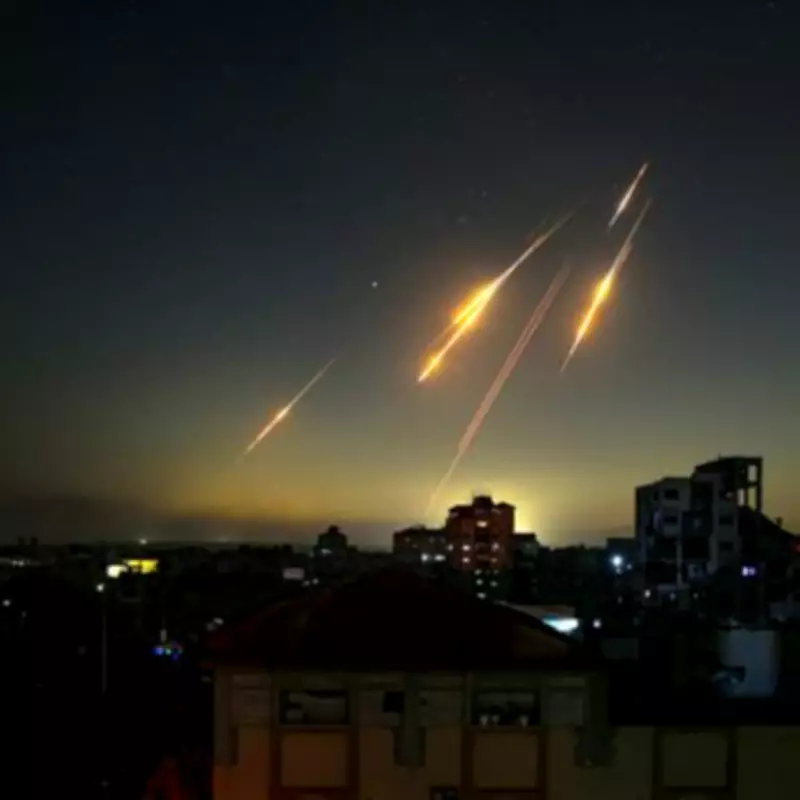
Iran's Missile Capabilities Spark Global Security Reassessment
A chilling new analysis has compelled defence experts to drastically reassess the potential reach of Iran's ballistic missile arsenal, with over fifty countries now technically within range. This revelation follows a recent incident where Iran fired two missiles toward the joint British-American military base on Diego Garcia island in the Indian Ocean, approximately 4,000 kilometres from Iranian territory.
Neither missile struck its intended target; one was intercepted by anti-missile defences mid-flight, while the other suffered a technical failure and plunged harmlessly into the ocean. However, the mere attempt to target a location so distant has triggered a comprehensive re-evaluation of Iran's military capabilities.
Revised Range Assessment and European Implications
A spokesperson from the Israeli Defence Force (IDF) has stated that the maximum effective range of Iran's missiles is now believed to be approximately 2,485 miles. If this analysis proves accurate, a weapon launched from Iran's Bakhtaran Missile Base, one of its most westerly launch sites, could potentially reach targets across a significant portion of Europe.

With this fresh assessment, a densely-populated stretch of the UK mainland, including major cities such as London, Cambridge, and Norwich, is now considered potentially vulnerable. Maps illustrating the revised range show that alongside the UK, most of mainland Europe could be at risk, with only Spain and Portugal appearing to be outside the immediate danger zone.
Expert Analysis on Payload and Accuracy Trade-offs
Dr. Sidharth Kaushal, a senior research fellow at the Royal United Services Institute (Rusi), explained to The Times that employing a lighter warhead could significantly extend the missiles' operational range. However, he noted that any potential missile launched toward the UK mainland would face substantial limitations.
"A missile fired over 4,000km likely has a pretty high circular error probable, which means you would need quite a few to strike anything specific," Dr. Kaushal stated. "The lighter payload also means that one would be trading impact for range. So even though it is theoretically possible to hit Britain, this would involve firing a limited capability over a well-defended trajectory with a small and inaccurate payload."
NATO's Defence Systems and Reassurances
Experts emphasise that even if Iran were to attempt firing missiles at British targets, they would almost certainly be intercepted long before reaching UK airspace. Matthew Savill, director of military sciences at Rusi, highlighted NATO's Ballistic Missile Defence (BMD) system as a robust countermeasure.
"If launched towards the UK, this is what NATO's BMD is designed for," Savill said. "The UK isn't actually defenceless against a threat launched from Iran." The BMD system comprises two land bases in Poland and Romania, plus four US Navy Arleigh Burke-class destroyers stationed in Spain.
Political Responses and Contradictory Statements
Steve Reed, addressing the BBC, sought to calm public concerns, stating there was "no specific assessment that the Iranians are targeting the UK - or even could if they wanted to." He reassured the public that the UK is "perfectly capable of protecting this country and keeping this country safe."
In contrast, Iran's foreign minister, Abbas Araghchi, has claimed that his country's missiles are deliberately limited to a range of 2,000km because "we don't want to be felt as a threat by anybody else in the world." This statement contradicts previous assertions from figures like former US President Donald Trump and Israeli Prime Minister Benjamin Netanyahu, who warned that Iran had developed missiles capable of threatening Europe.
Comprehensive List of Countries Within Theoretical Range
The revised assessment indicates that over fifty countries are now considered technically within range of Iran's missiles, although the likelihood of attacks varies significantly. The full list includes:

- The UK, France, Belgium, The Netherlands, Germany, Austria, Czechia, Hungary, Croatia, Serbia
- Bulgaria, Greece, Switzerland, Italy, Denmark, Norway, Sweden, Finland, Poland, Slovakia
- Romania, Moldova, Turkey, Ukraine, Belarus, Lithuania, Latvia, Estonia, Russia, Kazakhstan
- Uzbekistan, Turkmenistan, Kyrgyzstan, Afghanistan, Pakistan, India, Jordan, Saudi Arabia, Egypt
- Iraq, Israel, Syria, Lebanon, Azerbaijan, Georgia, Kuwait, Oman, The UAE, Libya, Tunisia, Mongolia, China
While many of these nations, such as China and Libya, are considered allies of Iran and thus unlikely targets, the technical capability alone has raised significant geopolitical concerns. The ongoing reassessment underscores the evolving nature of global security threats and the continuous need for robust defence strategies.