
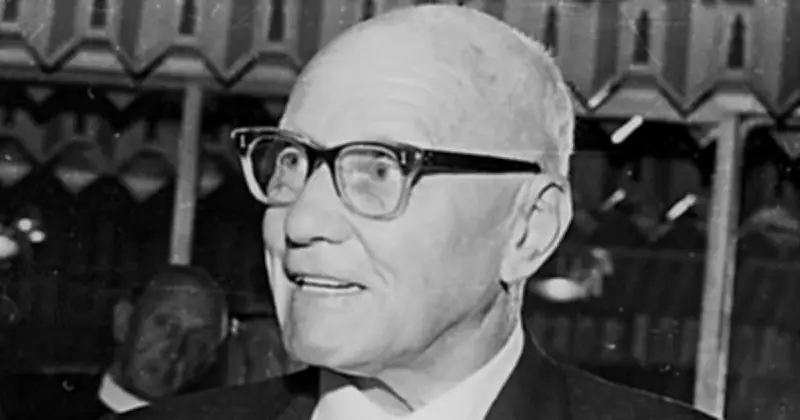
Lubeck in northern Germany is to honour a British war hero 80 years after his act of “cold-blooded fearlessness” saved the city from disaster. Squadron Leader Hubert Dinwoodie, one of the most decorated men in armed forces history, single-handedly stopped 1,100 tons of bombs from exploding in the city near Hamburg.
Bravery That Saved Thousands
His bravery saved thousands of lives, but the remarkable story is seldom known. Later this month, eight decades on from the exploit, the grateful city will pay a debt of gratitude to the man who epitomised bare-faced courage.
Less than 12 months after the end of the Second World War, one of 12 massive enemy devices exploded during an operation to dump them at sea, threatening to trigger a devastating chain reaction. The blast killed eight and injured 12 others, but even more highly explosive ordnance remained in railway wagons at the harbourside.
The 1946 Incident
Lubeck sits on the River Trave in Holstein, where it flows into the sea, and was an important German Baltic port. After the war, vast quantities of German weapons and ammunition were disposed of by Allied forces in the North and Baltic seas.
On August 20, 1946, two fully loaded freight trains packed with bombs and other munitions were ready for unloading onto barges moored alongside the dock. During the transfer, one bomb slipped from the lifting sling of a crane and fell onto the quay before exploding. Eight German dock workers were killed, and 19 people – including British military personnel – were seriously injured.
All bombs should have had fuses removed before transport, but because one particularly sensitive type was considered too dangerous, it was left untouched – a mistake that proved fatal. After the initial explosion, a British bomb disposal unit under Dinwoodie's command identified at least 11 more bombs of the same type, including one in a critical condition.
Fearless Action
There was an immediate danger that one enormous blast would destroy large parts of Lubeck’s historic city centre. Dinwoodie found the initial explosion was due to faulty German workmanship or design. He decided against transporting the remainder of the highly dangerous load by train and instead carefully loaded each by hand onto a boat before they were taken away and blown up in uninhabited marshland.
The death-defying feat took four days, with Dinwoodie, then 50, awarded the George Cross. Corporal Roland Garred, 23, from St. Leonards-on-Sea, East Sussex, received the George Medal, and Leading Aircraftman John William Hatton got the British Empire Medal.
Speaking at the time, the hero, who died on August 28, 1968 – almost exactly 22 years after his act of valour – said: “The fuse was quite tricky, about the size of a woman's wrist watch and we were not sure where it was in the casing. Even the Germans were not sure. It needed only one eighth of an inch movement the wrong way to set them off.”
Commemoration Ceremony
Lubeck is now preparing to honour Dinwoodie and his team with a commemorative ceremony at the harbour wall where he helped prevent a tragedy. The service will be attended by his great grandson Lawrence.
Born in Christchurch, Dorset, in 1896, Dinwoodie served as a Second-Lieutenant with the 76th Brigade, a British Army infantry formation that fought on the Western Front in the First World War. He was awarded the Military Cross in 1916 for conspicuous gallantry. His citation read: "During an attack by the enemy, although his gun emplacement was destroyed by a shell and the gun partially buried, he immediately got it into action again, and, after firing till his ammunition was exhausted, removed the gun to safety. He then, though partly incapacitated, led parties with ammunition and bombs up to the firing line."
As Acting Squadron Leader in 1942, he was awarded the OBE. His other gongs were the British War Medal and Victory Medal for his First World War service and Africa Star, Defence Medal, and War Medal for his Second World War service. He was such a frequent visitor at Buckingham Palace that while awarding Dinwoodie the George Cross, King George VI joked: "I shall have to get a flat ready for you as you're becoming a regular visitor."
Remembering a Hero
The story of Dinwoodie and his team would almost certainly have been forgotten had it not been for documents provided by Barbara Tull, whose father Sgt Roy Tull supervised and documented the dumping of captured German munitions after the war. It was brought to life at an exhibition called Munitions at Sea – The Explosive Legacy, held at the Museum of Regional History in Scharbeutz. She said: "They were heroes. They wanted to protect lives."
Original documents and records revealed an almost forgotten disaster that could have reduced large parts of the area to rubble. A spokesman for the Hanseatic City of Lubeck said: "Representatives will commemorate an event that claimed many lives 80 years ago, while also paying tribute to an exceptional display of courage, professionalism and responsibility that saved many thousands more."




