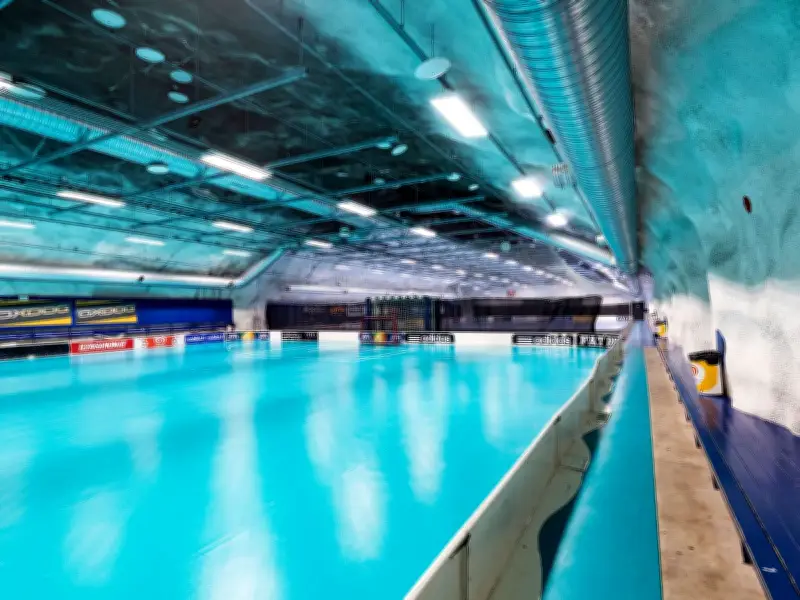
Finland's doomsday bunkers can hold nearly a million people, with access to playgrounds, gyms and even underground swimming pools. Beneath Helsinki's expensive coffee shops and saunas lies another underground world, only to be used in the outbreak of World War 3.
Origins of the bunkers
Following Russia's invasion during World War 2, the Finnish government mandated the need for bomb shelters under buildings larger than 1,200 square metres. Any new build exceeding this size must have a bunker, resulting in nearly 5,500 underground shelters occupying the space under Finland's capital.
The biggest of these shelters is named Merihaka and at 71,000 cubic metres is roughly the volume of a seven-story building. The shelter has a Play Cave, futsal and pitches, a huge gym and even a carpark.

Capacity and design
Though Merihaka has space for around 6,000 people, in the face of nuclear fallout, the shelter is designed to only sleep a third of this population, with 2,000 metal sleeping cots currently stored inside. Jukka-Pekka Schroderus, from the City Rescue Department, which oversees the safety of Helsinki’s residents, said: “The idea is we are like a submarine where at any one time a third of people are resting, a third doing activities and a third on duty, cleaning.”
The fallout shelter also contains a set of enormous blue blast doors. The first steel door is designed to withstand the power of a bomb's blast wave, whilst the second is to protect those inside the shelter from nuclear radiation and biological weapons.
Challenges and restrictions
The doors take a long time to fully operate and in the event of an unprecedented disaster, people may not have time to enter the shelter. “If the situation is challenging we may have to close doors and leave people outside,” said Schroderus.
Pets are not allowed in the underground shelters. Schroderus said: “We have studied that issue and decided the best place for dogs and cats is at home, so it’s up to owners if they stay with them or leave them with food and water. We will only protect animals if they are of international importance, like a very important parrot.”
Global interest
Shelter sales as part of Finland's security and defence exports are amounting to a dozen million euros with significant potential for growth, according to exports body Resilience Center Finland. Overseas politicians and businesses are now seeking information to see how the bunkers are built and maintained.
“We’ve been contacted by Gulf countries and Israel and asked to advise others,” said Schroderus. “We are happy to share our information, apart from a few classified things, but are also always updating by collecting ourselves from Ukraine, Switzerland and the Middle East.”