
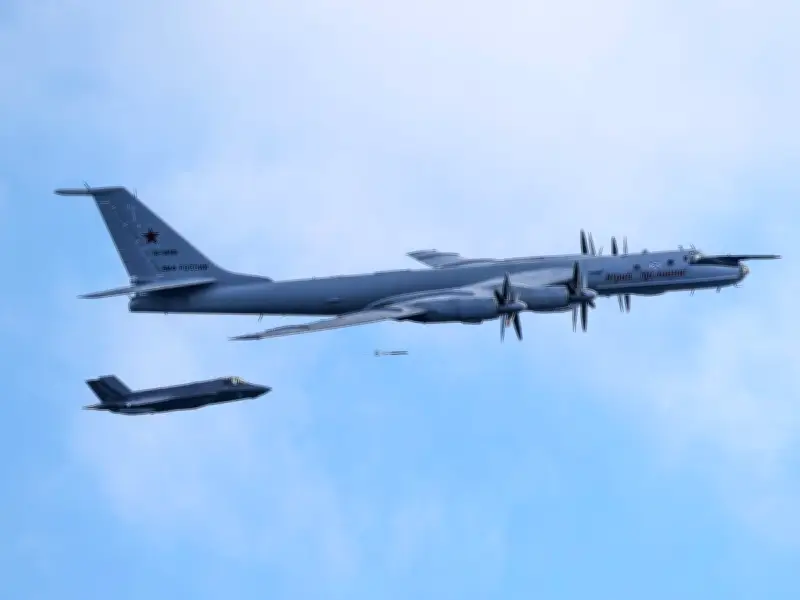
Defence Secretary Dan Jarvis has warned of “increasing Russian threats” during a visit to Iceland, after it emerged that a Kremlin warplane buzzed the Royal Navy’s flagship, HMS Prince of Wales. The incident occurred just days before Mr Jarvis boarded the aircraft carrier, which is in Iceland to support NATO efforts to bolster against the growing Kremlin threat in the region.
Russian Warplane Drops Sonobuoys Near Carrier
A Russian Tupolev Tu-142 (NATO reporting name Bear-F) maritime patrol aircraft repeatedly approached the carrier while it was patrolling the region around Iceland and dropped sonobuoys—devices used to track submarines—very close to the warship. The dangerous escalation was halted after two F-35B fighter jets from the Prince of Wales escorted the Russian aircraft away from the carrier fleet.
Sources told the Daily Mirror that the Russian plane dropped “tens” of sonobuoys, which are typically used to track and record information relating to submarines. The devices were dropped “dangerously close” to the warship and could have caused damage, according to sources. Sonobuoys are about three feet long and five inches wide, and they are used to detect underwater objects via acoustic sensors that transmit data to operators.
Defence Secretary’s Warning
Speaking onboard HMS Prince of Wales, Mr Jarvis said: “We should be clear-eyed about the fact that the threat from Russia exists in every domain, under the water, on the water, on the land, in the sky, in space and in cyberspace as well.” He emphasised the need for NATO allies to increase defence spending, noting that “some of what the Americans have said in recent times is absolutely right” and that “Europe does need to step up.”
Mr Jarvis added: “We must honour the commitments that we’ve made to our NATO allies. That’s why we will be spending 3.5% of GDP on defence by 2035.” He also expressed confidence that likely next prime minister Andy Burnham “understands the importance of defending our nation” and will ensure “we’ve got the resources we need to keep the country safe.”
Deployment Details
More than 1,500 British personnel are deployed as part of the Carrier Strike Group (CSG) to the North Atlantic, including those on HMS Prince of Wales, Type 45 destroyer HMS Duncan, and RFA Tidespring. The Ministry of Defence confirmed that the Russian Bear-F aircraft had repeatedly approached the UK carrier strike group in the Norwegian Sea in an “unsafe and unprofessional” manoeuvre late last week, dropping a large number of sonobuoys in close proximity to the carrier.
Mr Jarvis stated: “We live in an increasingly dangerous and uncertain time, and it’s deployments like this, supported by allies and partners including Iceland, that improve our deterrence and defence as part of NATO. We are investing £298 billion over the next four years to strengthen readiness and ensure our people have the kit and technology they need.”
Iceland’s Support
The Defence Secretary was accompanied by Icelandic foreign minister Thorgerdur Katrin Gunnarsdottir on the visit. Ms Gunnarsdottir said: “The visit of the UK Carrier Strike Group is a clear demonstration of NATO’s enhanced presence in this strategically important region, and one that Iceland is proud to support and contribute to. NATO continues to strengthen its deterrence and defence, demonstrating allied unity and resolve in the challenging environment of the North Atlantic and the Arctic.”
The Ministry of Defence also noted that the second carrier, HMS Queen Elizabeth, having recently completed a refit in Rosyth, Scotland, is preparing to serve as the floating headquarters for the force later this year.




