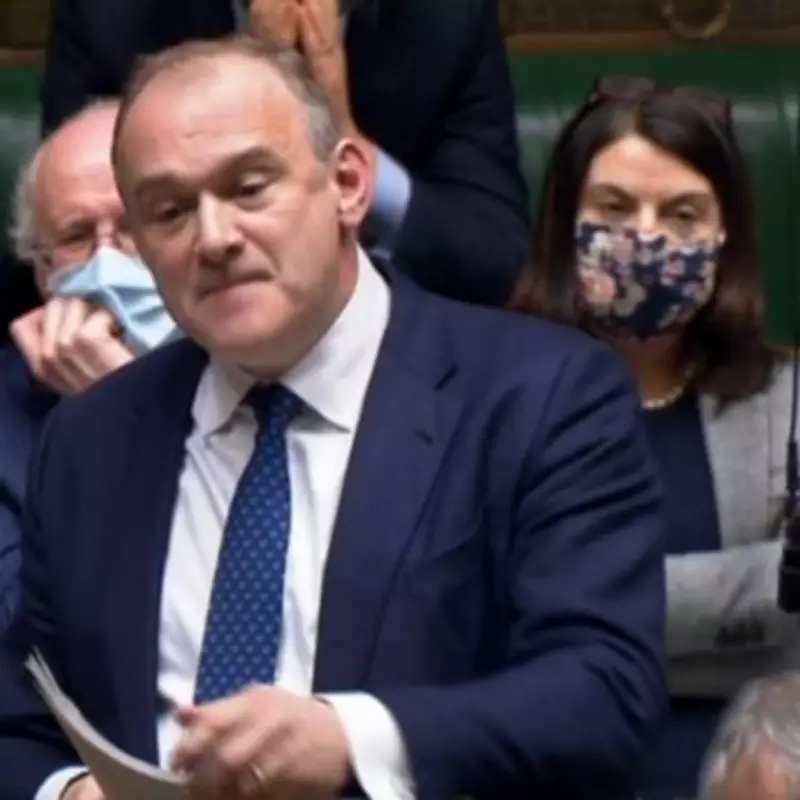
Liberal Democrat leader Sir Ed Davey has issued a bold call for the United Kingdom to develop its own independent nuclear deterrent, aiming to replace the current Trident system with a British-made alternative by the 2040s. In a significant policy shift, Davey argues that Britain must decouple from American dependency to ensure true autonomy in its nuclear capabilities.
Breaking Away from American Reliance
During a speech at the Liberal Democrat spring conference in York, Sir Ed Davey contended that while Britain's Trident nuclear missile system operates independently in theory, its reliance on American production and maintenance undermines genuine sovereignty. He emphasised that the deterrent is not fully autonomous due to this transatlantic dependency.
"Britain's nuclear deterrent must be genuinely, verifiably ours – not dependent on Trump or whoever his successor may be," Davey asserted. "Trump has proven we can't rely on America as a dependable ally." This statement reflects growing concerns over US unpredictability under President Donald Trump, who has criticised UK decisions and clashed with European partners.

Immediate and Long-Term Measures
Davey outlined a two-pronged approach to achieve nuclear independence. As an immediate priority, he urged the government to establish a UK-based servicing programme for Trident, reducing current reliance on American technical support.
Looking ahead, he advocated for the development of a completely British-manufactured replacement system to succeed Trident when it reaches obsolescence in the 2040s. "As the UK now prepares to replace Trident in the 2040s, we should make the decision now to spend the billions required over the next two decades here in the UK, not in the US," Davey declared.
Historical Precedents and International Context
The Liberal Democrat leader pointed to Britain's historical achievements as inspiration, noting that the nation developed its own atomic weapons in the 1950s, becoming only the third country to do so after the USA and Soviet Union. He also highlighted France as a contemporary model, operating its own fully autonomous nuclear capability without external dependencies.
This proposal emerges against a backdrop of global tensions, including the American-Israeli conflict with Iran, which has disrupted energy markets and strained international alliances. Trump's criticisms of UK neutrality and threats to allies like Spain have amplified calls for strategic independence.
Financial and Strategic Considerations
Trident currently consumes approximately 6% of the UK's annual defence spending, and transitioning to an independent system would entail significant financial investment. The Chatham House think tank has warned that pursuing complete independence would be enormously expensive, while partnering with France could create new dependencies.
Nevertheless, Davey remains optimistic about British capabilities. "Britain has the best scientists, the best engineers, the best builders in the world. So let's get building our own, truly independent nuclear deterrent here in the UK. Made in Britain," he proclaimed.
Infrastructure and Operational Framework
Britain maintains its nuclear capability through continuous at-sea deterrence, with one of four Vanguard class submarines operational from Faslane in Scotland. These are being replaced by new Dreadnought class submarines under construction at Barrow-in-Furness, Cumbria, forming the backbone of future nuclear defence.
Davey's call represents a pivotal moment in UK defence policy, challenging long-standing assumptions about transatlantic security partnerships and advocating for a resurgence of British industrial and technological prowess in the nuclear arena.