
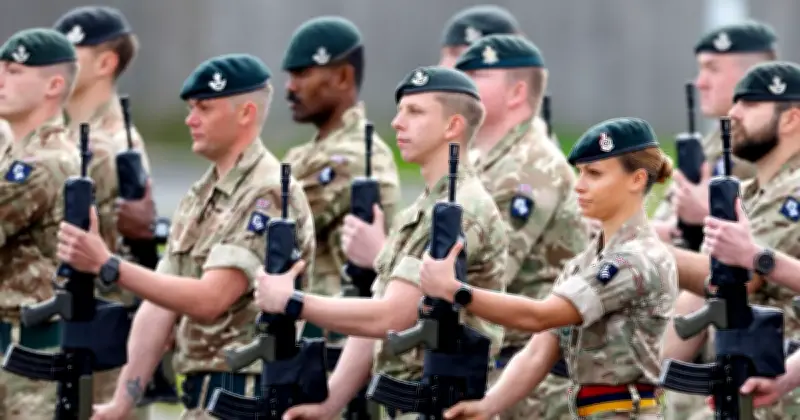
The University Officer Training Corps (UOTC), created six years before the First World War, is designed to develop a pipeline of future Army officers while strengthening links between the military and universities. The scheme proved its worth by training around 20,000 officers for the First World War and a further 30,000 to 50,000 for the Second World War. Today, around 1,400 students join each year across 15 units and 27 training locations involving dozens of universities.
Could the UOTC help the Army expand during a major war?
The UOTC's contribution to national security is difficult to measure, but supporters argue its greatest value could be the pool of potential leaders it provides during a major conflict. Army officers are trained at the Royal Military Academy Sandhurst, where around 1,000 cadets graduate each year. Although there are plans to expand the academy, concerns exist that it could struggle to meet the demands of a large-scale war.
Lieutenant Colonel Simon Pollitt, who leads the Yorkshire UOTC, told the i paper the scheme could allow the Army to increase its officer numbers quickly if required. "We know that during conventional warfare, the standing Army is going to have a high attrition rate in the opening few months or weeks, and so it’s about how we generate the next wave," he said. "The UOTC was set up to generate a cohort of people where we’ve already invested in and their education that could be commissioned in a national emergency. By running this constant cadence, we know what we’re doing if we need to."
Call-up limitations and cost
However, university officer cadets do not have any military commitment under their contracts and cannot be called up unless they later join a regular or reserve military unit. Last year, only 45 Army Reserve officers were commissioned through the UOTC. Call-ups would only be issued as part of a wider mobilisation of forces.
Pollitt said that if the country entered a large-scale war, UOTC graduates would already have valuable training. "If we’re going into a large-scale war, there will be some changes in policy, and there might be some form of conscription or similar. The point is that we’ve already invested a level of training in them, and that they’re already at a state that could mobilise." He also noted that graduates could play important roles away from the battlefield, such as in industry or other defence areas.
The UOTC also helps recruit officers during peacetime, with around 40 per cent of participants later joining the regular forces or reserves. The scheme is run by more than 400 military staff on part-time contracts, alongside more than 100 full-time military and civilian employees. Students receive payment for their training, earning roughly £50 to £63 per day, which works out at around £1,600 per academic year. With around 1,400 cadets joining each year, the overall cost runs into millions of pounds.
Debate over value amid defence spending pressures
The debate comes as the Government faces pressure over defence spending, with Andy Burnham’s Government attempting to address a £4.7bn gap in military funding while other projects face pressure.
Sir Julian Brazier, a former minister for the reserves and reservist officer, said the scheme was vital to the UK’s ability to sustain a long-term conflict. "If you are preparing for a national war, rather than a war of choice like Iraq or Afghanistan, the essence of sustainability is the ability to expand," he told The i Paper. "As the last Chief of the General Staff put it: professional armies start wars, citizen armies finish them." Brazier said producing officers was a greater challenge than training soldiers and that the whole expansion of the British Army in the event of war has a single point of potential failure: Sandhurst.
Brazier does not believe UOTC contracts should be changed to allow automatic call-ups, arguing many would volunteer in a major conflict. "Subjecting them to the idea that you can call them out for an operation short of total war, I think, is a bad idea. I think if there was a war, almost all of the good ones would volunteer anyway."
Paul O’Neill, a former RAF officer and Ministry of Defence official now at the Royal United Services Institute (RUSI), said the scheme remained popular but questioned whether one of its original aims was outdated. When the UOTC was created, only around 5 per cent of the population attended university; today that figure is around 50 per cent. O’Neill said the UOTC still helps create greater awareness of defence issues and could play an important role in creating a whole-of-society approach, but may need a clearer objective. He suggested the UOTC could provide broader education with less focus on expensive military-specific training, allowing funds to support a larger number of participants.




