
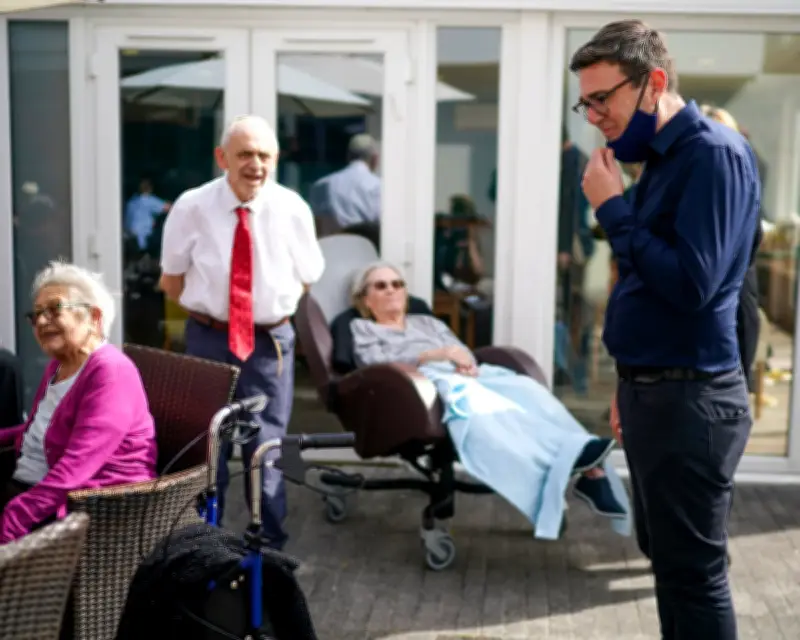
Andy Burnham will soon be adding his name to the list of prime ministers who have tried to answer one of the trickiest questions in British politics: how should we pay for social care? In his first sit-down interview as PM, he warned that the NHS would “collapse” without social care reform, and said he wouldn’t want to leave office without significantly changing the system.
A History of Failed Reforms
Burnham co-authored a paper setting out plans for a National Care Service in 2010. It was one of the few instances where politicians came close to a solution, but after Labour was accused of trying to introduce a “death tax”, the paper joined a list of at least 22 major reviews, commissions and reports published since 1997 that have tried – and failed – to fix the problem.
Care home fees have spiralled over the last two years. Based on a conservative estimate that fees increase by 4% annually, a 33-year-old woman moving into a care home at 90 and dying two years later would face fees of roughly £1.2m. Last year, fees increased by as much as 10%.
How the System Works Now
There is no cap on the amount someone will have to spend on care once they’re down to their last £23,250 (£24,000 in Wales, and an upper limit of £35,000 in Scotland). Many people have no option but to sell their houses or use their life savings to fund it. An estimated 10% of the money that councils and individuals spend goes on interest payments, dividends, directors’ fees and profits – not frontline care.
Past Attempts at Reform
In 1997, Tony Blair declared he didn’t want to see children growing up in a country where “the only way pensioners can get long-term care is by selling their home”. Two years later, a royal commission recommended that personal care should be free and funded by the state, but Blair’s government rejected its core proposal.
The Brown government produced the white paper co-authored by Burnham in 2010, which set out plans to create a free at the point of use National Care Service modelled on the NHS. The Conservatives accused the government of trying to implement a “death tax” – an attack line Nigel Farage resurrected yesterday. The white paper wasn’t explicit about funding, and the government planned to legislate during its next term. Labour lost the election two months after publication, and the idea was shelved.
2014 to 2024: A Cycle of Delays
Shortly after taking office, the Cameron-led coalition government commissioned a review chaired by economist Andrew Dilnot, whose 2011 report proposed a lifetime cap of £25,000-£50,000. This culminated in the 2014 care act, which proposed a cap on care costs in England of £72,000, with funding reforms supposed to come into effect from April 2016. But after unexpectedly winning a parliamentary majority in 2015, the Conservatives delayed the cap to April 2020.
During the 2017 general election, Theresa May announced plans including raising the means test threshold to £100,000 and allowing deferral of payment until after death. Labour branded it a “dementia tax”, helping destroy her majority. In 2021, Boris Johnson set out plans to cap care costs to £86,000 by October 2023, funded by a 1.25% health and social care levy. But Kwasi Kwarteng abolished the levy in September 2022, and Jeremy Hunt postponed the cap to October 2025. After Labour won the 2024 general election, Rachel Reeves said it would “not be possible” to proceed with the cap. The party pledged to create a “National Care Service” in its manifesto, and then health secretary Wes Streeting announced another commission chaired by Louise Casey, due to deliver a final report in 2028.
What Could Burnham Do Differently?
“In all the years that these debates have been happening in Britain, other countries have pretty successfully solved the social care problem,” Abby Jitendra, policy director at ThinkLabour, tells the Guardian. A paper Jitendra wrote last year pointed to international examples: Australia subsidises care for people on lower incomes and caps it for everyone else, funding through general taxation. In Japan, costs are covered by taxation, insurance contributions and individual fees.
The question for Burnham is how to fund it. Kemi Badenoch wrote to the PM saying the Conservatives would be “happy” to work with the government on a solution – so long as it doesn’t involve raising taxes or borrowing. “How much time do you really need to dither on this?” asks Patrick Butler, the Guardian’s social policy editor. “Every month that goes past, the crisis deepens. And the answers, and the options, are already out there.”




