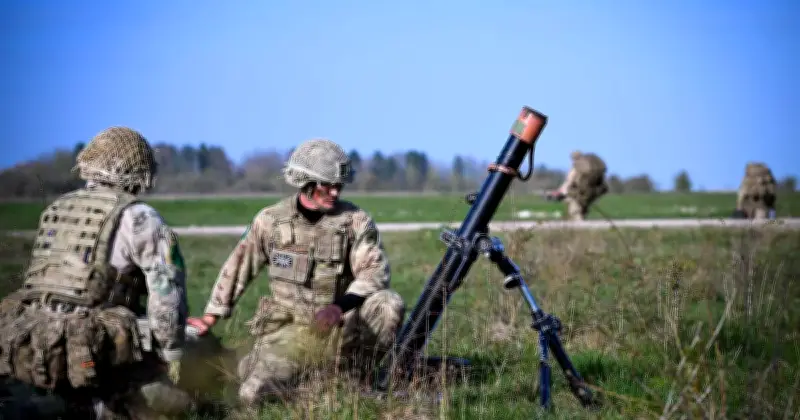
Former Defence Minister Tobias Ellwood has warned that Britain is dangerously unprepared for the threat of modern warfare, accusing the Government of failing to grasp the scale of the danger facing the country. His warning comes as around 100,000 former members of the Armed Forces have been sent letters by the Ministry of Defence asking them to update their contact details and declare their current employment and skills, amid efforts to establish who could be recalled in an emergency.
Veterans' skills could be vital
Mr Ellwood told the Daily Express the military could draw on the expertise of older veterans who might no longer be physically capable of fighting on the frontline but could still provide valuable skills. He said: "Within British society, clearly not everybody would have been able to pass the Basic Fitness Test (BFT), but some people would certainly be able to provide useful skills."
He pointed to former personnel who had developed specialist civilian experience since leaving the services, including those working in advanced manufacturing. Mr Ellwood said: "If you're basically fit and have advanced your civilian skills – say, you now work for a 3D printing company that can manufacture drones – that accumulation of knowledge is very interesting indeed."
The comments raise the prospect of older former service personnel being called back to help in a major conflict, even if they would be unlikely to return to conventional frontline roles. Former officers can retain a statutory or prerogative liability to be recalled in exceptional circumstances, including imminent national danger, a great emergency or an attack on the UK. The precise arrangements and age limits vary according to rank, pension status and service regulations.
Government 'drip-feeding' information
Mr Ellwood, himself a former British Army officer, said the Government was giving the public hints about the deteriorating international situation without properly explaining the risks. He said: "What gets me is how the government is drip-feeding information, providing hints that our world is clearly getting darker and that we've entered a new era of insecurity, yet they won't admit that's where we are."
He pointed to the war in Ukraine, rising tensions in the Middle East and Donald Trump's relationship with Vladimir Putin as evidence of a crumbling international order. But he warned that a Russian attack on Britain would be unlikely to involve troops landing on the beaches.
Instead, he said the Kremlin could target critical national infrastructure, undersea cables, cyber networks and essential supplies. Mr Ellwood said: "The Russians aren't going to land off Dover or on the beaches in Scotland. That's not what's going to happen."
Cyber and energy threats
He warned that cyberattacks, assassinations, coercion and disinformation campaigns could cause widespread disruption without a conventional invasion. He cited attacks affecting the NHS, the Ministry of Defence, Marks & Spencer and Jaguar Land Rover as examples of the growing cyber threat, warning that such incidents would become more commonplace.
He also questioned Britain's ability to withstand disruption to its energy supplies, claiming the country had just six days of gas reserves compared with around 70 or 80 days in Germany. Mr Ellwood called for a four-star equivalent military figure to take charge of coordinating homeland resilience, bringing together police, local communities, utility companies, ports and businesses responsible for critical infrastructure.
He said: "We need to build resilience on a scale that we are simply not addressing or getting our heads around." He warned that the Government's plans to increase defence investment by 2030 did not address the immediate threat, arguing that Britain was effectively relying on its adversaries not to strike before it was ready.
Reservists await letters
Former Army officer Stuart Crawford, himself a reservist, said he was waiting to see whether he would receive one of the letters. He told the Express: "Speaking as a reservist myself (although probably too old to get in a tank these days!) I await the letter."
Mr Crawford said he understood that, having previously served as a regular officer, he remained a reservist for life. He added: "I suppose I could look at maps/screens and answer radios/telephones in some warm and safe bunker somewhere if push came to shove."
Joking about the prospect of returning to service, he said: "But would they still pay me my Lt Col's salary? If so I might be tempted!" He added: "I don't think there's a chance that we'll be involved in open conflict with Russia/Iran/North Korea anytime soon but it's increasingly likely to happen in due course. If you look at all the sub-threshold stuff that's going on - RAF Fairford, terrorism attempts etc - then the government is slowly waking up to the realisation that perhaps we had better be prepared."
He said nothing significant could happen on current levels of defence funding, noting that the annual welfare budget is nearly six times that of the defence budget, and that until the government shifts priorities not much can happen. Alternatively, income tax needs to go up, with neither option attractive to a Labour government.
The MoD has described its letters to strategic reservists as a "practical step to strengthen preparedness and deterrence, helping reduce the risk of conflict". Veterans minister Calvin Bailey has stressed that the correspondence does not mean reservists are about to be mobilised.