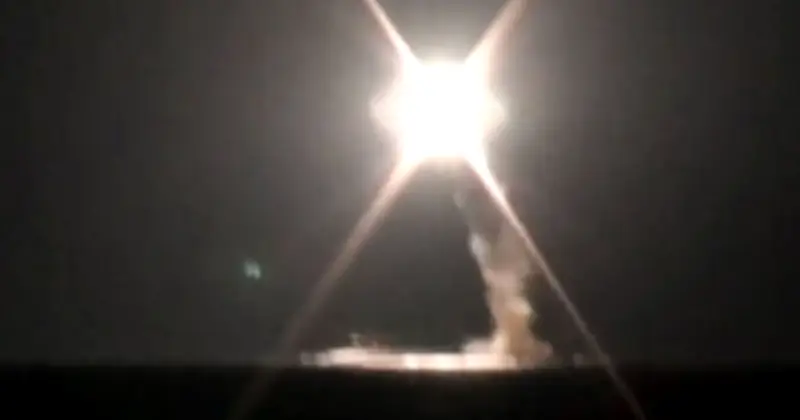
Fears are mounting that Vladimir Putin is about to test a doomsday weapon dubbed a 'flying Chernobyl' in the Arctic, as tensions escalate over Britain giving Ukraine new long-range missile capability.
Putin and the Kremlin have expressed fury after Prime Minister Andy Burnham travelled to Ukraine this week and agreed to share British long-range missile blueprints with the war-torn country. Kremlin advisor and former deputy foreign minister Andrei Fedorov said he could not “100% exclude” the prospect of “semi-military” action against the UK as a result of Mr Burnham's gift to Kyiv.
During his first overseas trip the PM reiterated the UK's “unwavering” support for Ukraine, which in turn handed over what officials have called a “goldmine” of battlefield data to help bolster British security.

Arctic build-up signals possible missile test
In a sign Moscow wants to ratchet up the stakes, Russian Air Force planes have been swarming towards the Arctic, leading some to fear Putin is about to test a terrifying cruise missile which is fuelled by its own atomic reactor.
The Kremlin has long hailed the “invincible” Burevestnik missile which carries a nuclear warhead and reportedly boasts an “unlimited range”. This means it could strike the UK should Putin ever decide to blitz the West, according to analysts.
Satellite images from across the past few weeks show Moscow's high-powered aircraft descending on the Novaya Zemlya archipelago in the Arctic. The region has already hosted tests for the Burevestnik and was previously used by the Soviets as one of their main nuclear sites between 1955 and 1990. This included the 1961 detonation of the largest nuclear weapon ever tested, the 50MT AN602 Tsar Bomba hydrogen bomb.
Pattern matches previous tests
This week, two specialist Il-976 SKIP aircraft used to monitor missile trajectories and collect test data reportedly arrived at Rogachevo airbase. Imagery from the archipelago already shows an A-50U airborne early-warning aircraft, four An-26 military transports, an An-74 and several helicopters at the base.
Civilian vessels previously involved in missile trials have also taken up positions in the Barents and Kara seas around the Pankovo test range.
The Kremlin, who have boasted about firing the Burevestnik before, are yet to confirm or deny the suspected test fears. However, Norwegian defence analyst Thord Are Iversen says the satellite pictures are a tell-tale sign. He says they follow the same pattern seen during previous tests of Putin's experimental 9M730 cruise missile.
He told Russian outlet The Insider: “It now appears that everything is ready for actual Burevestnik flight testing.”
Missile's history and risks
The missile has reportedly been tested up to 14 times before but had only been successful twice – in 2022 and 2025. Last year, the supposedly successful missile launch saw the weapon travel 14,000km for 15 hours, top Russian general Valery Gerasimov said.
Gerasimov added: “During the flight, the missile performed all the prescribed vertical and horizontal manoeuvres, demonstrating its high capabilities for evading missile and air defence systems.”
The chilling Flying Chernobyl nickname comes from the 1986 Chernobyl Nuclear Power Plant disaster which caused irreversible damage across the Soviet Union. Experts fear any future tests or actual usage of the weapon could lead to a similar radioactive disaster due to its atomic-powered reactor.