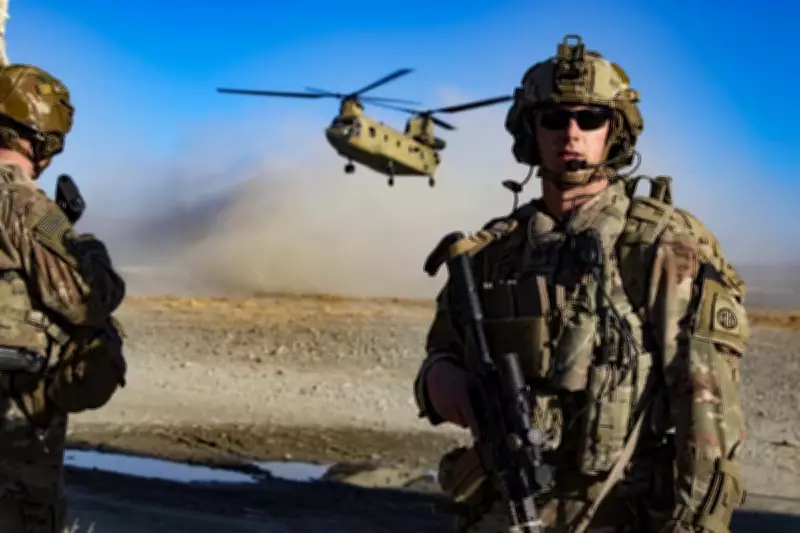
US Army's Elite 82nd Airborne Division Readies for Middle East Deployment
The United States military is preparing to deploy at least 1,000 specialized paratroopers from the renowned 82nd Airborne Division to the Middle East in the coming days. This significant move comes as the conflict with Iran enters its fourth week, with President Donald Trump reportedly considering options to fully reopen the strategically vital Strait of Hormuz, a crucial global oil shipping route.
Speculation and Strategic Planning
Speculation regarding this deployment intensified earlier this month following reports that the Army had cancelled a major training exercise involving the division's headquarters element, which is based at Fort Bragg in North Carolina. According to The New York Times, the Trump administration has examined plans to potentially seize Kharg Island, Iran's primary oil export hub, as a means to pressure Tehran into reopening the strait.
Members of the Senate Armed Services Committee are scheduled to receive a classified briefing from Pentagon officials on Capitol Hill, where this potential deployment is expected to be discussed, according to a U.S. official speaking anonymously to the Associated Press.

Capabilities of the 82nd Airborne Division
The 82nd Airborne Division is trained for rapid, high-risk missions, including parachuting into contested areas to secure airfields or strategic terrain. Retired Marine Colonel Mark Cancian told Axios that these paratroopers possess the unique ability to threaten targets in the Gulf region without having to transit the Strait of Hormuz directly, and they can arrive on scene relatively quickly.
White House spokeswoman Anna Kelly referred reporters' questions about the deployment to the Pentagon but emphasized that "President Trump always has all military options at his disposal."
Composition and Readiness of the Division
The 82nd Airborne Division stands as one of the U.S. Army's most recognizable and agile combat units, serving as the primary fighting arm of the XVIII Airborne Corps. In 2022, it reportedly contained approximately 18,000 paratroopers trained for rapid global deployment.
A key component is the Immediate Response Force (IRF), a unit of around 3,000 soldiers capable of deploying anywhere in the world within 18 hours. The planned Middle East deployment reportedly includes a battalion from the 1st Brigade Combat Team, along with Major General Brandon Tegtmeier, the division's commander, and elements of his staff.
Historical Deployments and Mission Profile
The division specializes in joint forcible entry operations, meaning it can parachute into hostile territory to seize key objectives such as airfields, ports, or strategic infrastructure. This makes it one of the military's primary tools for rapid crisis response.
Historically, the 82nd Airborne has been involved in nearly every major U.S. conflict since World War I. Notable deployments include Operation Desert Storm in 1991, major roles in Iraq and Afghanistan during the Global War on Terror, the 2020 deployment to Iraq following the U.S. embassy attack in Baghdad, the 2021 evacuation of Afghanistan, and the 2022 deployment of around 3,000 troops to Europe following Russia's invasion of Ukraine.
Growing US Military Presence in the Region
The 82nd Airborne troops will join an already substantial U.S. military presence in the Middle East. Thousands of Marines aboard Navy ships, including the USS Tripoli and the 31st Marine Expeditionary Unit, have been ordered to the region. Furthermore, a rapid-response Marine force has reportedly been deployed from San Diego.
Together, these Marine Expeditionary Units add approximately 5,000 Marines and thousands of sailors to the area. The United States already maintains around 50,000 troops stationed across the broader region.
Diplomatic Context and Iranian Response
This military buildup occurs as the Trump administration claims to have initiated negotiations aimed at ending the war, with figures including Steve Witkoff, Jared Kushner, Secretary of State Marco Rubio, and Vice President JD Vance involved in discussions. However, Iran has publicly rejected these claims, denying that direct talks are taking place and suggesting the U.S. is effectively "negotiating with itself."