

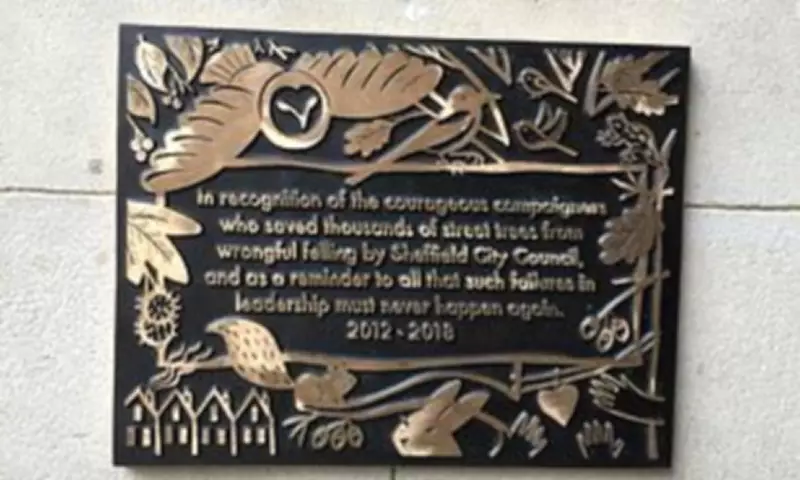
Sheffield Council Faces Hypocrisy Claims Over Greenbelt Development
Sheffield City Council has been accused of "wanton hypocrisy" after unveiling a commemorative plaque to campaigners who fought to save thousands of street trees, while simultaneously advancing controversial plans to construct thousands of new homes on 800 acres of protected greenbelt land. The council's actions have drawn sharp criticism from local residents and prominent figures, including actor Sean Bean, who grew up in the area.
The Tree-Felling Scandal and Its Legacy
The plaque, installed at Sheffield Town Hall, praises "courageous campaigners" who successfully resisted the council's programme to fell approximately 12,000 street trees between 2013 and 2018. The inscription states it should serve as a "reminder to all that such failures in leadership must never happen again." This refers to the council's highly controversial street improvement initiative, which saw over 5,000 trees removed amid widespread public outcry.
An independent inquiry later revealed that the council employed subterfuge, lies, and underhand tactics to chop down trees that residents were desperately trying to protect. The programme was part of a 25-year, £2.2 billion private finance initiative agreement with contractor Amey, aimed at resurfacing roads and maintaining roadside trees. The scandal led to prolonged protests, daily confrontations in leafy suburbs, and several unwarranted arrests.

New Controversy Over Greenbelt Development
Campaigners now argue that the council has failed to learn from past mistakes, as it pushes forward with proposals to build 3,539 homes, two schools, a cemetery, and 130 acres of business space on greenbelt land between Richworth Road and Beaver Drive in Handsworth. This forms part of the council's Local Plan, which targets 14 greenbelt sites for development.
Sean Bean, the Sheffield-born actor known for roles such as Sharpe, has spoken out forcefully against the plans. He stated, "This should have been a moment of reflection. Instead it feels like history repeating itself and we have to remember when areas of the greenbelt have gone - you cannot replant them - they are gone forever." Bean has also submitted a formal letter of objection, highlighting the irreversible loss of green spaces.
Campaigners Demand Brownfield Alternatives
Opponents, organised under the Sheffield Greenbelt Alliance, are urging the Labour-run council to reconsider and instead prioritise brownfield sites for development. They warn that the current plans threaten to destroy large areas of farmland, ancient woodland habitats, mature trees, hedgerows, and wildlife corridors. These green spaces are crucial for biodiversity, carbon storage, air quality, landscape character, and flood mitigation.
Cheryl Hague, spokesperson for the Sheffield Greenbelt Alliance, remarked, "The council might apologise for their failures around the tree-felling but they do not seem to learn. For many residents concerned about the proposed loss of green belt land, the key question is whether those lessons are now being applied in practice or is this just wanton hypocrisy?"
Political and Planning Context
The controversy has also drawn attention to the city's Green Party, which voted in favour of the greenbelt housing plan, prompting campaigners to form the Sheffield Greenbelt Alliance. Last month, Government planning inspectors deemed the proposals acceptable, allowing them to proceed to the next stage.
Councillor Tom Hunt, leader of Sheffield City Council, has acknowledged past errors, stating the plaque serves as a "permanent reminder" and vowing never to take public trust for granted. He emphasised efforts to improve communication and transparency, aligning with lessons from the 2023 Lowcock Report, which found the council had been "economical with the truth" during the tree-felling scandal.
Despite these assurances, campaigners remain sceptical, arguing that the council's actions contradict its professed commitment to environmental preservation and learning from historical failures.






