

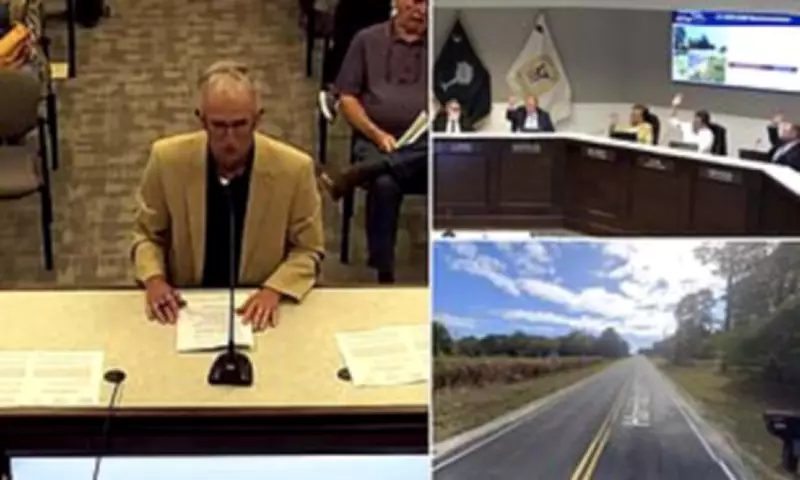
A South Carolina county has rejected plans for a proposed mosque on Indian Land following a fiery public hearing dominated by traffic congestion concerns and repeated references to Sharia law from opponents. Members of the Lancaster County Council voted to deny the permit application for the Islamic community center on Harrisburg Road, despite county planning staff recommending approval.
Council Emphasizes Land Use, Not Religion
County leaders repeatedly stressed the decision was based on land use and compatibility concerns rather than religion, as speakers packed the meeting to debate the controversial proposal. 'This body cannot consider opinions about religious beliefs, the identity of the applicant or generalized support or opposition unrelated to land use impacts,' Council Chairman Brian Carnes stressed during the tense hearing.
However, several opponents used their speaking time to voice fears about Islam and Sharia law, while others argued the already congested main road could not handle another place of assembly. 'We do not want Sharia law in this area,' one resident told council members before launching into a lengthy criticism of Islamic teachings, urging them to vote against the mosque proposal.

Project Details and Opposition
The proposed development centered on nearly five acres along Harrisburg Road in Indian Land, where property owner Arafath Mohammad hoped to establish a mosque and community gathering space. Plans submitted to the county showed a roughly 3,400-square-foot structure identified as both residential space and a mosque, along with another smaller building farther back on the property and a parking area for worshippers.
The project quickly became one of the most contentious zoning fights in the fast-growing community. Dozens of residents spoke either for or against the proposal during Monday night's meeting, while county officials also received a flood of emails ahead of the vote. Supporters argued the mosque would provide a place of worship and community for Muslim families already living in the region. Opponents, meanwhile, repeatedly warned about traffic backups, overcrowded infrastructure and what some said were broader cultural concerns.
One speaker urged council members to reject the project over what he described as fears surrounding Islamic law. Another woman opposing the project told council members she believed Islam represented 'a takeover,' while also arguing the mosque would worsen congestion and place additional strain on local infrastructure.
Residents Voice Practical Concerns
Several residents insisted their objections were not rooted in religion but in practical concerns surrounding the rapidly developing Indian Land area. Donna McCrorie, who lives beside the proposed site and has lived in the area for more than two decades, told officials that traffic delays already create dangerous conditions for emergency response crews. She recalled it taking emergency responders roughly 15 minutes to reach her home when her husband died years ago because of traffic problems in the area. 'Congestion is the issue here,' McCrorie said. 'We do not need to add to it with any place of assembly.'
Another longtime resident, Josh Pangle, pointed to growth surrounding a nearby Islamic center and warned county officials that the proposed site could eventually create similar traffic headaches. 'I watched it begin as a single family home in a residential area, similar to how this one is proposed,' Pangle said, referencing another mosque in the area that has since expanded significantly.
Supporters Defend Project
Supporters of the project, however, said they were disturbed by some of the rhetoric that surfaced during the heated debate. Indian Land resident Salman Mahmood defended the proposed mosque as a place intended to strengthen families and community ties. 'What truly shapes a community is how people come together, how they support one another, raise their families and contribute to the place they call home,' Mahmood told council members.

Mohammad, the property owner behind the application, also pushed back against claims that the project posed some broader threat to the area. 'This is for a small community,' Mohammad said. 'Mostly we are engineers, doctors and professionals. We live in the south Charlotte and Indian Land area.' He argued that concerns about massive traffic surges were overstated, telling officials the site would only include 28 parking spaces and would primarily draw larger attendance during Friday prayer services. Other days, he said, attendance could involve as few as five to 10 vehicles - a tiny fraction compared to the nearly 9,000 cars that already travel Harrisburg Road daily. 'It's a rounding error,' Mohammad argued.
Final Decision
County planning staff had recommended approval of the permit, but the Lancaster County Planning Commission previously voted unanimously against the proposal after hearing extensive opposition from residents. Ultimately, council members sided with opponents, concluding that another assembly site in the heavily traveled corridor was not compatible with the surrounding residential area.





