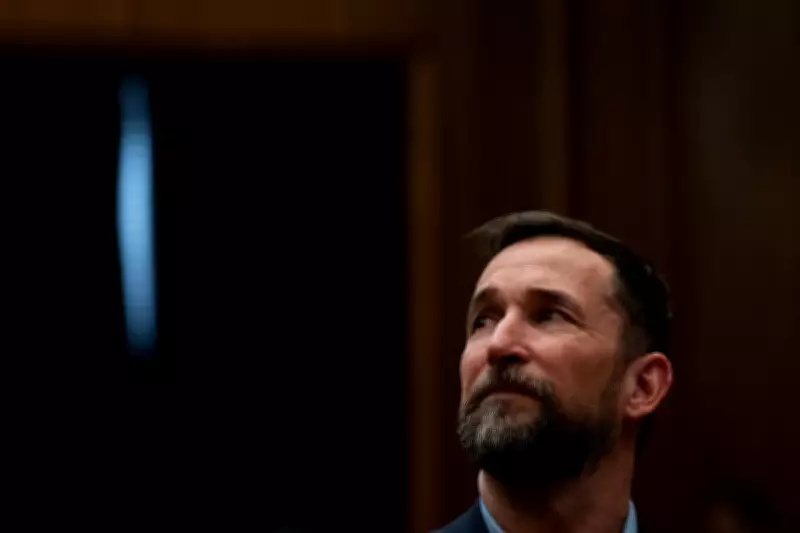
Noah Wyle Champions Hollywood Revival at Senate Hearing on Production Tax Breaks
Noah Wyle, the star and executive producer of the acclaimed HBO Max hospital drama 'The Pitt', delivered compelling testimony at a Senate hearing on Friday, arguing that his show serves as a powerful blueprint for reviving television and film production within the United States. The hearing, organized by California Senator Adam Schiff and held at Burbank City Hall, focused on the critical role of economic incentives in sustaining the domestic entertainment industry.
'The Pitt' as a Domestic Success Story
Wyle emphasized that 'The Pitt', which has garnered critical praise and multiple Emmy Awards, including Best Drama for its first season, represents a significant achievement in an era where production has increasingly migrated overseas. 'I was asked to participate in today’s hearing to tell a success story,' Wyle stated. 'I’m happy to report we’ll commence shooting season three this summer, and that a rising tide has indeed lifted all boats.'
The actor highlighted that the series is filmed at the Warner Bros. lot in Burbank, a notable departure from the trend of relocating to jurisdictions offering more favourable financial conditions. He credited California's recent tax breaks for making this possible, revealing that the first season alone generated nearly 600 production jobs and injected approximately $125 million into the state's economy.

'That is proof of concept,' Wyle asserted. 'That is replicable. And it is vital to the strength of our industry and to our city to support these incentives.'
Personal and Industry-Wide Challenges
Drawing from his extensive career, which includes a iconic 15-year run on NBC's 'ER' from 1994 to 2009, Wyle shared personal anecdotes about the toll of industry dislocation. 'I’ll speak from personal experience and say that I haven’t slept in my own bed in 15 years while I’ve been working as an actor. Since the end of 'ER,'' he recounted. 'It’s hard on families, and I can speak to that. It is hard to fracture your industry that way.'
His return to a medical drama with 'The Pitt', set in a fictional Pittsburgh hospital, earned him an Emmy for Best Actor, underscoring the potential for high-quality, domestically produced content.
Legislative Efforts and Economic Arguments
Senator Schiff and other congressional members, including U.S. Representative Laura Friedman, whose district encompasses Burbank, discussed initiatives to nationalize production tax breaks currently implemented by various states. Friedman addressed criticisms of preferential treatment for Hollywood, arguing, 'We give tax credits to many industries. Hollywood is not asking for special treatment. This is something that is standard across the United States for industries that we have determined that we care about.'
Matthew Loeb, President of the International Alliance of Theatrical Stage Employees (IATSE), noted challenges such as Marvel's recent shift of its production hub from Georgia to England. However, he pointed out that the project-based nature of filmmaking allows for more agile responses compared to other sectors. 'It’s not as hard for film to come back as it might be for other industries,' Loeb remarked.
Concerns Over Consolidation and Broader Economic Impact
A recurring theme at the hearing was the pending acquisition of Warner Bros. by Paramount, with participants expressing apprehension about potential job losses and reduced production. Representative Friedman warned, 'This merger could define whether Los Angeles remains the entertainment capital of the world or becomes an afterthought.'
While Paramount has pledged to produce 15 major motion pictures annually for both studios, skepticism remains. Loeb highlighted, 'The big missing piece is that there is no commitment about where they’re going to shoot 30 films.'

Wyle, Schiff, and others underscored the extensive ecosystem supported by entertainment production, benefiting hotel workers, equipment vendors, food servers, and dry cleaners. Schiff emphasized, 'All those livelihoods are tied to a production shop setting up in their community.'
U.S. Representative Sydney Kamlager-Dove shared an anecdote from her Los Angeles County district, illustrating widespread concern: 'After my acupuncturist took the needles out of my back, she said, ‘Can you do anything to help bring back entertainment jobs?’’
The hearing concluded with a consensus on the necessity of sustained policy support to ensure Hollywood's vitality, with 'The Pitt' standing as a testament to what can be achieved when economic conditions align with creative ambition.