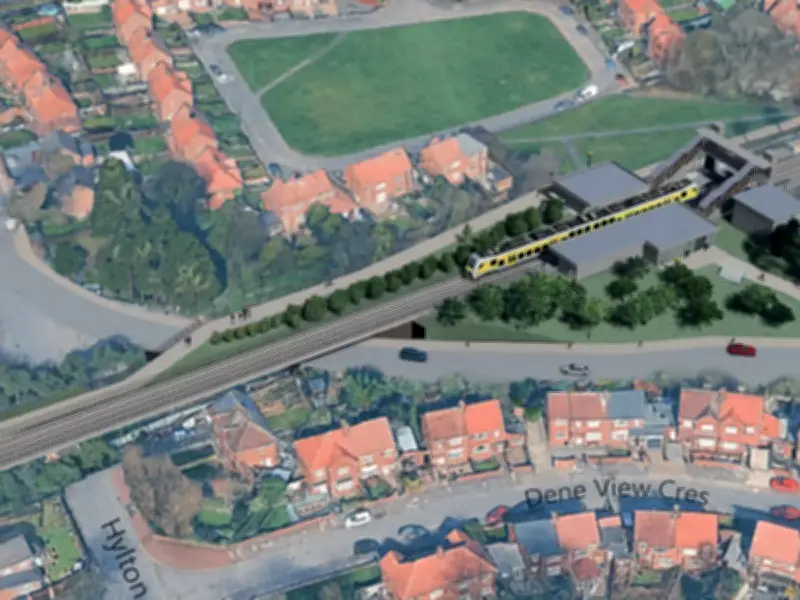
Plans to extend the Tyne and Wear Metro to Washington for the first time in three decades have sparked concerns that some Wearside communities could be “cut off” from the new line. The proposals would see a new 13km loop opened between the Metro’s current end point in South Hylton and Pelaw, via three new stations in the Washington area.
The scheme, which would mark the first phase in the restoration of the mothballed Leamside Line, has long been an ambition of the region’s leaders. However, residents in South Hylton fear their village could be “cut in half”, and questions have been raised about the location of the proposed stations, with the route not covering popular destinations like The Galleries.
Concerns over station locations
The proposed stations would be at Follingsby, serving the Amazon warehouse and other businesses around the large industrial estate, a Washington North stop at Sulgrave, and Washington South near Teal Farm. Washington South councillor Robert Pattison told transport chiefs this week that he was getting complaints from people in Penshaw, Shiney Row, and Mount Pleasant who had “simply missed out” on the new loop.
The Reform UK councillor also criticised the planned closure of Hylton Bank, which would allow for the Metro line extension through South Hylton, saying that a proposed alternative road looked “like someone with a piece of spaghetti throwing it at a road map”. Coun Pattison told a North East mayoral authority scrutiny committee: “The residents are not happy about it being cut off. The residents of Penshaw, Shiney Row, and the outlying areas are feeling left out. Could we have some indication of any plans to extend Network Rail or Northern rail in those areas to pick them up?”
Positive reaction and reassurances
Tobyn Hughes, the mayoral authority’s director of transport, said there had been a “widespread positive reaction” to the Metro extension as well as “understandable” concerns in areas like South Hylton. He replied: “That is perfectly legitimate and we value hearing that information. It is welcome feedback and it will inform further development of the scheme and please take my assurance that engagement with residents will continue.”
Mr Hughes also confirmed that Penshaw would be a proposed location for a new railway station if the southern section of the Leamside Line could also be reopened, creating a restored train link that would run down through County Durham.
Questions over investment
Heidi Wildhirt, a Reform UK councillor in South Tyneside, also questioned the scale of investment potentially going into a Metro extension that she said was “not necessarily wanted from what I have heard”. The cost of the Washington extension has previously been estimated at around £900 million, but that is currently being reassessed and it is thought that the bill may ultimately come in at more than £1 billion.
Coun Wildhirt said she was “really struggling to reconcile the scale of investment on major public transport and active travel projects with the lived reality of many constituents across the entire authority”, at a time when car ownership is on the rise. She added: “Residents are actually spending hours a week sitting in congestion on routes including the A19, A194, and the wider Tyneside network. The issue is not really whether cycling, or buses, or Metro investment have a role, because they obviously do – the question is whether the balance of investment reflects how people actually travel today, in the now.”
“The proposed Metro extension alone is costed at £900 million, which is a lot of money. I want officers to explain what assessment has been undertaken of the economic, social and wellbeing costs of congestion across South Tyneside and the wider region and what evidence demonstrates that the benefits of a £900 million Metro extension outweigh the benefits that could be delivered through greater investment in strategic road capacity, congestion reduction, traffic flow improvements, maintenance backlog, and access to employment sites?”
Mr Hughes replied that the “there is only so much money” and it was a political decision over which projects are given priority. While he said that most North East residents do travel by car and “we must make sure that roads are fit for purpose”, there was a “general tendency towards sustainable travel choices over use of roads” in the transport investment plan led by mayor Kim McGuinness.
He did, however, highlight ambitions for major road upgrades at locations like the Moor Farm roundabout and the dualling of the A1 in Northumberland. Jonathan Balies, the authority’s assistant director of transport programmes and investment planning, told the meeting in Gateshead that he “would not want members to leave with the impression that the pipeline somehow deprioritises investment in roads because it is absolutely not the case”.