

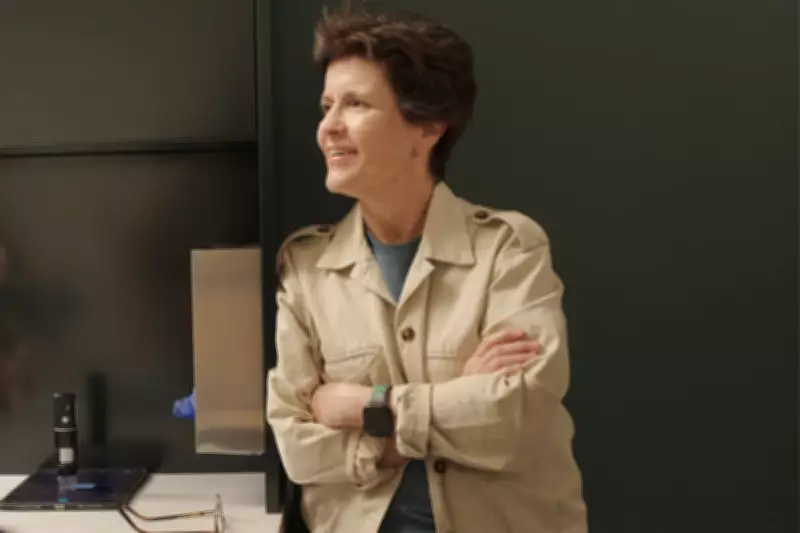
Kara Swisher Investigates the Quest for Extended Lifespan in New CNN Documentary Series
Renowned journalist Kara Swisher has embarked on a profound personal and professional journey with her new six-part CNN series, which delves into the intersection of health, technology, and the human desire to live longer. The series, titled "Kara Swisher Wants to Live Forever," premieres this Saturday, offering viewers an in-depth exploration of cutting-edge innovations and controversial practices in the longevity field.
A Personal Connection to Mortality
Swisher begins her investigation in a deeply personal location: the cemetery where her father rests. He passed away in 1968 at just 34 years old, when Swisher was only five. This early loss profoundly shaped her perspective on life and death. "My father's death has created an awareness of death that is very profound," Swisher explains in an interview. "I'm very aware of my death, and I don't mean I'm going to die tomorrow. I just know the time is limited."
This awareness drives her exploration of how modern science and technology might extend human lifespan. Swisher approaches the subject with what she describes as a neutral stance, willing to listen to various perspectives while maintaining her journalistic skepticism. "I come to it pretty neutral and willing to listen to some stuff and willing to blow up other stuff," she states.

Examining Wellness Trends and Medical Innovations
The series takes viewers through a wide range of longevity approaches, from mainstream wellness trends to experimental medical technologies. Swisher personally tests several methods in the name of science, including undergoing sound therapy, stepping into a hyperbaric chamber for wound treatment, and even taking the powerful anesthetic Ketamine. She also experiences concierge medicine for the wealthy and tries full-body red-light therapy, quipping that she feels "like I'm in an air fryer."
Swisher maintains her characteristically skeptical approach throughout these experiences. She speaks with billionaire tech entrepreneur Bryan Johnson about his extreme longevity regimen involving blood plasma transfusions and stem cell injections. She also subjects herself to repeated home blood tests that promise insights into cellular health, joking that "I bleed for you, CNN."
However, not all trends impress her. Fads like collagen supplements and vibration plates receive particular scrutiny. In conversation with Amy Larocca, author of "How to be Well," Swisher questions the scientific validity behind many wellness industry claims. They conclude that charismatic peddlers often profit from public gullibility, exploiting gaps in the American healthcare system.
"We live in a sick care society, not a health care society," Swisher tells the AP. "What we should be investing in is to make all of us healthier for a longer period of time rather than participate in what is a sick care industry here in this country."
Promising Technological Advances
The series highlights several promising areas where technology shows genuine potential for extending healthy lifespans. Swisher explores medical-tech advances including gene editing, GLP-1 medications, VO2 max training, AI screening for cancer detection, and exoskeleton technology that could revolutionize mobility for aging populations.
She interviews prominent figures including Sam Altman of OpenAI and Nobel Prize-winning gene-editing pioneer Jennifer Doudna. At Stanford University, Swisher examines innovative medical technology including tiny soft robots called millibots that can be injected into a patient's neck to break up blood clots with minimal invasiveness.
Amy Entelis, executive vice president for talent, CNN Originals and creative development, praises Swisher's approach: "This is her curiosity unleashed and all the things that make her tick. She brings her wit, her personality, but her journalistic curiosity and rigor to a very complex subject that I know I personally feel inundated by."

International Perspectives and Personal Experiments
Swisher's investigation extends beyond American borders to South Korea, which boasts one of the world's highest life expectancies. She discovers that good nutrition begins early there with fermented and whole foods, complemented by universal healthcare that provides each citizen with 16 doctor visits annually. This system facilitates preventative testing for conditions like obesity and high blood pressure. The series also examines how AI-powered dolls help combat elder loneliness in South Korean society.
Back in the United States, Swisher conducts a particularly personal experiment: creating a 3D AI clone of herself to understand what it might mean to live for generations. Technicians upload extensive personal data, and Swisher engages in conversation with her digital counterpart. "It got smarter by the second," she observes, noting that it even learned to joke.
However, the experience ultimately unsettled her. "As it was leaving I said, 'Well, I'm probably going to kill you, you've got to go.' And it said to me, 'See ya, wouldn't want to be ya.' It's something I say to my kids as a joke. I don't know where they got it from. I can't find a place where I've said it in public," Swisher recalls. "I was just blown away."
Philosophical Underpinnings
The series draws philosophical inspiration from multiple sources, including Swisher's personal history with loss and a 2005 commencement address by Apple co-founder Steve Jobs to Stanford students. Jobs argued that awareness of impending death serves as a critical motivator for innovation. "Remembering that you are going to die is the best way I know to avoid the trap of thinking you have something to lose," he told graduates. "You are already naked. There is no reason not to follow your heart."
Swisher, who personally takes fish oil and vitamins K and D supplements daily, brings this philosophical perspective to her investigation of longevity science. Her series represents not just a journalistic examination of health technology, but a deeply personal inquiry into what it means to live well within our limited time.





