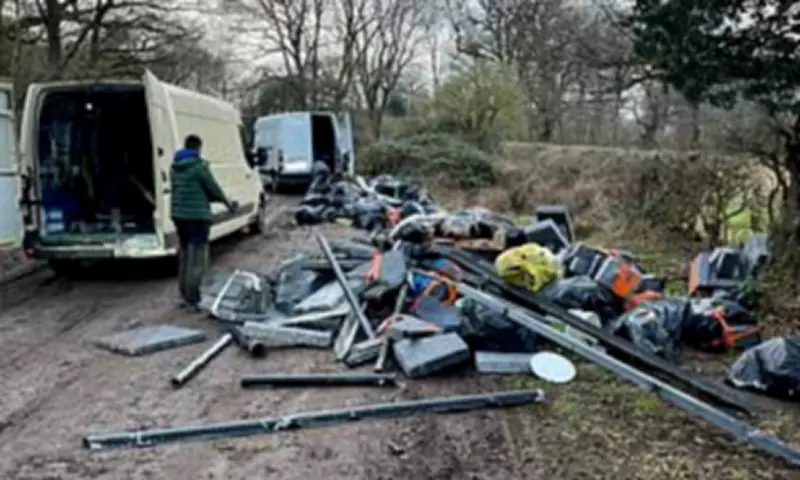
Fly-tippers across England now face the prospect of being banned from driving as part of a significant new government crackdown targeting waste criminals. Ministers are set to empower courts with fresh authority to punish individuals convicted of illegal dumping by imposing penalty points directly onto their driving licences.
New powers to deter illegal dumping
This decisive move, revealed by the Daily Mail, aims to combat the escalating scourge of fly-tipping, which saw over 1.2 million incidents recorded in England during the 2024-25 period. A substantial proportion of these illegal activities involve the use of vans and cars, prompting authorities to target vehicle ownership as a key deterrent.
Government officials express hope that the threat of vehicle seizure and the potential loss of a driving licence will serve as a powerful disincentive for offenders. The strategy specifically aims to disrupt the operations of serial fly-tippers, who rely heavily on vehicles to conduct their illicit waste disposal businesses.

Legislative pathway and political consensus
An initial proposal, which emerged as a Conservative amendment to the Crime and Policing Bill, suggested imposing three penalty points on the licences of convicted fly-tippers. However, insider reports indicate that Labour's forthcoming plan may advocate for an even larger points penalty, signalling a cross-party consensus on the need for tougher measures.
Under current UK driving regulations, motorists face disqualification from the roads if they accumulate 12 or more penalty points within a three-year timeframe. Implementing this new points-based penalty will require specific legislation. A spokesperson for the Department for Environment, Food and Rural Affairs (Defra) confirmed the department is actively "considering the appropriate legislative vehicle" to enact these changes.
Government action and environmental impact
Environment Secretary Emma Reynolds emphasised the government's commitment, stating: "Fly-tipping damages our communities and the environment and we are taking action to stop them. Litter louts who repeatedly break the law will see points added to their licence – and risk losing it for good if they continue to offend."
She further highlighted efforts to empower local authorities, including enhanced powers to seize and crush vehicles used in fly-tipping operations. Last month, Defra published comprehensive guidance to assist councils in more effectively seizing and crushing offending vehicles, or repurposing them for community clean-up operations, alongside practical advice on pursuing legal cases.
Scale of the problem and criminal profits
The urgency of this crackdown is underscored by a series of vast illegal dumps that have captured national attention in recent months. Notable examples include a 500-foot-long, 12-foot-high waste 'mountain' discovered in a field near Kidlington, Oxfordshire, and a sprawling two-acre illegal rubbish site at Over Farm in Gloucestershire.
Criminals engaged in fly-tipping often generate substantial profits by charging fees for waste collection, only to illegally dump the material on public land, thereby avoiding the landfill tax, which currently stands at £126.15 per tonne. While some offenders receive fines, experts warn that the lucrative nature of this crime means financial penalties are frequently viewed merely as a "cost of doing business".
Statistical overview and existing penalties
The latest data from Defra reveals a troubling nine per cent increase in fly-tipping incidents, with councils in England recording 1.26 million cases last year. These figures pertain specifically to rubbish illegally dumped on public land, with private landowners across the nation also bearing significant clear-up costs when waste is fly-tipped on their properties.
Council reports indicate that nearly two-thirds of all cases (62 per cent) involved household waste, encompassing 777,000 incidents in 2024/2025. This marks a rise from the 688,000 incidents requiring clearance the previous year. Household waste in this context ranges from everyday black bag rubbish to discarded furniture, carpets, and assorted items from loft and shed clearances.

Currently, convicted fly-tippers can face a range of penalties including substantial fines, community service orders, or even prison sentences. The new proposal to add driving licence penalty points forms a core component of the Government's imminent Waste Crime Action Plan.
Funding and future measures
In a parallel support measure, the government is making approximately £78 billion available to council budgets in England this year to help fund key responsibilities, including the ongoing battle against waste crime. This integrated approach of legislative change, enhanced enforcement powers, and increased funding underscores a comprehensive strategy to tackle the environmental and community blight caused by fly-tipping.