

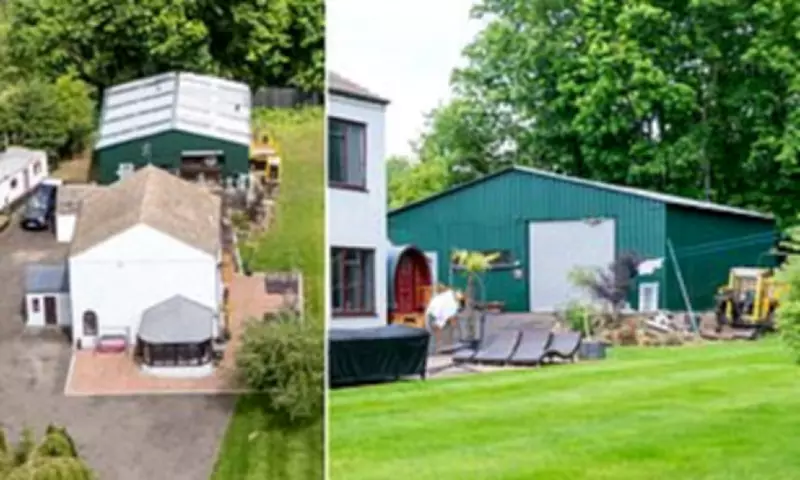
A desperate father who constructed a 'flood survival shed' to safeguard his family's belongings after repeated inundations by filthy river water, which left them unable to obtain insurance, has been ordered to demolish it. Robert Rycroft, 57, erected the large steel-framed outbuilding in the garden of his home in Horbury, West Yorkshire, following years of devastating floods that forced them to hastily move treasured possessions out of the water's path.
The father-of-three, who serves as a full-time carer for his 16-year-old daughter Rose, who has Down's syndrome, insists the shed was never meant as a luxury addition to their secluded property. Instead, he describes it as a 'lifeline' to quickly haul their belongings above flood level whenever the nearby River Calder bursts its banks.
However, Wakefield Council ruled that the 4.5-metre-tall metal structure was built without planning permission in the Green Belt. A planning inspector has now upheld an enforcement notice requiring the family to tear down the building and clear the land within six months.

Mr Rycroft, who lives at the 18th-century cottage with his wife Joanne, 55, daughter Rose, and sons Cole, 22, and Kendall, 19, has endured four serious flood events since purchasing the home in 2015. He said the demolition ruling has left the family fearing the next flood will wipe them out again.
Family's Fear of Future Floods
Mr Rycroft expressed his despair, stating, 'I'm going to lose everything I've got again, aren't I? If it can't go upstairs in the house, then it'll get ruined. It might not be today, it might not be this year - but there will be another flood at some point.' He emphasised that the shed was 'just a really obvious way of protecting what's ours. It was the difference between saving our belongings and watching them go under water again. It was a lifeline for us.'
Without the building, he said, 'we are back to losing everything again. It makes no sense. We are not hurting anyone. We are just trying to protect our home and our family.'
History of Flooding
The Rycrofts bought the property in 2015, hoping to knock down the existing cottage and build a raised bungalow to escape the flooding cycle, but claim planning obstacles made that impossible. Within months, they were hit by flooding, and again in 2020, 2022, and 2024, with filthy water rising through the ground and surging into the house.
Mr Rycroft described the terrifying experience: 'Water from the river absolutely hammers the place. As soon as it starts raining, I can see the colour drain from my wife's face. The water comes up through the ground in no time, because it's all sand and gravel. Before you know it, it is in the house. It has risen so high it covers the radiators and comes just below the window sills. The smell is vile. You cannot escape it. Even with dehumidifiers running day and night, the damp stays for months.'
Impact on Vulnerable Daughter
The repeated floods have taken a heavy toll on the whole family, especially Rose. Mr Rycroft said, 'It spirals her into panic. She sees her toys, the sofa, the house - everything - at risk. It is too much for her. She will talk about it over and over because she is frightened. We have all ended up in one bed, the five of us, listening to the water and smelling it. You cannot get away from it. It changes your life.'
The family has lost furniture, electrical equipment, machinery, and outdoor items in repeated floods, while Mrs Rycroft's BMW was written off. They have claimed on insurance to replace damaged possessions but were advised to take steps to 'mitigate' against future flooding or risk payouts being refused.
The Shed as a Practical Solution
During the Covid lockdown, Mr Rycroft began building the outbuilding himself, believing he did not need planning permission because it replaced a larger, derelict structure that had stood on the land for decades. The new building sits around a metre higher than the family cottage, allowing him to move possessions into it quickly using a loader when flood warnings are issued.

He explained the process: 'From September to February, that's all you do - you move stuff. Before the shed, if a flood warning came in and I started at nine in the morning, I might still be moving things at three in the afternoon. I would be carrying things upstairs or ferrying them down the lane to higher ground. With the shed, I could get everything in one safe place quickly. It was the difference between saving our belongings and watching them go underwater. You cannot just keep claiming for the same things over and over again. At some point you have to protect yourself.'
Council's Decision and Appeal
Wakefield Council said it received a complaint while the building was under construction and informed Mr Rycroft that planning permission was required. He later submitted a retrospective planning application in August 2023, which attracted no objections, but it was refused in February 2025, with enforcement action following. Council officers concluded the structure amounted to 'inappropriate development' in the Green Belt.
Mr Rycroft insists the shed is surrounded by trees, does not overlook anyone, and cannot be seen from nearby homes. He said, 'You can't see it from anywhere. The only way you can see it is from the air. I'm not overshadowing anyone. I'm not affecting anyone. I'm causing harm to no one. My nearest neighbours are on the other side of the river, about 100 metres away. There are other buildings around here - some bigger than mine - and they have been allowed. I fail to understand why we are being treated differently.'
The family argued in their appeal that the outbuilding was essential to help them 'survive during incidences of flooding'. Their planning agent submitted to the Planning Inspectorate that 'the property is well screened and only visible from above by drones. Access to the site is restricted to the appellant and visitors only therefore the development has no impact upon the surroundings but is vital for the family to survive during incidences of flooding.' They added that the family has had to replace goods on several occasions due to flooding, restricting their ability to obtain insurance, and that demolition is 'excessive and unreasonable'.
However, the appeal was dismissed, leaving the Rycrofts facing the loss of the building. Mr Rycroft accused 'jobsworth' council officials of showing no compassion for the reality of living in a flood-hit home with a vulnerable child. He said, 'I visibly shake when I see a council van. They've ruined my family's life from the moment we moved in. I think they've been vindictive. We're not hurting anyone, we're just trying to protect what is ours. Every time there is heavy rain, we are looking at the river, looking at the floor, wondering if this is the day it all happens again.'
Mr Rycroft is planning to meet with newly elected Reform councillors in Wakefield to find a way forward. Joe Jenkinson, Wakefield Council's Service Director for Planning, Transportation and Strategic Highways, stated: 'Retrospective planning permission was refused due to the building being in the Green Belt and not providing sufficient information to demonstrate that it would not be at risk of flooding or wouldn't create a flood risk elsewhere. Following the refusal of planning permission an enforcement notice was served which was appealed. The Planning Inspectorate is completely independent of the Council, and having looked at it impartially, have dismissed the owner's appeal and upheld the enforcement notice.'





