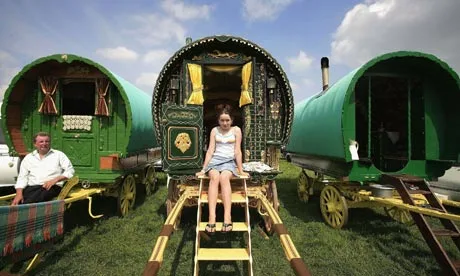
England's 276 Official Traveller Sites Mapped: Capacity, Shortages & Controversies
England's 276 Official Traveller Sites Mapped

For the first time, all 276 official Traveller sites across England have been comprehensively mapped, providing unprecedented visibility into the public sector provision for Gypsy and Traveller communities. Our interactive tool, powered by official data from the Ministry of Housing, Communities and Local Government, displays the precise locations of every site, alongside detailed information about pitch numbers and caravan capacities at each location.

England's Largest and Smallest Traveller Sites

The mapping reveals significant variation in site sizes across the country. Cottingley Springs, operated by Leeds City Council, emerges as England's largest Traveller site with capacity for 120 caravans. The second largest is Thistlebrook Travellers Site in Greenwich, managed by Greenwich Council, which accommodates 82 caravans. Completing the top three is Paston Ridings in Peterborough, operated by Peterborough City Council, with space for 80 caravans.

At the opposite end of the spectrum, the data identifies 40 smaller sites with capacities of fewer than 10 caravans each, highlighting the diverse nature of Traveller accommodation provision across different local authorities.

Wide Pickt banner — collaborative shopping lists app for Telegram, phone mockup with grocery list

Significant Data Limitations Revealed

Despite providing the most comprehensive view of public sector sites to date, the mapping tool has significant limitations. The Government does not publish data on private pitches or unauthorised sites, meaning only those registered by local authorities and social housing providers are visible. This means just 22% of all Traveller caravans appear on the map, representing the proportion in social housing accommodation.

The remaining caravans are distributed across authorised private sites (62%) and unauthorised sites (16%). Of those on unauthorised sites, 87% occupy land owned by Gypsies or Travellers themselves, while 13% are situated on land owned by private landowners or public authorities including farmers' fields, parks, and even cricket grounds.

Chronic National Shortage and Its Consequences

Traveller communities have long campaigned for increased access to publicly provided sites, arguing that chronic national shortages mean families might wait years to secure a pitch, particularly in southern regions. This shortage is widely cited as a primary reason why many Travellers feel compelled to break planning regulations and establish unauthorised sites.

The data reveals a concerning trend: caravans on unauthorised sites have increased by 24% over the past three years, rising from 3,602 in July 2023 to 4,464 in July 2025. This growth reflects the ongoing accommodation crisis facing Traveller communities.

Controversial Development Tactics

In recent years, several high-profile cases have emerged where Travellers have purchased land, often in rural parts of the Home Counties, before rapidly laying tarmac and creating pitches without planning permission. These developments then seek retrospective planning approval, forcing local authorities into lengthy and costly legal processes to address already-established sites.

This tactic was prominently showcased last year near Warrington, Cheshire, where a field was quickly paved over to create an unauthorised site. Such approaches have generated significant frustration among local communities, prompting the Conservative Party's 2019 election manifesto to promise police additional powers to address unauthorised developments.

Social Challenges and Inequalities

The accommodation shortage contributes significantly to the inequalities experienced by Traveller communities. A House of Commons Library report from last year identified accommodation issues as a source of tension between travelling and settled communities. Separate research commissioned by the Office for National Statistics in 2022 described Travellers staying in laybys or car parks for several years at a time due to inability to access permanent site space.

Multiple studies have raised concerns about site quality, with some established on poor-quality land beneath motorways or adjacent to sewage works. Reports also cite issues with vermin contamination and failed fire safety checks. Even those living on official Traveller sites frequently report poor conditions including isolated locations, inadequate basic amenities like showers and toilets, and significant overcrowding.

Pickt after-article banner — collaborative shopping lists app with family illustration

Statistical Disparities Revealed

The 2021 Census reveals stark disparities: Gypsies and Irish Travellers are over three times more likely to live in overcrowded accommodation than the general population (27% compared with 8%). These communities also rely on social housing at more than twice the average rate (44%) compared with all ethnic groups (17%).

Despite this reliance, the number of caravans on private sites has grown steadily, first surpassing those on public sites in 2008. As of July 2025, caravans on private sites constituted 74% of all authorised site caravans, compared to just 32% in July 1983.

Changing Living Patterns and Demographics

The caravan pitch shortage has prompted increasing numbers of Gypsies and Travellers to choose conventional brick-and-mortar accommodation. The 2021 Census recorded 71,440 Gypsy or Irish Travellers in England and Wales, representing 0.12% of the population. Of this number, 78% lived in brick-and-mortar accommodation, while 22% resided in caravans or other mobile or temporary structures.

It's important to note that 'Gypsies and Travellers' encompasses diverse groups with different histories, cultures and beliefs, including Romany Gypsies, Welsh Gypsies, Scottish Gypsy Travellers and Irish Travellers.

Government Policy and Future Directions

The Ministry of Housing, Communities and Local Government maintains that meeting Gypsy and Traveller site needs remains the responsibility of local authorities, equivalent to other housing provision. The Government argues that authorities should deliver suitable accommodation, address under-provision, and reduce unauthorised developments.

Currently, the Government is consulting on a new National Planning Policy Framework featuring clearer, 'rules-based' policies for decision-making and plan-making. This includes specific proposals regarding how authorities should assess and plan to meet Traveller site needs, alongside a strengthened approach to intentional unauthorised development.

Planning authorities must also consider whether enforcement action against Travellers aligns with the European Convention on Human Rights, adding legal complexity to an already challenging policy area.

Criminal Justice Concerns

Public concerns about Traveller sites often focus on potential crime increases, supported by a previous HM Inspectorate of Prisons report indicating Gypsies and Travellers are significantly over-represented in prisons. Evidence also suggests Gypsy and Traveller children are substantially over-represented in the youth justice system, highlighting broader social challenges facing these communities.




