

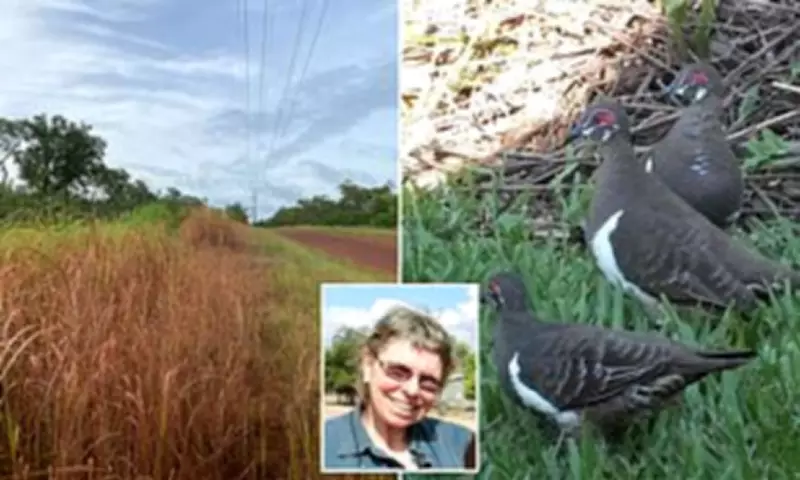
Council Faces Backlash Over Weed Killer Use in Vulnerable Bird Habitat
Litchfield Council has come under intense scrutiny following allegations that it used weed killer to destroy a breeding habitat for the partridge pigeon, a vulnerable bird species. The incident occurred on February 12 in Darwin River, Northern Territory, where council workers sprayed a 50-meter stretch of grass with glyphosate, a herbicide, after identifying it as gamba grass, an invasive weed.
Dispute Over Grass Identification
The sprayed area is located along the fence line of a property owned by Dr Denise Lawungkurr Goodfellow, a wildlife book author and biologist. Dr Goodfellow vehemently disputes the council's assessment, asserting that the grass is native spear grass, not gamba grass. She explained, 'I'm a biologist and an environmental scientist so I know it's native spear grass. It's not gamba grass because that has thick stems which can be as thick as bamboo.'
Dr Goodfellow, who has resided in the Northern Territory since 1975, reported that in 2017, she observed 23 partridge pigeons living along the verge. She further noted discovering a nest with chicks in 2022, indicating the area served as a sustainable breeding ground for these birds. She expressed anger at the council's actions, stating she did not believe it was necessary to poison the grass, especially as nearby clumps of actual gamba grass were reportedly missed.

Council's Response and Defence
In response, Geoff Thomas, Director of Infrastructure and Operations at Litchfield Council, acknowledged that 'a small amount of spear grass was sprayed' but maintained that the primary target was gamba grass. He defended the council's procedures, saying, 'Council officers that undertake weed spraying are trained in weed identification relevant to the NT. They have undergone training in the identification of declared species such as gamba grass and to distinguish them from native grasses.'
Mr Thomas emphasized the council's commitment to environmental care, noting, 'Council is mindful of native flora habitats that can be used by native species. In this case, the area treated was only a small portion of the roadside verge to allow for ongoing operational access.' He added that the council is obligated to maintain roadside verges through slashing and spraying operations in line with operational requirements and weed management plans.
Options for Residents and Bird Conservation Concerns
Mr Thomas highlighted that residents can request exemptions from council maintenance. 'We would like to remind residents that any ratepayer can email the council to request that the verge immediately adjacent to their property be placed on a "No Spraying" and/or "No Mowing" register, provided they are prepared to maintain the area themselves,' he said, noting that many residents utilize this option.
The partridge pigeon, a grey and brown bird that rarely flies, is found exclusively in Australia's Top End, particularly in Kakadu. Its population is declining rapidly due to threats like fires and feral cats. Dr Goodfellow, a birdwatching and natural history guide who has authored books such as Birds of Australia's Top End and Fauna of Kakadu and The Top End, stressed the need for greater caution with native grasslands to protect such vulnerable species.






