
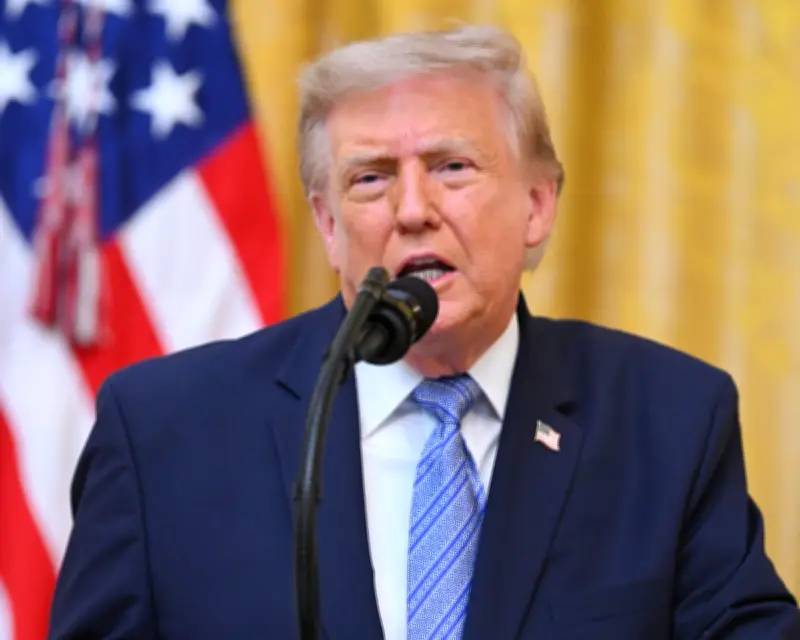
Donald Trump accused China of interfering with the 2020 election in a primetime televised address that laid bare his continuing obsession with his defeat to Joe Biden, but which opponents warned was a smokescreen for him to meddle in the forthcoming congressional midterms.
Trump's Address and Its Implications
In a 25-minute speech on Thursday that had been hyped by Trump himself, the US president cast extraordinary doubts on the integrity of the US electoral process, saying it was "catastrophically" short of standards of fairness and trust, and vulnerable to trespassing by foreign powers. "No country can be great without fair and honest elections," Trump said at the White House in an address that began with a familiar rehashing of his favorite campaign boasts, including claims of an unprecedentedly booming economy. "If there can be no trust, there can be no greatness. Unfortunately, the system we have falls catastrophically short of that standard."
Democrats warned that Trump was trying to sow confusion, spread misinformation and lay the groundwork to challenge the results of the midterm elections, which polls suggest could deliver significant losses for the president's party.
Reactions from Democrats and Intelligence Officials
Mark Warner, a Democratic senator from Virginia and vice-chair of the Senate intelligence committee, said he spent years working to strengthen the country's defenses against foreign meddling in US elections. "Tonight, Americans heard the president once again repeat claims about our elections that have been investigated for years and repeatedly rejected by the intelligence community, the FBI, DHS, DOJ, bipartisan state election officials, audits, recounts, and the courts," Warner said. "The facts have not changed." He added: "China is a serious strategic competitor, and it absolutely seeks to advance its interests at America's expense. So do Russia and Iran. We should confront those threats with facts, not distort them for political purposes."
As a prelude to his claims of interference by China, Trump on Thursday said he was announcing the "immediate declassification and release of critical intelligence, revealing shocking vulnerabilities in our election infrastructure." He asserted that evidence showed the electoral system was "dangerously exposed … to hacking, exploitation and interference." Trump's allegations have long been at odds with the views of officials who served in his first presidency. An assessment carried out by the CIA director, John Ratcliffe, then Trump's director of national intelligence, concluded that the 2020 election was the most secure in US history. However, Trump took issue with those findings, accusing intelligence agencies – whom he tarred as "the deep state" – of a years-long cover-up. "Those responsible for sounding the alarm instead kept the information secret and hidden," he said. "They did not disclose to me as president or to anyone else and, to the best of our knowledge, they did not inform Congress. In fact, all they kept saying is: 'This is the most secure election in the history of our country.'"
Trump said he was directing the office of national intelligence, the Department of Justice, the FBI and the CIA to "investigate how and why such crucial information was hidden, to fire those involved in the coverup and to file criminal charges, if appropriate, against those people." Trump recently installed a key ally, Bill Pulte, as acting director of national intelligence, despite the fact he has no previous intelligence experience. Pulte, who used his previous position in charge of the federal housing finance agency to dig for evidence for retribution against Trump's adversaries, is believed to have provided intelligence documents meant to validate the president's claims of interference in the 2020 poll. He spearheaded a drive to release previously classified documents along with John Solomon, a rightwing former journalist who has been active in spreading election conspiracy theories and was hired as a White House special adviser last month. Speaking to reporters outside the White House on Thursday night, Solomon acknowledged that the documents released contained no evidence that foreign actors flipped a single vote in the 2020 election.
Legislative Push and Iran Remarks
In Thursday's speech, Trump repeated calls for the passage of the Save America Act, legislation requiring strict voter ID, which is currently stuck in Congress. "Addressing this crisis of election security demands that Congress must pass the Save America Act," he said. "How easy is that to do? Unless you want to cheat." The speech barely touched on Iran, just days after Trump jettisoned last month's vaunted ceasefire deal and resumed ordering military strikes in an effort to loosen Tehran's grip on the strait of Hormuz, which has been largely closed to commercial shipping since the start of the war on 28 February, causing global energy costs to soar. "We are … winning big in Iran, and you will see the fruits of that labor very, very shortly," he said in a reprise of previous claims that victory is near.
Speech Delivery and Media Coverage
Despite holding regular media briefings, Trump has delivered relatively few set-piece addresses from the White House – frequently used by past presidents to convey messages deemed of national importance. The setting involves reading a set text from a teleprompter for a limited period, constraints at odds with Trump's speaking style, which often deviates from script and meanders at length. On Thursday, the White House said Trump's longtime teleprompter operator had been placed on administrative leave, following allegations he had placed bets of nearly $100,000 on the prediction market about what the president would say. A new operator was assigned for Thursday's speech, Karoline Leavitt, the White House press secretary, said. Trump spoke to an audience of about 55 people in the East Room, including the vice-president, JD Vance, and other cabinet secretaries and White House officials. He appeared at times to have difficulty following the syntax of the written speech and frequently adopted the sarcastic tone characteristic of his stump speeches.
Several networks, including NBC, ABC and CNN, declined to air the speech on their main broadcast networks, citing concerns that the content could be politically partisan or inflammatory. The move prompted Trump to call for their broadcast licenses to be revoked. All three stations gave live coverage on their streaming services, and some ABC affiliates aired the speech. Television networks are not legally obliged to grant a president's request to air a speech live. Biden and Barack Obama had requests for White House speeches to be broadcast live refused during their presidencies.
Preemptive Denunciations and China's Response
Even before Trump spoke, Democrats issued denunciations in the expectation he would intensify his accusations about the 2020 election. Several said his focus on the past masked a more forward-looking agenda: to interfere in November's congressional midterm elections, when Democrats will attempt to take control of the House of Representative and the Senate. Kamala Harris, the former vice-president and the defeated Democratic candidate in the 2024 presidential election, accused Trump of planning "to peddle lies and conspiracy theories." "Here is what you need to know: The 2020 election was not stolen; we won and he lost," she wrote on social media. "The Save Act is voter suppression. It is part of a larger agenda of conservatives trying to steal power from the people."
China rejected Trump's claims that it interfered in the 2020 election. A spokesperson for the Chinese embassy in Washington told CNN: "China has all along adhered to the principle of non-interference in others' internal affairs." Trump's remarks were at odds with the conciliatory tone he has struck with Beijing since he travelled to China to meet Xi Jinping in May. The Chinese president has been invited to Washington in September. A 2021 US intelligence community assessment concluded that no foreign actor, including China, attempted to alter any technical aspect of the 2020 voting process. The report said that while Russia had conducted influence operations aimed at denigrating Biden's campaign, China did not deploy any interference efforts intended to change the outcome of the election. US intelligence assessed that China did not see either a Trump or a Biden victory as advantageous to Beijing and it was therefore not worth the risk of damaging the US-China relationship with interference efforts. China has long denied claims by western governments, including the UK, that it has meddled in the politics of other countries. Several European countries have raised the alarm about Chinese spying operations in their legislatures. Last year a former parliamentary aide for Germany's far-right Alternative für Deutschland party was convicted of spying for China.




