

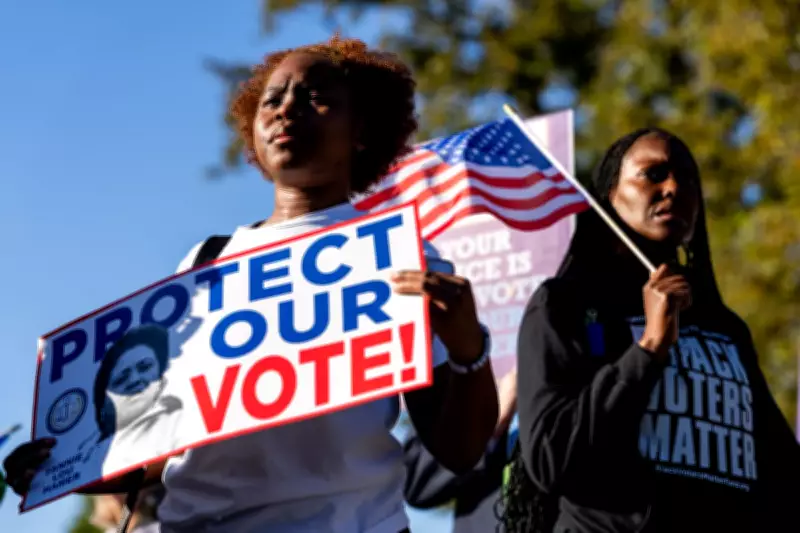
The US Supreme Court issued a landmark ruling on Wednesday in the case of Louisiana v Callais, fundamentally altering how states can draw congressional maps under the Voting Rights Act. By a 6-3 vote, the conservative majority ordered Louisiana to redraw its congressional districts, which had previously included two majority-Black districts out of six, roughly proportional to the state's African American population. The court deemed this an unconstitutional racial gerrymander, effectively prohibiting race-based redistricting under Section 2 of the Voting Rights Act.
What is the ruling about?
At its core, the case focused on Louisiana's congressional maps, which were crafted to comply with existing law by creating two majority-Black districts. A group of white voters sued, arguing that drawing maps based on race constituted unlawful discrimination. The Supreme Court agreed, dramatically changing the interpretation of Section 2 of the Voting Rights Act. Now, challenges to maps require proof of intentional racial discrimination, a difficult standard that Congress had avoided for decades. Additionally, race can no longer be considered when proposing alternative maps.
Impact on voting rights protections
Section 2 had long served as a shield for minority voters, particularly in southern states, allowing them to challenge maps that diluted their electoral power. Wednesday's ruling strips away that protection. Under the new standard, challengers must prove that lawmakers were motivated by racial discrimination rather than partisan advantage. Given that 83% of Black voters favor the Democratic party, according to Pew Research, states can now claim partisan intent to avoid racial discrimination claims, effectively immunizing most maps from challenge.

Reception and immediate effects
Republican leaders in Louisiana celebrated the decision, with Attorney General Liz Murrill declaring, "We win in Louisiana v Callais!" However, civil rights advocates and the court's liberal justices expressed deep concern. In a dissent written by Elena Kagan and joined by Sonia Sotomayor and Ketanji Brown Jackson, they condemned the ruling as a "demolition" of the Voting Rights Act that will lead to a sharp decline in minority representation. Hours after the ruling, Louisiana postponed its primary elections to revert to a single majority-Black district, and other southern states began redrawing maps, emboldened by the court's blessing.
Midterm election implications
The court issued its decision unusually early, raising suspicions that conservative justices wanted to give Republican states time to act before the November midterms. Several states are scrambling to redraw congressional districts, with Donald Trump signaling that Tennessee plans to redistrict to gain an extra Republican seat. This flurry of redistricting is highly unusual for mid-decade elections and could impact control of the House of Representatives.
Long-term implications for minority voters
The Voting Rights Act, enacted in 1965 to combat racial discrimination under Jim Crow laws, has been progressively weakened by conservative Supreme Court rulings, starting with Shelby County v Holder in 2013. Wednesday's decision effectively guts the remaining protections, leaving minority voters vulnerable to practices like "cracking" and "packing" that diminish their electoral representation. As Justice Kagan noted, the Voting Rights Act is now all but dead, and minority representation in government institutions is likely to decline sharply.






