

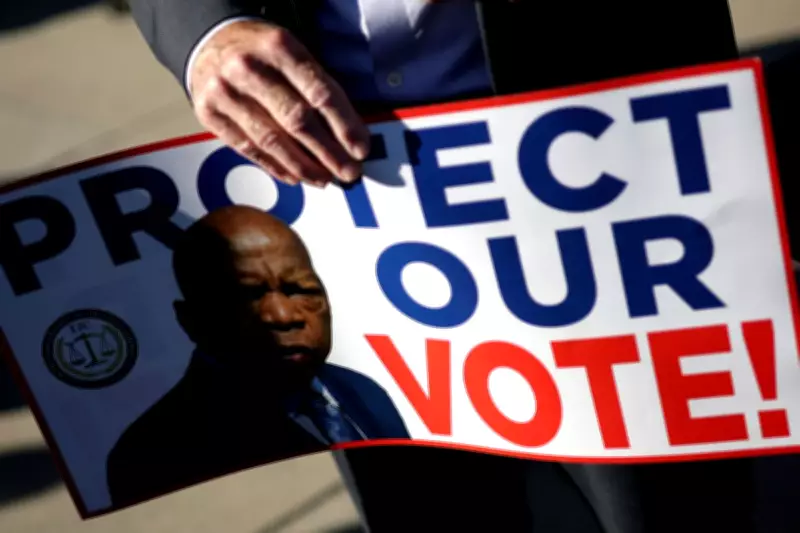
The Supreme Court has dealt a blow to the Voting Rights Act by ruling that a congressional map in Louisiana, which created a second Black-majority district, was an unconstitutional racial gerrymander. The 6-3 decision, handed down on Wednesday, could have significant implications for the upcoming midterm elections, potentially benefiting Republican candidates.
Court's Ruling and Implications
The conservative majority of the court determined that the district relied too heavily on race, but stopped short of intervening in Section 2 of the Voting Rights Act, leaving it intact for now. This marks another chapter in the ongoing legal battles over the landmark civil rights law, more than a decade after the court struck down a critical component of it. Section 2 prohibits voting rules that discriminate based on race. However, if states are no longer required to consider the racial impact of drawing congressional districts, the consequences could be far-reaching, opening the door for Republican lawmakers to eliminate Democratic-led districts across the South. This would provide a major boost to the GOP's gerrymandering efforts ahead of the midterm elections.
Arguments and Reactions
Republican officials and Trump administration attorneys argued that the racial discrimination that necessitated the Voting Rights Act in 1965 is no longer relevant today. The court's ruling limits the ability of lawmakers to use race as a factor in drawing voting maps, likely triggering a new wave of redistricting attempts. The decision effectively prevents states from creating congressional districts that help minority voters elect candidates of their choice. Liberal justices dissented, warning that the ruling will open the door to eliminating the protections of the Voting Rights Act.

Black voters constitute one-third of Louisiana's population but were largely concentrated into one majority-Black district and dispersed across the other five after the state redrew its map following the 2020 census. Most Black voters in Louisiana have historically supported Democratic candidates. Following a Voting Rights Act lawsuit, Louisiana was required to create a second majority-Black district.
Legal Context
The Supreme Court's decision follows a series of rulings that have gradually eroded the Voting Rights Act and constitutional protections against racial gerrymandering. In a landmark 2013 case, the court gutted a key provision requiring states with a history of discrimination to obtain federal approval before changing voting laws. Chief Justice John Roberts wrote at the time, "Our country has changed," but noted that Section 2 remains permanent and applies nationwide.
During oral arguments in October, conservative justices questioned whether there should be a time limit on considering race in redistricting. Justice Brett Kavanaugh asked about the endpoint for such considerations. Janai Nelson, director of the NAACP Legal Defense Fund, argued that it would be "reckless" to deem Section 2 unnecessary due to its success in combating racial discrimination in voting.
This is a developing story, and further updates are expected.






