

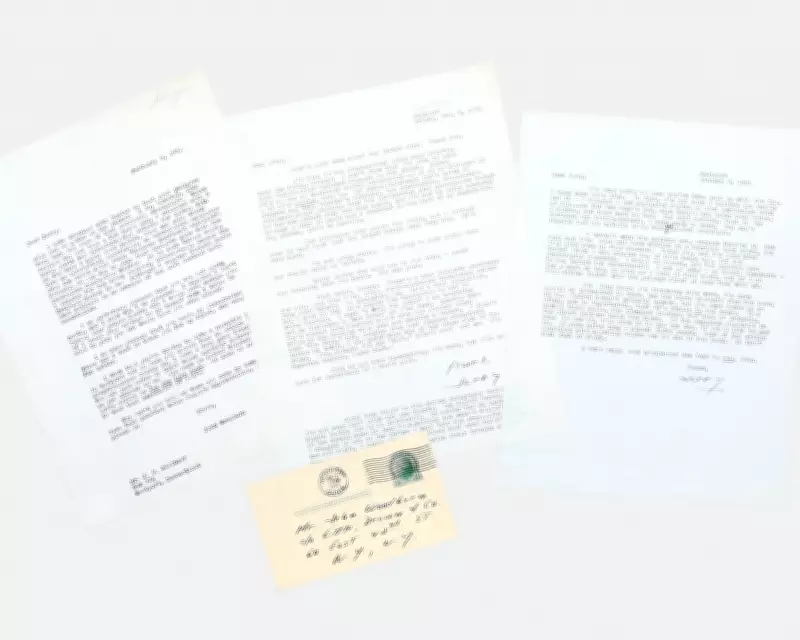
Newly released letters reveal that JD Salinger, the reclusive author of The Catcher in the Rye, actively intervened to conceal his Jewish and Irish Catholic heritage from the dust jacket of his 1951 masterpiece. The correspondence, acquired by Peter Harrington Rare Books in London from a private collection, offers unprecedented insight into the author's concerns about how his identity might be used by critics.
Salinger's Request to His Editor
In the final stages of production for The Catcher in the Rye, Salinger wrote to his editor, John Woodburn, asking him to remove any mention of his “Jewish-Irishness” from the book jacket. He stated: “I don't know that I'd like to have that Jewish-Irish business slapped on the jacket … Surely it's as bad to advertise worthy information as it is to withhold it – if it's catchy, that is.”
Salinger further explained his reasoning, expressing fear that “second-rate reviewers would probably find the information just provocative enough to use and misuse over and over again and I'd end up being expected to wear a Star of David and a Shamrock on the back of my sweatshirt. So, please, let's be careful.” He signed off the letter with “Yours, Jerry.” Woodburn's reply, preserved as a carbon copy, confirms his agreement to the request.

Impact on the Dust Jacket
The first-edition dust jacket of The Catcher in the Rye bears no reference to Salinger's cultural or religious background, noting only that he was born in New York City. The correspondence includes an autograph postcard and two typed letters, now held by Peter Harrington Rare Books.
Expert Commentary
Sammy Jay, senior specialist at Peter Harrington, remarked: “It's very exciting to have letters of consequence from a major writer, particularly ones that are revelatory for their books and their intentions around them. For Salinger, this is really rare because he was very private. Occasionally, you see a letter here or there, but ones where he's actually writing about his books are very unusual.”
Jay added that this exchange provides “the clearest primary-source documentation yet of Salinger's resistance to biographical framing and his determination to control how his identity intersected with his work.” Salinger once described publishing as a “terrible invasion of my privacy,” and this correspondence reflects his wish “to separate authorial identity from textual interpretation.”
Additional Insights from the Letters
The letters also discuss an unpublished “long story” involving “three brothers from the novel,” a reference to The Ocean Full of Bowling Balls, Salinger's prequel to The Catcher in the Rye. This prequel has long fascinated fans because Salinger suddenly cancelled its publication and stipulated in his will that it must remain unpublished until 50 years after his death in 2010. Despite this, a leaked version circulated online in 2013.
Salinger wrote to Woodburn about the prequel: “Holden doesn't actually appear, but his name comes up so often, and so importantly, that he's really in the story.” Jay noted that this letter shows Salinger giving his editor a sense of the story, reinforcing the interconnectedness of his fictional world.
Woodburn's letter also reveals, in a jocular tone, that he wanted to coax Salinger from his “hermit's life in Westport [Connecticut]” even before the novel's publication.
The correspondence will be presented by Peter Harrington at the New York International Antiquarian Book Fair, opening on 30 April.






