

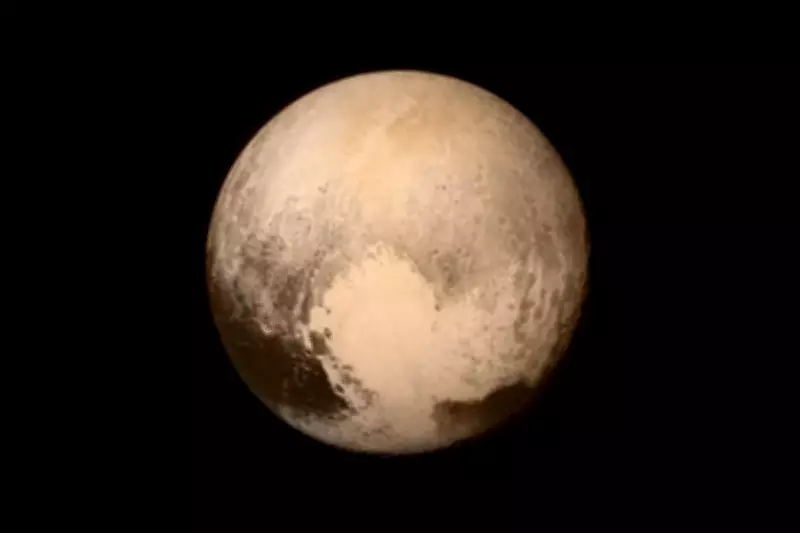
NASA Administrator Jared Isaacman has reignited the long-standing debate over Pluto's planetary status, declaring his support for reinstating the celestial body as the ninth planet in our solar system. Speaking before the Senate on Tuesday, the billionaire SpaceX astronaut told Kansas Senator Jerry Moran that he is "very much in the camp of making Pluto a planet again," adding that scientific papers are underway to "revisit this discussion."
The Background of Pluto's Demotion
Pluto was discovered in 1930 by astronomer Clyde Tombaugh and was immediately classified as the ninth planet. However, in 2006, the International Astronomical Union (IAU) reclassified it as a dwarf planet due to its failure to clear its orbital neighborhood of other objects. Critics argue that Earth and Jupiter share their orbits with asteroids, and recent research has revealed more about Pluto's complexity.
Isaacman's Stance
Isaacman had previously responded to a social media post asking him to make Pluto a planet again, writing, "We are looking into this." He also noted that former NASA Administrator Jim Bridenstine has supported the idea. However, the scientific community remains divided.

Mike Brown, a professor of planetary astronomy at the California Institute of Technology, who played a key role in the IAU's decision, told The Independent: "While NASA administrators are free to wax nostalgic for the days when Pluto was a planet, the actual scientists working in the field will continue to try to explain and classify objects in the solar system in the way that actually helps us understand the world in which we live."
IAU spokesperson Ramasamy Venugopal emphasized that scientific classifications are based on evidence and consensus: "We understand that many people feel Pluto was 'demoted,' but in fact, Pluto became the leading object of a new family of solar system bodies. Scientific classifications are determined through international consensus and evidence-based processes."
Arguments for Reclassification
Proponents of reinstating Pluto point to its complex geology, atmosphere, and five moons. Bill McKinnon, director of the McDonnell Center for the Space Sciences at Washington University in St. Louis, argued: "Of course Pluto's a planet, but it is a dwarf planet, a subspecies of planet. Pluto is round, has an atmosphere, active geology and five moons. What more does a planet need?"
Adeene Denton, a geologist and planetary scientist at the University of Arizona, said: "I personally subscribe to what's sometimes called the geologic/geophysical definition of a planet – if it's big enough to have its own active geology, it's a planet!"
Opposition and Challenges
Others caution that reclassifying Pluto would open the door to dozens of other dwarf planets, complicating the solar system's taxonomy. Adam Frank, a professor of astrophysics at the University of Rochester, wrote that the science behind demoting Pluto was "really important and really exciting," urging people to stop "whining" about Pluto's fate.
Erik Ian Asphaug, a planetary science professor at the University of Arizona, criticized the IAU's definition: "If one day we discover an Earth-mass planet full of inhabitants, orbiting a super-Jupiter, it would not be a planet according to the IAU — how silly is that!"
What Would It Take?
For Pluto to be officially reinstated as a planet, the IAU would need to amend its definition. Currently, that seems unlikely, but for many, Pluto remains a planet in spirit. Amanda Bosh, executive director of Arizona's Lowell Observatory, where Pluto was discovered, said: "In the hearts and minds of many scientists and the public, it has remained a beloved planet, despite its reclassification to a dwarf planet in 2006."






