
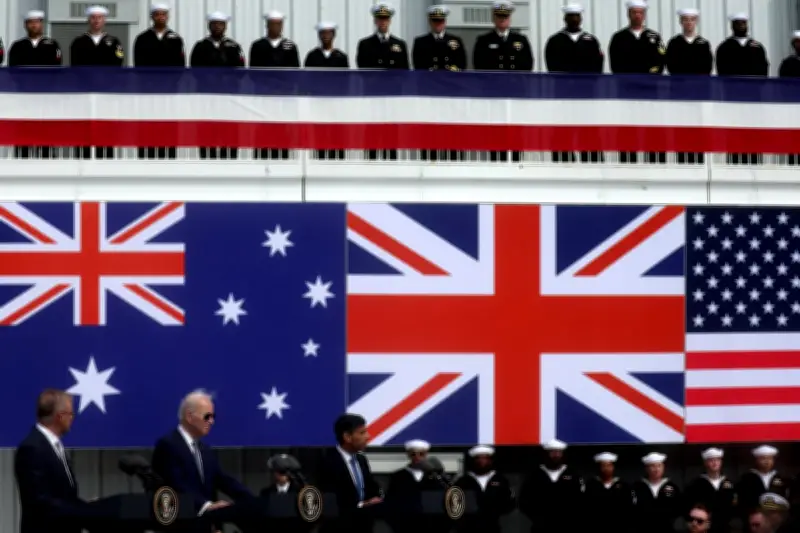
In 2021, leaders of Australia, the UK, and the US – Scott Morrison, Boris Johnson, and Joe Biden – announced a plan to co-design and build eight nuclear-powered submarines for Australia. Morrison championed the pact after reneging on a previous agreement to purchase French-built submarines, which would have cost about $90bn, with a cancellation cost alone of $5bn. After losing office, he went on to work with the US defence industry. His decision, effectively made in secret, was accepted by the incoming Albanese Labor government.
Independent Aukus Inquiry Underway
The independent Aukus public inquiry, led by former Labor environment minister Peter Garrett, has been instigated to enable Australians to better understand the scope, implications, and rationale of the largest ever single defence expenditure in the country. It is publicly funded, transparent, and open to all views. Neither the federal parliament nor the major parties have formally inquired into or substantively debated the merits of this deal.
While substantial concerns about Aukus have been expressed in motions by several Labor party branches and by senior figures including former prime minister Paul Keating and former foreign ministers Gareth Evans and Bob Carr, this week’s Labor conference in Adelaide – a key location for Aukus – looks unlikely to accommodate any meaningful debate on the issue.
Garrett Criticises Lack of Debate
Peter Garrett writes that it is a great pity Labor would be forfeiting the opportunity to reclaim public trust at a time when support for the two major parties is fragile. Retreating from its auspicious past, where robust debates and serious consideration of foreign affairs was a hallmark, Labor would be refusing to meaningfully interrogate the most important national conversation about defence decision-making since 1945.
Halfway through the public inquiry, it is clear that substantial reservations about the Aukus pact have not abated. Australia will commit nearly $10bn to subsidise US and UK naval shipyards so that it eventually receives newly built nuclear-powered submarines. Experts have queried whether this payment, intended to speed up the US Virginia-class submarine building program, will actually deliver any submarines given current build rates. The UK, already experiencing chronic difficulties with existing naval construction, is considered highly unlikely to build from scratch a new, yet to be designed Aukus SSN submarine, on time or on budget.
Cost and Operational Concerns
Repeated concerns about cost blowouts have been raised. The current $368bn does not include establishing infrastructure to safely dispose of medium- and high-level radioactive waste, including weapons-grade uranium associated with the decommissioning of the submarines. The fundamental question of whether the submarines will be fit for purpose has also emerged as a key issue. The 1:3 ratio in submarine deployment – where for every submarine at sea, two are undergoing repairs and maintenance – means that eight submarines, in the words of Australia’s foremost naval submarine expert Peter Briggs, are “mathematically insufficient to maintain a two-ocean presence”.
Significant statements about Aukus have come from former Coalition defence ministers who support the deal. Linda Reynolds’ observation that under Aukus, the Stirling submarine base in Western Australia (where US nuclear-powered and armed submarines will be based on rotation from 2027) would be a nuclear target remains a startling admission. Gareth Evans, one of Australia’s most experienced foreign ministers, told the inquiry Aukus would see Australia’s nuclear submarines function as an extension of the American fleet.
Regional and Environmental Questions
Security and defence policy experts continue to raise crucial questions about what Aukus means for relationships with regional neighbours, Australia’s adherence to the international nuclear non-proliferation treaty regime, and whether the submarines will actually be suitable for patrolling the shallow waters of the northern coastline. From First Nations communities and those living in suburbs close to future Aukus activity, deep anger has been heard at the absence of any prior notice or meaningful consultation.
Despite an open invitation to the government and relevant agencies to submit to and appear at the inquiry, none has been forthcoming. All of the questions about Aukus deserve to be fully explored and better understood at a time of rising cost of living pressures, global political upheaval, the spectre of increased climate risk to national security, and more. If governments won’t attend diligently to the task, then this public inquiry will.




