

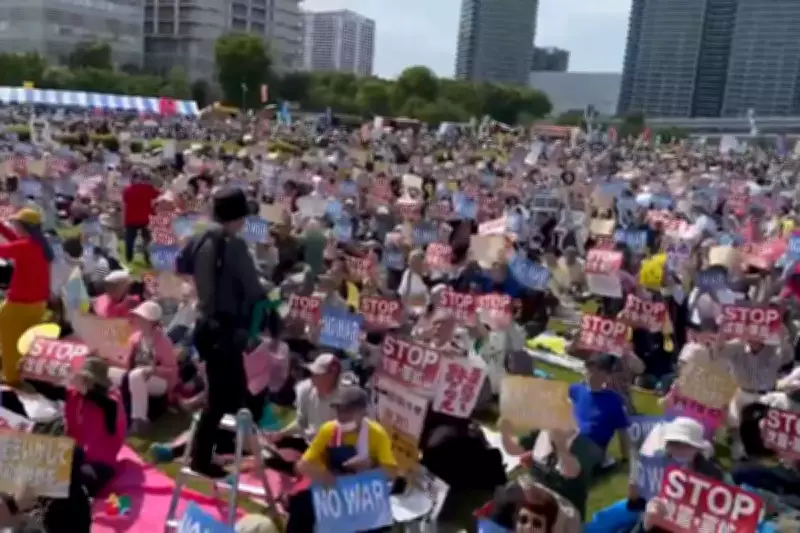
Japan witnessed its largest protest in support of pacifism on Sunday as an estimated 50,000 people gathered in Tokyo to oppose Prime Minister Sanae Takaichi's efforts to amend the country's post-war constitution. The demonstration, organized at Tokyo Rinkai Disaster Prevention Park, marked Constitution Memorial Day and drew crowds from across the nation.
Protest Against Constitutional Revision
Protesters rallied to protect the existing constitution, unchanged since 3 May 1947, and specifically to oppose changes to Article 9, a clause that renounces war and limits the country's military capabilities. Many carried banners reading "STOP Constitutional Revision and Military Expansion" and chanted "No to War" and "Protect the Peace Constitution." Similar events took place nationwide, attracting a diverse crowd including long-time activists, families, and many younger participants.
Haruka Watanabe, an 87-year-old war survivor, told Kyodo news agency: "I want to cherish the constitution like my own child and pass it on to the next generation." At another rally in Tokyo, non-fiction writer Shinobu Yoshioka criticized the conservative government's moves, including proposals to criminalize desecration of the national flag, warning that "centralized methods are becoming increasingly entrenched. Where this leads is a country that wages war."

Government's Push for Change
Prime Minister Takaichi and the ruling Liberal Democratic Party (LDP) have called for "advanced discussions" to amend parts of the constitution. The revisions would formally recognize the Japan Self-Defence Forces and adapt to regional security threats, including tensions with China and North Korea. Takaichi has argued that the constitution should be periodically updated to reflect modern needs, saying: "Politicians should hold discussions in order to make decisions," with debate aimed at reaching outcomes rather than continuing indefinitely.
Any constitutional amendment requires a two-thirds majority in both houses of parliament (the Diet) followed by a majority vote in a national referendum. The LDP already holds a two-thirds majority in the lower house and, with pro-reform allies, is close to reaching the same threshold in the upper house.
Military Buildup and Controversies
Since taking office in October, Takaichi has pushed for policies accelerating Japan's military buildup as a deterrent against regional threats. Her cabinet scrapped restrictions on Japanese lethal weapons exports, a move welcomed by the United States and other defence partners but criticized by pacifists at home and China for deviating from Japan's post-war principle of limiting military advancements to self-defence.
Public Opinion Divided
According to a Kyodo News poll, 73 per cent of respondents believe any constitutional amendment should only proceed with broad cross-party agreement, not just pushed through by the ruling party alone. A Yomiuri Shimbun poll found nearly 57 per cent in favour of revisions, while the liberal Asahi Shimbun reported only 47 per cent support. Sunday's protest, one of the largest in recent years, underscores the deep division in Japanese society over the future of its pacifist constitution.






