
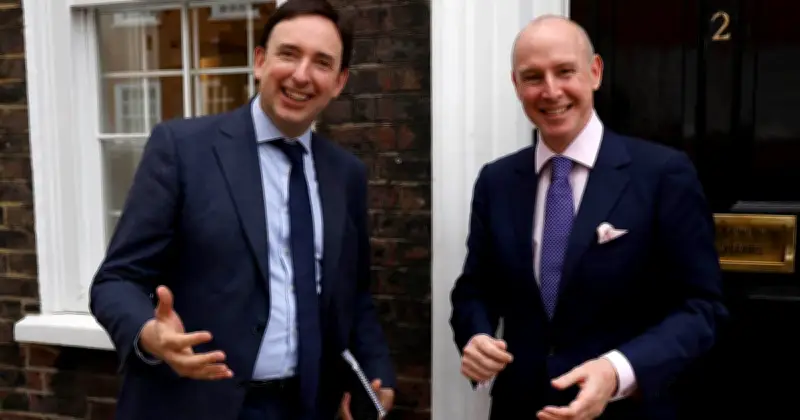
Lord Daniel Hannan has disclosed that a land invasion on his family's farm in Peru and the toppling of Margaret Thatcher were pivotal events that drove his campaign for Britain to leave the European Union. Speaking in an interview, the former MEP and now director of the Institute of Economic Affairs detailed the origins of his euroscepticism.
Peru Farm Invasion: A Childhood Awakening
When Hannan was five years old, a mob attacked his family's farm in Peru. “They were attacking all the farms in the valley,” he recalled. His parents debated whether to flee the invaders, giving him a first-hand experience of the fear and chaos in a country where “disorder was normal”. Years later, he noted, “the most shocking thing about that whole episode is that no one had been shocked. It was totally unsurprising in a country like that.”
His father, a British-educated World War 2 veteran, and his Scottish mother, who worked at the British embassy in Lima, sent him to England for schooling. There, he was astounded by the basic amenities Britons took for granted: “I was just blown away by the wonder of being in a place where you could drink the tap water and you flick the switch and the light actually came on because there was 24-hour electricity… When you stopped at a traffic light, you didn't have every car behind you hooting, and when the guy in the shop gave you change, you didn't have to count it.” He added, “Even now, all those years on, the wonder has not totally left me.”
Thatcher's Ouster: The Radicalising Moment
During his first term at Oriel College, Oxford, aged 18, an event changed British politics and his life: Margaret Thatcher was ousted. “I think that was probably the moment when I began to get politically radicalised,” he said. “She’d won these three elections, and then she was brought down by this coalition of europhile backbenchers and EU leaders. And it felt like a coup and I was so angry about that.”
In December 1990, he met two friends at the Queen's Lane Coffee House in Oxford—one was Mark Reckless, later a Conservative MP who defected to Ukip, and the other, now a conductor, remains unnamed. They launched the Oxford Campaign for an Independent Britain. “Some people have said this is the first flowering of what became the Brexit campaign,” he remarked. “I think it was.” The group quickly attracted 300 members within three weeks.
From Oxford to the European Research Group
Hannan invited the so-called Maastricht rebels to speak at the university—MPs fighting to stop the treaty that laid the foundation for the euro. “History would have been very different, by the way, had we stopped the Maastricht treaty. Brexit probably wouldn't have happened; we'd have drifted much more gently into a kind of detached relationship,” he noted.
After graduation, he co-founded the European Research Group (ERG) with Conservative MP Michael Spicer, serving as its first secretary. The ERG later became famous for its role in the Brexit wars. Hannan said the group's deliberately boring title was chosen because “if you have a campaign to take over the world, you don't call it The Campaign To Take Over The World”.
In 1999, he was elected to the European Parliament, where he described MEPs as “self-selecting euro-fanatics who absolutely wanted a country called Europe”. He aimed to “direct my torch beam at some of the corners that they don't really want people to know about”. He helped the Danish campaign against joining the euro and fought for a referendum on the Lisbon Treaty.
Founding Vote Leave and the 2016 Victory
In the UK, Hannan laid the foundations for the Vote Leave campaign. “I think I can claim to have founded it in the sense that I appointed Matthew Elliott as our chief executive,” he said. On the night of the referendum in June 2016, as victory became clear, he jumped on a table and recited an altered version of Henry V’s “we happy few, we band of brothers” speech, name-checking campaign workers. Afterwards, he walked by the Thames as the sky brightened with a “beautiful pink dawn”, feeling “this great sense of pride in everyone who had defied all of the bullies, all of the corporates, all of the foreign governments, all of the political party leaders, and done what they knew to be the right thing”.
Post-Brexit Reflections and Current Priorities
Despite his pioneering euroscepticism, Hannan said he was not “hard line about what relationship we would have with the EU afterward”. He was shocked by the subsequent divisions: “Remainers lost all interest in trying to have a gradual or flexible Brexit, and went all-in on a second referendum to try and overturn the result… And Leavers suddenly began to say, ‘What do you mean you want a common market? You traitor, you europhile.’”
Now, his focus is on reviving prosperity. He diagnoses the problem as “long lockdown”: “We paid ourselves to stay at home for the better part of two years. We were borrowing from our future selves. The price rises, the tax rises, the debt, the welfarism, the truancy, the petty crime, the shoplifting, they are all consequences of what we might call long lockdown.” He argues for suspending net zero policies and making it less risky to hire staff. At 54, Hannan remains determined to push Britons to recognise the brilliance of their homeland.




