

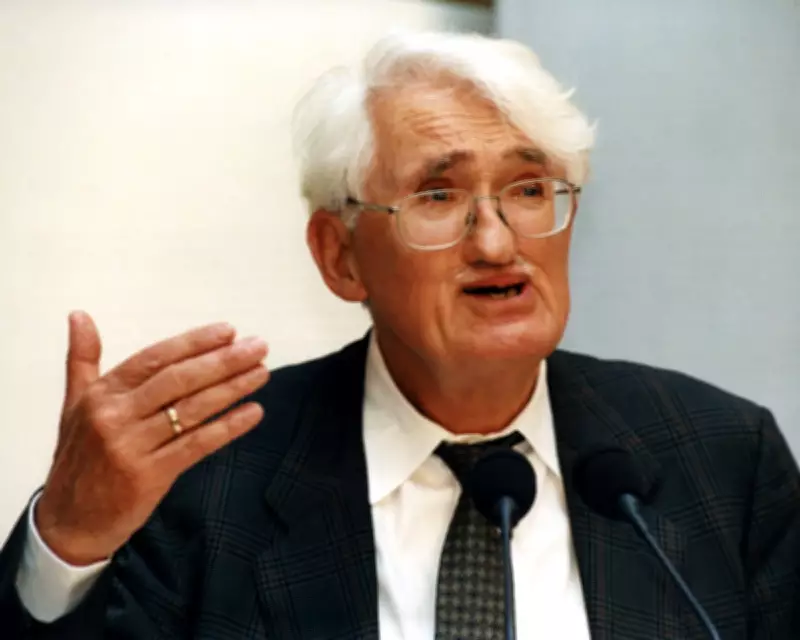
The Enduring Legacy of Jürgen Habermas in an Era of Unreason
Jürgen Habermas, often hailed as "the last European" for his unwavering dedication to European Union ideals, passed away at 96, leaving behind a monumental philosophical legacy. As one of the final survivors of a postwar intellectual generation shaped by the horrors of World War II, his work resonates deeply in today's turbulent political climate, where demagogues and big tech dominate public discourse.
A Lifelong Commitment to Democratic Values
Born into a Germany scarred by Nazism, Habermas was briefly a member of the Hitler Youth as a boy, an experience that profoundly influenced his life's mission. He dedicated his career to philosophically anchoring democratic principles, which are now under renewed threat from far-right movements in France and Germany and illegal conflicts like the war in Gaza.
His magnum opus, The Theory of Communicative Action, published in the 1980s, posits that human nature, as linguistic beings, inherently prioritizes reason and consensus. This idea serves as a powerful antidote to the intellectual relativism and Trumpian "realism" that elevate self-interest above collective moral argument.

The Public Sphere and Its Modern Challenges
Habermas's concept of the public sphere envisioned a space for rational debate, pluralism, and inclusion, free from state bullying or market corruption. While critics from the left argued he underplayed structural issues like class, race, and gender, his vision remains urgently relevant.
In recent decades, he applied this framework to diagnose the dangers of algorithmic social media, which distorts communication, and the hubris of big tech companies. His insights also made him a prescient observer of 21st-century demagoguery, though his perspective on conflicts like Gaza was tempered by the weight of German history.
Bridging Secular and Religious Thought
A notable tribute from the Vatican highlighted Habermas's 2004 debate with Joseph Ratzinger, later Pope Benedict XVI. In this exchange, the rationalist philosopher and Catholic theologian found common ground, agreeing that the Christian notion of humans made "in the image and likeness of God" aligns with secular principles of equal worth. Habermas termed this a "saving translation," offering a philosophical bulwark in illiberal times.
As the world grapples with algorithmic distortions and rising authoritarianism, Habermas's work provides essential sustenance for defending democratic values and fostering inclusive public discourse.






