
The UK and Irish Governments, along with the Northern Ireland Executive, have held discussions on safeguarding the Common Travel Area (CTA) and implementing stronger enforcement measures to “prevent abuse” of the system following a stabbing incident in Belfast.
Northern Ireland Secretary Hilary Benn, Irish Justice Minister Jim O’Callaghan, and Stormont Justice Minister Naomi Long participated in a phone call on Wednesday, during which the CTA was a central topic of discussion.
Hadi Alodid, a 30-year-old Sudanese national, has been charged with attempted murder in connection with the knife attack on Monday, which resulted in Stephen Ogilvie losing an eye. Alodid entered Northern Ireland by bus across the Irish border in February 2023, having flown to Dublin from Paris. He subsequently claimed asylum and was granted permission to remain in the UK until 2028.
The discussions occurred amid riots that erupted in Belfast following the knife attack. Democratic Unionist Party leader Gavin Robinson has called for the closure of the “open porous border” with Ireland, while TUV leader Jim Allister has sought clarification on the basis upon which Alodid was admitted at Dublin Airport in 2023.
A UK Government spokesperson stated on Wednesday that immigration enforcement against “illegal migrants” would be intensified in Northern Ireland, including intelligence-led operations along CTA routes.
Deputy First Minister Emma Little-Pengelly remarked that there were “questions to be asked” about immigration policies across both islands and the checks conducted in Dublin. “The number of people landing without documentation has reduced significantly since 2023,” she noted. “This was a man who came through a number of different routes, through from Paris into Dublin and across the Irish border. And very clearly a dangerous individual, so there’s questions to be asked about vetting, about the immigration policy in the UK, the cooperation with the Irish Government, how those checks happen when people arrive into Dublin. Those are all questions that, of course, should be answered.”
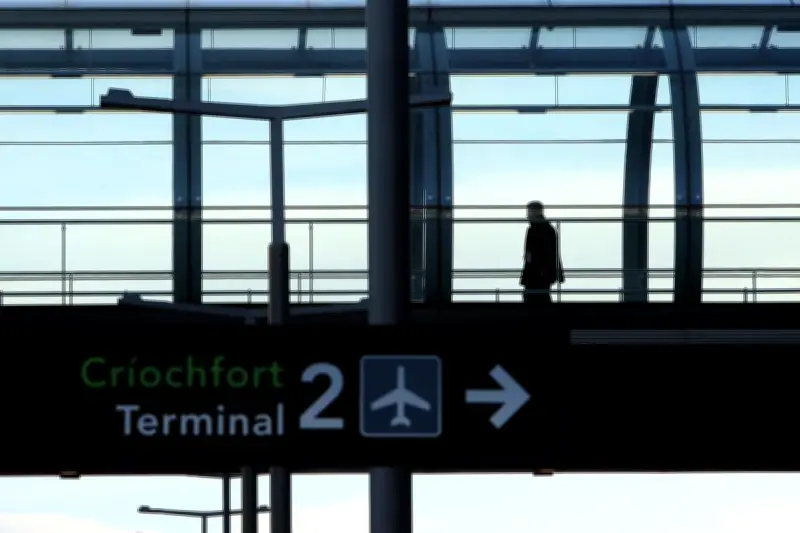
Ireland’s Department of Justice issued a statement confirming that Minister O’Callaghan emphasized to Mrs. Long and Mr. Benn the “significant” border management operations currently taking place at Dublin Airport. The department noted that the three ministers agreed to collaborate to “prevent abuse” of the CTA.
“The invisible border on the island of Ireland is among the most tangible gains of the peace process and is essential to the continuing normalisation of relationships,” the Department stated. “Minister O’Callaghan discussed the importance of cross border cooperation in protecting the Common Travel Area for both Ireland and the UK yesterday by phone with the Northern Ireland Minister for Justice Naomi Long and the Secretary of State for Northern Ireland Hilary Benn. They discussed stronger cooperation and enforcement to prevent abuse of the Common Travel Area. Minister O’Callaghan emphasised that significant Border Management Unit doorstop operations now take place at Dublin Airport. The number of people landing without documentation has reduced significantly since 2023. Northern Ireland Minister for Justice Naomi Long and Secretary of State for Northern Ireland, Hilary Benn, agreed to work with Minister O’Callaghan to prevent abuse of the CTA.”
On Wednesday, Irish Premier Micheál Martin asserted that the Common Travel Area “works” for Irish and British citizens, and that the key to UK-Irish cooperation on migration lies in “engagement between the two governments.” He stated, “We discussed this at the Anglo-Irish summit in February last in Cork, and the need for ongoing engagement between the Home Secretary and our Minister for Justice, that is important. Secondly, comprehensive coordination between police forces, between An Garda Síochána and the PSNI in this instance, and probably clear assertion of the principle that the Common Travel Area works for citizens in the United Kingdom and for Irish citizens, that’s a benefit. Others may abuse the Common Travel Area, and it’s primarily a framework for citizens, and so there are issues both ways that we can only really address by proper engagement between the two governments, and in particular between the Home Secretary and the Minister for Justice.”




