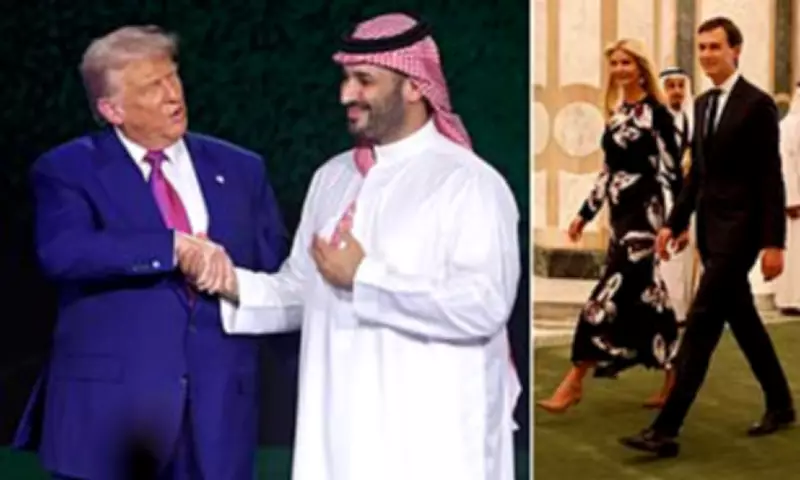
Donald Trump's Arab allies have reacted to his demand that they recognize Israel as part of an Iran peace deal with silence, alarm, and even laughter, sources have revealed.
Arab Officials Dismiss Trump's Push
Officials in Muslim-majority countries flatly dismissed Trump's push to expand the Abraham Accords, his signature first-term deal that normalized Arab ties with Israel. However, other insiders suggested that Trump's demand was a shrewd gambit aimed at appeasing hawkish Republicans who fear the President is ceding too much to Tehran.
'It is a smart tactic to calm down the angry base,' an Arab diplomat told Politico. 'He will keep bringing it up again and again. But it will not be part of the deal.'

Trump was met by stunned silence on a Saturday conference call with leaders from Saudi Arabia, Qatar, Turkey, Egypt, and Pakistan when he told them an Iran peace deal hinged on their countries recognizing Israel. After a long pause, the President joked nervously: 'Are they still there?'
One former US official sent mock congratulations to his Arab government contacts on joining the Abraham Accords, only to receive laughter emojis in reply, Politico reported. Arab officials view Trump's ultimatum as a 'poison pill' that 'creates new conditions for peace that neither Iran nor the states in question will accept,' the former diplomat added.
Disbelief and Frustration Across the Middle East
A second former US official described the mood across Middle East governments as one of 'disbelief and frustration.' The White House pushed back, insisting the Abraham Accords had been a resounding success since Trump struck them in his first term, deepening both diplomatic and economic ties across the region.
'The Abraham Accords have provided massive economic benefits to all countries involved and enabled historic cooperation, so this would be a natural complement to a peace deal between the United States and Iran,' Anna Kelly said.
The new demand lands at a precarious moment in the negotiations, with US forces carrying out fresh strikes on Iranian missile sites and mine-laying boats on Monday as Israel ramped up its offensive against Hezbollah in Lebanon. Oil prices tumbled 4 percent on Wednesday on hopes a deal could reopen the Strait of Hormuz, with global benchmark Brent crude sliding to $95 per barrel.
Background on the Abraham Accords
The accords, brokered by Trump's son-in-law Jared Kushner in 2020, normalized ties between Israel and the United Arab Emirates, Bahrain, Morocco, and Sudan, marking the first formal Arab recognition of the Jewish state since Jordan in 1994. Saudi Arabia, long seen as the crown jewel of any expansion of the accords, has insisted it will not normalize relations with Israel without a credible pathway to a Palestinian state, a condition Israel has flatly rejected. A November 2022 poll found 76 percent of Saudis viewed the Abraham Accords negatively, and opposition has only hardened since the Gaza war.