
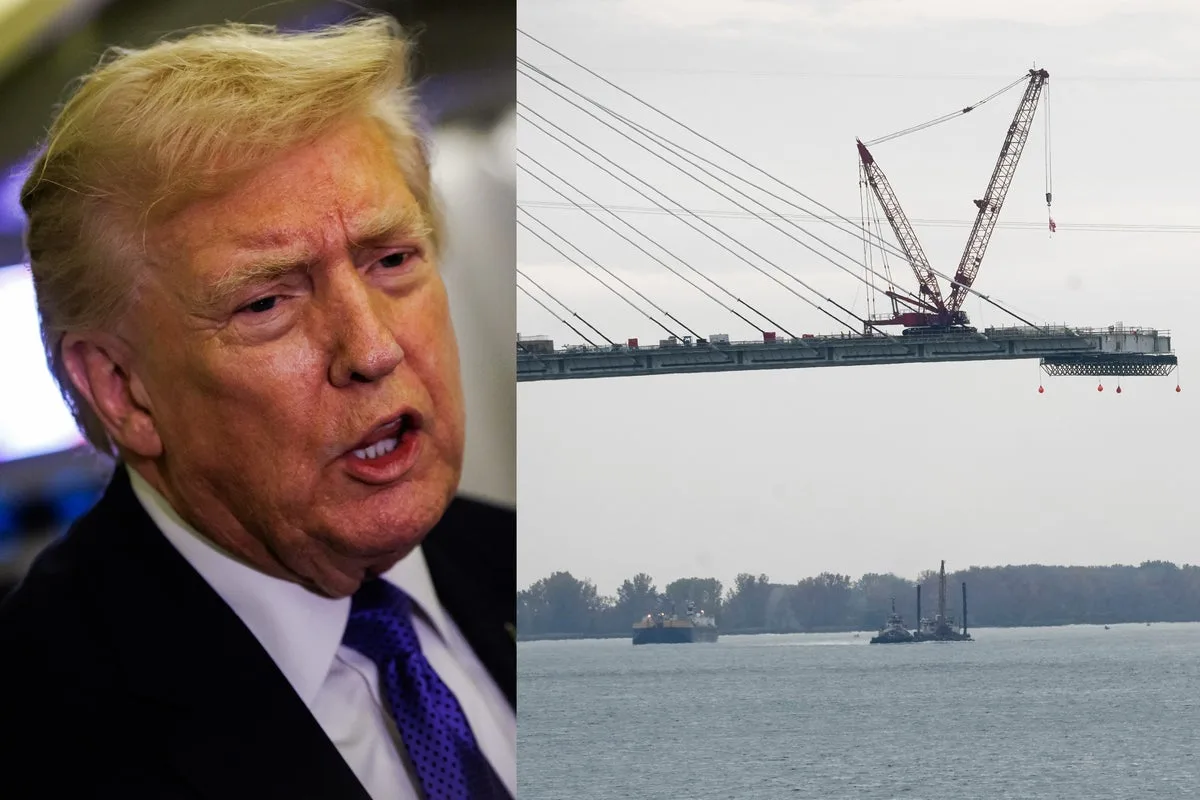
President Donald Trump has made the extraordinary claim that China would 'terminate ALL Ice Hockey' in Canada if it took over the country, as he threatened to block a new suspension bridge between the United States and its northern neighbour. In a post on Truth Social, Trump accused Canada of 'taking advantage of America' and demanded part-ownership of the Gordie Howe International Bridge, a 1.6-mile span across the Detroit River linking Michigan and Ontario.
The bridge, named after the legendary Canadian hockey player, has been under construction since 2018 and is entirely funded by the Canadian government, which plans to recoup costs through tolls. Trump's outburst came amid escalating trade tensions, including his tariffs and threats of annexation, and he claimed that without compensation, the bridge would not open. 'We will start negotiations, IMMEDIATELY. With all that we have given them, we should own, perhaps, at least one half of this asset,' he wrote.
Trump also railed against reports that Canada is seeking new trade deals with Beijing, declaring that China would 'eat Canada alive' and would 'permanently eliminate The Stanley Cup'. He offered no explanation for how this would be achieved. The remarks drew swift condemnation from Michigan politicians, including Governor Gretchen Whitmer, whose spokesperson noted that Canada financed the bridge's construction and that it would be jointly operated with Michigan.
Michigan Senator Elissa Slotkin called the bridge an 'incredibly important infrastructure project' and warned that any cancellation would cause 'serious' economic damage. 'With this threat, the President is punishing Michiganders for a trade war he started,' she said. Senator Gary Peters described Trump's claims as 'completely backwards', while Representative Debbie Dingell pointed out that the bridge was negotiated by a Republican governor and endorsed by Trump himself in 2017. 'We cannot forget Canada is our friend and ally,' she added.
The dispute adds to a frayed relationship that saw Canadian Prime Minister Mark Carney warn in Davos last month that the old US-led world order 'is not coming back'. Trump's post also attacked Ontario's boycott of US liquor, which saw American spirits removed from provincial stores in February and yet to return.




