
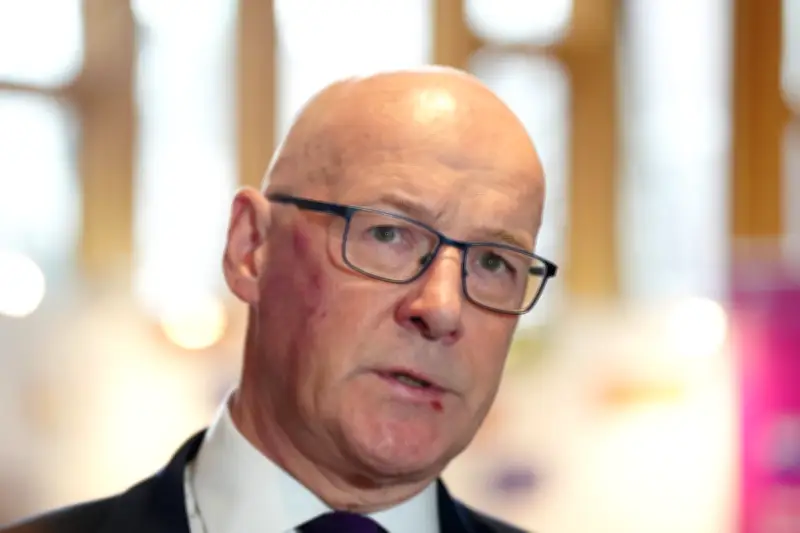
First Minister John Swinney has said he is “extremely disappointed” by the announcement from Dundee University that a further 190 jobs are at risk. The institution said on Tuesday it is opening a formal consultation on the cuts, which follow the loss of 645 roles in recent years as a result of financial issues.
Bosses at the university said a further £20 million in savings have to be found, with the job losses to be spread evenly between teaching and professional services. Dundee’s interim principal Professor Nigel Seaton said he knew the announcement would be “awful” for staff, but action must be taken to save the university.
The Scottish Government recently gave the university £40 million through the Scottish Funding Council (SFC) to support its recovery. During First Minister’s Questions at Holyrood on Tuesday, Mr Swinney said: “The announcement by the University of Dundee this morning of a consultation on further job cuts is extremely disappointing and (Dundee SNP MSP) Heather Anderson is absolutely right that there is public funding involved.”
The cash was provided to the university by ministerial direction, meaning the former education secretary ordered it be passed on, but as a result it has to meet conditions set out by the Government. While the SFC has told ministers it is confident the conditions have been met, Mr Swinney said “ministers have not been assured on the detail of this”.
He said: “The Education Secretary has spoken to the university principal, also the chair of court and also with the funding council about these issues and the Government will continue to engage. But the assurance I will give Heather Anderson is that the Government will be absolutely attaching the greatest priority to meaningful and effective dialogue with members of staff, who I recognise will be feeling deeply alarmed by the announcements that have been made by the university. The conditions from the Government require substantive engagement with staff and trade unions and the Government will make sure that is the case.”
In a statement, Prof Seaton said: “We have informed staff that we are moving into collective consultation on proposals to reduce staffing by around 190 posts, split equally across our academic and professional services communities. Staff who are at risk of redundancy are being informed today. Over the last 18 months we have taken vigorous action to address our financial situation, including two rounds of voluntary severance, introducing tighter financial controls, freezing non-essential recruitment and limiting our operational expenditure. The number of people working at the university reduced by 675 between August 2024 and May 2026. This has all had a substantial impact, and we have made considerable progress in our aim to achieve financial stability. We have also received essential support from the Scottish Government, via the Scottish Funding Council, to help us on our road to recovery. However, even after all of this is taken into account, we still have some way to go to become financially sustainable. To achieve this we need to realise further annual savings of around £20 million.”
The university has made “progress” in cutting its non-staff spending, Prof Seaton added, but there is “a limit to how much further we can go”, with further saving required to come from staffing. While he stressed the 190 job cuts are just a proposal, the principal said: “We know this is a very difficult message for staff and all in our community, particularly given the staffing changes that have already been made over recent months. Our aim is that any reduction in roles will be achieved through voluntary redundancy wherever possible. I am very conscious of the very difficult – actually, awful – experience that staff in particular have gone through since our financial crisis was acknowledged. If there were any other way to secure the future of the university without carrying out the change we have outlined, we would take it. But we must go through this to ensure that the university survives and that we continue to do great things for our students, for those who benefit from our research, and for society more widely.”
Ian Ellis, the co-president of the Dundee branch of the UCU trade union, said the news is “devastating” for staff and students. “Staff are once again paying the price for management failings and a catalogue of managerial missteps,” he said. “Every job that is lost, whether by voluntary redundancy or by possible compulsory redundancies, is a tragedy for the individuals impacted but also diminishes the university and leaves increasingly unmanageable workloads for the staff who remain.”
UCU general secretary Jo Grady added: “Only last week UCU members at Dundee returned an overwhelming ballot result to defend jobs and ensure a future for the university. It is for members to decide the next step in this dispute, but I know their resolve is undiminished since the crisis was first announced in autumn 2024. Management should be clear that we will, as we have always done, continue to defend every job that we can, both individually and collectively.”
Scottish Conservative education spokeswoman Meghan Gallacher urged the university against “tightening the screw” further with more job losses, adding: “Rather than fixating on one-off payments which seem today to have done very little, the SNP Government must act to help its leaders form a multi-year plan that secures jobs and learning for students. Failing to do that risks a brain drain and a much-loved uni that functions in name only.”




