
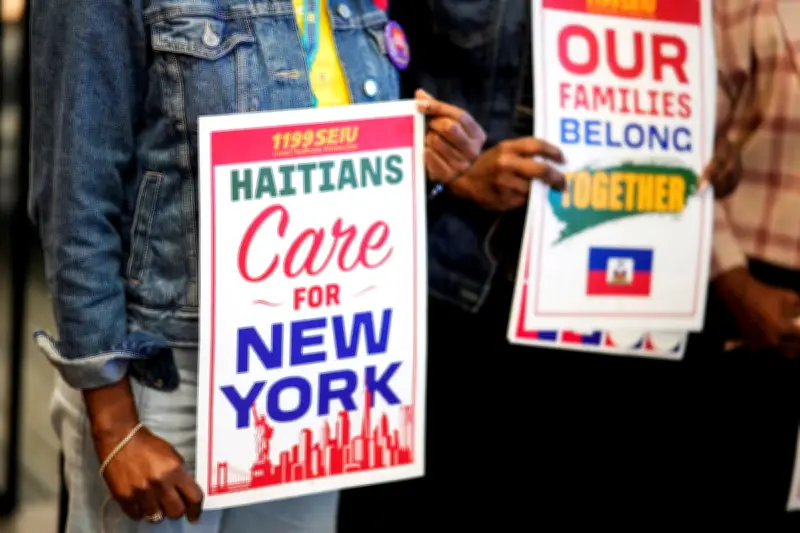
The US Supreme Court has handed the Trump administration significant victories in its campaign to restrict immigration, ruling on Thursday to allow the termination of Temporary Protected Status (TPS) for hundreds of thousands of Haitians and Syrians and to permit border officials to physically block asylum seekers at the US-Mexico border. The decisions, part of a broader conservative shift on the court, empower the government to circumvent immigration laws and selectively administer them.
Rulings Bolster Administration's Hardline Approach
In a pair of rulings, the 6-3 conservative majority allowed the administration to end humanitarian protections that had enabled people from Haiti and Syria to live and work legally in the US for over a decade. The court also cleared the way for the government to turn away asylum seekers by preventing them from setting foot on US soil. Earlier in the week, the court granted border officials broad discretion to deport lawful permanent residents, or green card holders, who have committed crimes of "moral turpitude," without requiring "clear and convincing evidence."
These decisions are among dozens of policies aimed at radically restricting immigration from people of color, redefining who can live in the US. The court is still set to rule on whether Trump can deny birthright citizenship to children born in the US to parents who are temporary visitors or undocumented immigrants.
Racist Underpinnings Ignored by Court
The rulings signal the court's unwillingness to address the racist and nativist philosophy driving Trump's policies. On the same day Justice Samuel Alito wrote that Trump's remarks about Haiti being a "shithole country" and Haitians "poisoning the blood" of America did not prove policies were "overtly racial," Trump officials repeated these tropes. On Fox News, Stephen Miller, a top Trump aide, argued against admitting migrants from "nations that have never had contact with the west, would have never developed the combustion engine or airplanes or televisions or radio or the internet." Miller has advocated for a return to the nativist 1920s, when the US barred entry from much of the world.
The administration has largely blocked entry from the global south, pausing nearly all refugees except white South Africans and reshaping the refugee system to favor English speakers and white Europeans. A federal judge struck down a policy that stopped processing immigration applications from 39 countries, mostly in Africa and the Middle East, but with the court's blessing, the administration may revive "metering" at the southern border, instructing officials to block asylum seekers at the border line.
Impact on Legal Residents and TPS Holders
The court's decisions also target people already living in the US legally. The TPS ruling allows the administration to strip legal status from 350,000 Haitians and 4,000 Syrians who fled political instability, economic collapse, natural disaster, and civil war. "Never let anyone tell you this administration only goes after 'undocumented' immigrants," said José Palma, a coordinator at the National TPS Alliance. "By trying to kill TPS, they are attacking people who are living and working here legally, paying fees and taxes, following all the rules. They are de-documenting people."
Viles Dorsainvil, co-founder of Haitian Support Center and a Haitian TPS holder, said: "Families have started asking us questions that we are not able to answer. It is the saddest day of my life." Advocates are calling on Congress to extend protections, but the ruling could be disastrous for those affected.
Deadly Consequences for Migrants
These decisions could have deadly consequences for millions of people in the US and those seeking safety. During the first Trump administration, people, including children, died when asylum seekers were turned back at the border, languishing without medical care or safe housing. The most dire consequences will be borne by Black, brown, and Asian immigrants who fled war or persecution.
In a circular argument, Alito claimed the administration was not racially motivated in ending TPS for Haitians, citing that the Department of Homeland Security "terminated the TPS designations for every country that came up for review," including countries in South America, Africa, the Middle East, and Asia. Ahilan Arulanantham, an attorney for the Syrian plaintiffs, said: "That conclusion is deeply troubling not just for immigration cases, but for the state of racial justice in this country more broadly."




