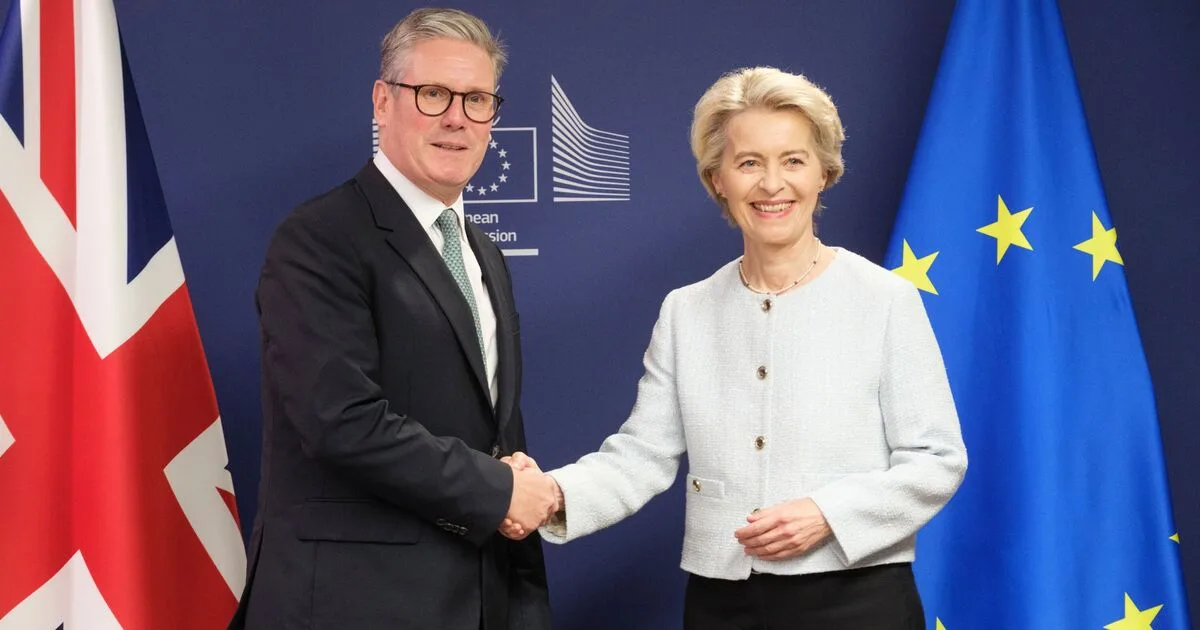
Government ministers have conceded that Sir Keir Starmer's proposed 'reset' with the European Union will impose significant financial burdens on thousands of British businesses through costly Brussels red tape, regardless of whether they engage in trade with the bloc. The business and environment secretaries have promoted a new agreement that would bind the United Kingdom to the European Union's rulebook on food standards, urging companies to commence preparations for its implementation.
Widespread Impact on Smaller Enterprises
Officials have acknowledged that numerous firms, particularly smaller businesses, will need to adapt to these regulatory changes even if they do not conduct trade with the European continent or have shifted their commercial focus to other global markets. Critics have denounced this development as a 'betrayal' of the historic 2016 Brexit referendum outcome, warning that it represents an act of 'self-harm' that could potentially bankrupt enterprises already grappling with Labour's national insurance increases for employers, rises in the minimum wage, and expensive new employment legislation.
International Relations and Trade Implications
Concerns have also been raised regarding the potential damage to relations with the United States, which has expressed interest in enhancing trade with the United Kingdom on food and agricultural products. The agreement, referred to as 'dynamic alignment' within Brussels circles, entails returning oversight of trade in food and agricultural goods to the European Court of Justice (ECJ). This arrangement effectively positions Britain as a 'rule-taker' that must adhere to future regulations without having any substantive input in their formulation.
John Longworth, Chairman of the Independent Business Network and former director general of the British Chambers of Commerce, stated: 'This is an absolute disaster. The whole concept that the Government is following at the moment is a betrayal of the democratic decision on Brexit, without a mandate to do it.' He emphasized that while only 8% of British businesses export to Europe, the regulations would apply to 100% of enterprises, creating an additional burden of red tape at a time when operational costs are escalating.
Political Opposition and Economic Concerns
Mark Francois, Chairman of the European Research Group of Conservative MPs, commented: 'So-called 'dynamic alignment' is just code for becoming a rule taker from Brussels again, regardless of the wishes of our own Parliament. What did we have a referendum for, if it was only to be sold down the river by Starmer on this?' He added that regardless of the adverse effects on British small businesses, Sir Keir remains a 'passionate Europhile.'
Although larger corporations such as supermarket chains have welcomed the deal due to its potential to reduce paperwork for UK-EU trade, critics argue that smaller businesses will become entangled in expensive new bureaucratic requirements even if they do not trade with the bloc. Furthermore, the agreement would effectively prohibit innovations like gene-edited crops, which could lower costs and increase profitability for agricultural enterprises.
Implementation Timeline and Economic Estimates
Environment Secretary Emma Reynolds and Business Secretary Peter Kyle confirmed that ministers intend for the new agreement, negotiated by Sir Keir Starmer last year, to take effect by mid-2027. They asserted that it could reduce the cost of a UK cheese shipment by approximately £1,200, a salmon load by £1,400, a beef shipment by £1,200, and a cargo of apples by £440.
However, their official statement noted: 'The government wants businesses in the agri-food sector to start getting ready now. This includes those that do not currently trade with the EU.' The announcement indicated that around 500,000 businesses would be affected, including 'firms operating entirely within Great Britain who do not currently trade directly with the EU.'
Shanker Singham, a former adviser to ex-International Trade Secretary Liam Fox, has estimated that Labour's deal could cost the UK economy £15 billion when compared with alternative policies involving divergence from Brussels and increased trade with non-EU nations. He remarked: 'The vast majority of UK businesses sell to the rest of the world or in the UK. And so what the government has done by doing this is prevent any potential reduction of cost and regulatory burden for those businesses. It's unnecessary. The major beneficiary of this is the EU. It's an act of self-harm.'
Singham further warned that the United States would take a 'dim view' of the agreement, as it is among numerous countries that consider EU regulations excessively burdensome. 'And that's going to have an effect on the UK's potential trade deals with countries like the US,' he concluded.




