
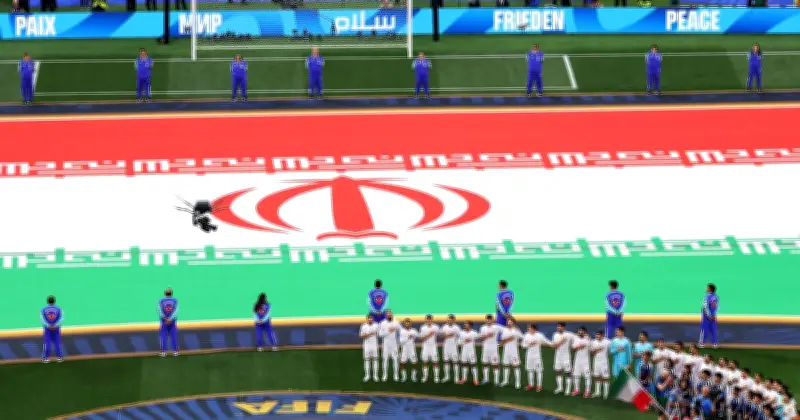
The age-old adage dictates that sport and politics should never mix. Yet what unfolds when the two are inevitably thrust together? That question was answered when Iran kicked off their World Cup campaign in Los Angeles against New Zealand, with tensions running just as high as anticipated, both inside and outside Los Angeles Stadium.
The controversies surrounding Iran have been numerous, from Donald Trump refusing to guarantee the team's safety to the side being forced to sleep and train in Mexico. Beyond navigating the political complexities of a host nation, the Iranian national team also faced the challenge of gauging how Los Angeles' Iranian community - one of the largest in the world - would receive them before, during and after the match.
Unsurprisingly, the response proved every bit as divided as many had anticipated. As the Iranian players took to the pitch for their warm-up, the crowd - with vast swathes of Los Angeles Stadium packed with Iranian supporters brandishing an array of flags and banners - were broadly welcoming towards the nation's stars as they readied themselves for one of the most significant matches of their careers.
Furthermore, when the Iran national team, widely known as "Team Melli" (Persian for "national team"), were introduced, captain Medhi Taremi was met with a thunderous reception as he appeared on the 120-yard-long TV screen above the pitch, with the crowd erupting in passionate support of the 33-year-old.
In the moments leading up to kick-off, whenever an Iranian player appeared on the videoboard, the Los Angeles crowd - which significantly outnumbered New Zealand supporters owing to the substantial local Iranian population - would roar their approval, with the current Iranian national flag being waved enthusiastically.
Once the Iranian national anthem began to play, however, that mood swiftly shifted. As the opening bars of the anthem rang out across the stadium, a considerable portion of the more than 70,000 spectators present began to boo, nearly overwhelming the anthem itself.
Simultaneously, cheers erupted, creating a jarring mixture of hostility and celebration as supporters declared their allegiance, despite backing the same team. Also visible throughout the stands as the anthem played was the Shir o Khorshid, Iran's national flag from prior to the 1979 Islamic Revolution.
That specific emblem has become a symbol of resistance for those opposed to the existing regime in the country, representing an era before the Islamic Republic. Ahead of the World Cup, the Shir o Khorshid, which depicts a golden sun and lion, was prohibited by FIFA and was categorised under "Flags and Political/Offensive/Commercial Items", a designation which prevents such articles from being brought into stadiums.
"Any material, including but not limited to banners, flags, fliers, apparel and other paraphernalia, that are of a political, offensive and/or discriminatory nature, containing wording, symbols or any other attributes aimed at discrimination of any kind against a country, private person or group on account of race, skin color, ethnicity, national or social origin, gender identity and expression, disability, language, religion, political opinion or any other opinion, birth, wealth or any other status, sexual orientation or on any grounds," FIFA's notice at every entry gate at Los Angeles Stadium read.
Protesters were seen walking over the current Iranian flag outside Los Angeles Stadium. The old version of the Iranian flag, which featured a sun and lion, is banned at World Cup venues. Outside Los Angeles Stadium, the Shir o Khorshid flag was flown with pride during the demonstrations, as opponents of the current regime were even spotted treading on and marching over the present Iranian flag.
Protesters brandished the pre-Islamic Revolution flag or draped it across their shoulders, wearing shirts bearing the names and numbers of those killed by the current regime for daring to speak out. Those gathered outside Los Angeles Stadium also delivered a powerful message to the assembled crowds: "Iranians, both inside and outside, outside of Iran, share a common hope for freedom, justice, and a better future for our country. Today is not only about the football. It's not only about the football match. It is about reminding the world that, behind the name, Iran stands as a nation whose voice deserves to be heard. Let us continue to represent that voice with unity, respect, dignity, and determination."
Given how politically charged the afternoon had promised to be, the Iranian squad had threatened in the days leading up to their World Cup opener to stop playing should the flag be displayed inside the stadium or anti-Iran chants ring out from the terraces. Yet, surrounded by a thunderous wave of jeers and cheers, with supporters brandishing a flag from a bygone era inside Los Angeles Stadium, Taremi and his team-mates stood firm at the centre of the pitch, belting out the anthem and conducting themselves with remarkable composure.
As the national anthem drew to a close, the chorus of boos turned into cheers, with the players removing their hands from their hearts and clapping back towards the crowd in a show of solidarity. That overriding atmosphere pervaded throughout the entire match, even as sentiments had been divided during the anthem. Each time Iran threatened to find the net, the crowd rose expectantly to their feet, willing on what they hoped would be a moment to savour.
Whenever the referee failed to award a foul that the crowd believed the Iranians deserved, their disapproval and frustration reverberated around the stadium. When the team eventually broke through, thanks to Mohammad Mohebi and Ramin Rezaeian, the crowd exploded in celebration, with Los Angeles Stadium trembling as tens of thousands of supporters leapt in unison. The supporters' fervour appeared to diminish only when New Zealand star Elijah Just netted twice, levelling the scoreline at 2-2. Ultimately, the Iranian players did everything within their power as the sport they cherished collided directly with the politics outside their influence.
This became apparent in how captain Taremi, alongside Mohebi and Rezaeian, responded to media questions in the mix zone following the draw. For the most part, all three attempted to deflect questions away from politics, though it was Rezaeian's response regarding the booing of the anthem that revealed where he and his team-mates' minds were, at least publicly and among journalists. "Actually, we are here to answer football, a question about football, so you have to know my people in Iran, they are so great, they are so good into everything, everyone in the world now knows about my people, if there is any problem between us, this is our business, this is none of your business, so I just respect you, but this is something between us and we are going to solve it, don't worry," the player stated.




