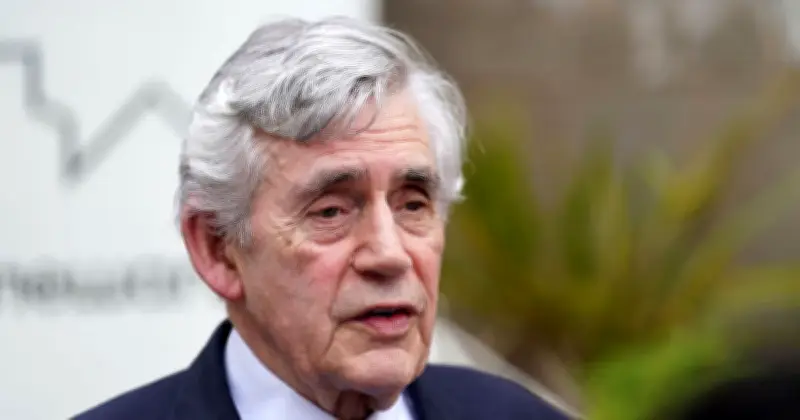
Former Prime Minister Gordon Brown has warned that fears of a third world war are stronger than at any time since the 1960s, as the Doomsday Clock moves closer to midnight. He criticized Russia, China, and the US under Donald Trump for abandoning international law, but named countries that could offer leadership.
Doomsday Clock and Global Fears
In an essay published by The Guardian, Brown referenced the 1962 Cuban Missile Crisis, saying, “Now, more than at any time since the 1960s Cuban Missile Crisis, the European public fears a third world war.” He noted that nations like Japan, South Korea, Saudi Arabia, the UAE, Egypt, Poland, and Germany are considering acquiring nuclear weapons or hosting them, signaling a shift from a rules-based order to one where “might is deemed right and brute force dominates.”
Brown’s comments follow a threat from a Kremlin adviser, Andrei Fedorov, a former Russian deputy foreign minister, who warned of “semi-military action” against the UK, potentially targeting British drone factories, in response to Britain’s support for Ukraine.

Leadership Alternatives
Despite the grim outlook, Brown pointed to public opinion surveys showing people look to Canada, Australia, Italy, Japan, the UK, France, Brazil, and South Korea for leadership. These findings appear in his book, The Future Starts With Us, published on September 1.
Solomiya Khoma, co-founder and head of international co-operation at the Ukrainian Security and Co-operation Centre, said Russia’s threats against the UK are not new but should be taken seriously. She stated, “Russia has long been engaged in hybrid activities against NATO member states, while Russian propaganda has systematically promoted anti-Western narratives.”
US-Russia Dynamics
Khoma also commented on the recent visit of CIA Director John Ratcliffe to Moscow, calling it “an extraordinary event.” She suggested the visit may have served as a warning to Russia about the consequences of continuing aggression against Ukraine, or could indicate the US strengthening its role as a mediator.
Meanwhile, the US faces tensions with Iran, as Trump threatened “economic D-Day” after military action failed, and China’s claims over Taiwan remain a point of contention.