
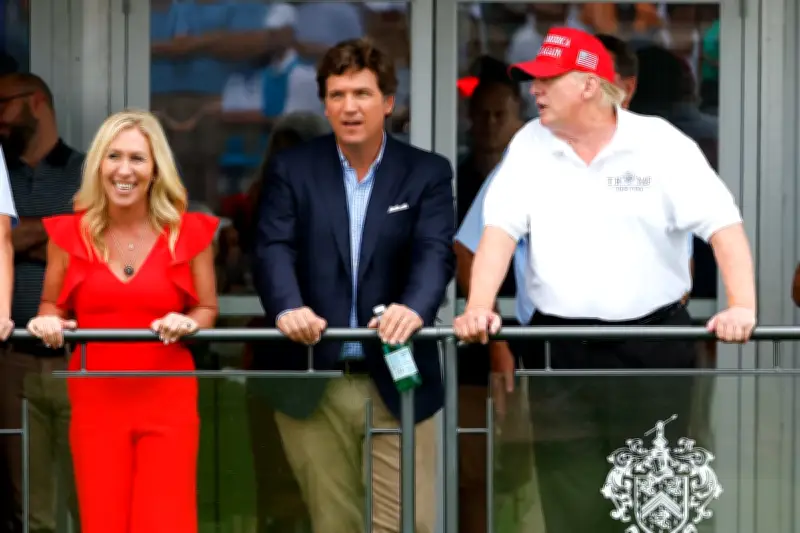
Tucker Carlson and Marjorie Taylor Greene, once staunch allies of Donald Trump, have formally left the Republican Party. The former Fox News host and ex-congresswoman announced their departures after Trump’s military engagement with Iran, which they argued prioritized foreign intervention over pressing domestic concerns such as inflation and high gas prices. While both have stated they will not support Democrats, their exit underscores deepening rifts within the GOP that could impair the party’s performance in the 2026 midterm elections and beyond.
Breakdown of the Republican Coalition
The Republican establishment has dismissed Carlson and Greene as malcontents, and Trump has escalated his attacks, labeling Greene a traitor and Carlson a “low-IQ person.” Other conservative critics attribute their critiques to animosity toward Israel. Greene became the first Republican in Congress to describe Israel’s actions in Gaza as a “genocide,” while Carlson has accused Trump of betraying Americans by allowing Israel to push the U.S. into war with Iran. Carlson’s criticism of Israel, following a sympathetic interview with white nationalist Nick Fuentes, has sparked accusations of antisemitism, which he denies.
Despite Greene’s tendency for outlandish statements—such as her tirades against “Nancy Pelosi’s gazpacho police”—both figures are considered potential 2028 presidential contenders. Their political influence lies with the “America First” faction of the Republican Party, distinct from the MAGA faction dominated by Trump. Although Trump previously kept these groups united, they represent divergent worldviews rooted in different eras of American conservatism.
Historical Roots of America First and MAGA
The America First Committee, active from 1940 to 1941, campaigned against U.S. entry into World War II. Though initially nonpartisan, “America First” became tied to populist nationalism and antisemitism, exemplified by Charles Lindbergh. Trump revived the label for his 2016 campaign, tapping into a persistent American fear of foreign entanglements, suspicion of immigrants, and distrust of internationalist policies that benefit elites. Carlson has articulated this isolationist stance in terms reminiscent of mid-20th-century figures like Senator Robert Taft, and he feels betrayed by Trump’s Iran war.
In contrast, Trump’s “Make America Great Again” slogan evokes different historical periods. When pressed, Trump points to the late 19th and early 20th centuries—a time of American military and industrial expansion—and the post-World War II era of his own baby boomer generation. MAGA supporters often romanticize the Gilded Age, when tariffs funded the government and U.S. industry thrived behind protectionist walls. Yet that era also marked the onset of American imperialism, including the annexation of the Philippines after the Spanish-American War. Trump’s “Donroe Doctrine” echoes the 19th-century Monroe Doctrine, asserting U.S. regional hegemony, and his alignment with Russia against Ukraine reflects a belief that great powers should respect spheres of influence. While MAGA shares America First’s contempt for alliances, it is not isolationist, as Trump’s interventions in Venezuela and Iran demonstrate.
Nostalgia for the 1950s and Fractures Ahead
Many MAGA supporters view the 1950s as a vanished utopia. A 2024 survey found that about 70% of Republicans believe America’s culture and way of life have worsened since the 1950s, compared with only 30% of Democrats. Both MAGA and America First factions express nostalgia for a time of patriotism, religiosity, and blue-collar prosperity. Critics argue this longing is for an era when minorities were marginalized, LGBTQ+ individuals were closeted, and women’s roles were largely confined to marriage and motherhood. Trump also cherishes the memory of when America was the unchallenged global power—a vision at odds with isolationism.
Carlson, in a recent podcast, said of MAGA: “I never understood it. I think there was a strong latent desire in the hearts of a lot of Americans to improve the country … but it was imprecise by design.” Trump’s charismatic incoherence, along with traditional Republican advisers during his first term, allowed him to bridge the contradictions between the factions. However, no likely 2028 Republican candidate—including JD Vance—is expected to replicate Trump’s ability to hold them together.
“I’ve been a consistent defender for 35 years of the Republican party,” Carlson told interviewers. “And if I’m out, then I think a lot of other people are out.” Disillusioned America First supporters may sit out the midterm elections, especially if Middle East instability drags on the economy. It is possible that Carlson or Greene could attempt to reclaim the party in 2028 or form a populist-isolationist third party. Yet shared opposition to the left may still keep Republicans united despite internal divisions, according to Geoffrey Kabaservice, director of political studies at the Niskanen Center and author of Rule and Ruin: The Downfall of Moderation and the Destruction of the Republican Party.




