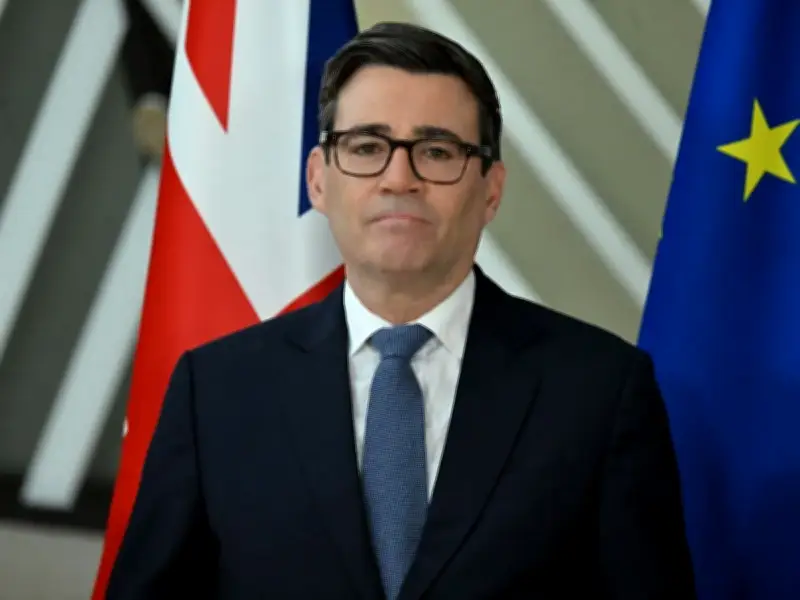
Prime Minister Andy Burnham's Brexit reset deal with the EU is at risk unless an agreement is reached over tuition fees faced by students from the European Union. Mr Burnham is in Brussels today to finalise agreements over food and agriculture exports, emissions trading, as well as a youth mobility scheme that could open the doors for 100,000 young Europeans to temporarily work in the UK.
Mr Burnham said the deal would be "good for working people, good for Britain and good for Europe", and claimed it would deliver an economic boost by adding 0.5pc to gross domestic product (GDP).
Tuition fees row threatens deal
The EU has demanded fees for students from member states studying in the UK to be cut to the same level as domestic undergraduates. That would mean a reduction from fees of up to £38,000 a year to £9,970 – something the UK has resisted because of the financial implications for universities.
A six-month deadline has been put on talks to reach a deal on fees, with the prospect that other elements of the agreement might not be implemented until a solution is found. An EU official said the agreements would have to "come into force in a balanced way". The source told PA: "I think this is an important element, so let's hope that everything can go ahead."
Youth mobility scheme and economic benefits
The youth mobility scheme could allow 100,000 young people from the EU to travel, work and study in the UK per year, with the same number of Britons to be allowed into Europe. Mr Burnham described it as a "good day for young people in Britain". He said: "Gen Z, millennial kids, I think they arguably were the biggest losers from the changes of a decade ago. They lost opportunities when Brexit came and then Covid."
Mr Burnham said the deal would reduce export costs for both sides to take pressure off food prices and that access to the European carbon trading scheme would help bigger industries. He said he was pleased with language around the EU's Made In Europe scheme to avoid negative impacts on the UK's steel and automotive industries.
Labour claims the food and agriculture deal will add up to £5.1 billion a year to the economy, cutting red tape by removing the need for certificates and border checks for products crossing between the UK and EU. Linking the emissions trading regime, which will protect British exporters from facing a carbon tax when supplying customers in the EU, could add a £3.8 billion annual boost, the government has claimed.
Political opposition and criticism
However, Reform UK leader Nigel Farage has accused Mr Burnham of "betrayal". He told the BBC's Today programme: "I'm afraid that the great Brexit debate has just started again. We don't need to be in a political union of any kind at all to do business and have good relations with our neighbours. That's the betrayal that Burnham is committing today and he's trying to do it incrementally, but it's perfectly clear that this very, very soon becomes a debate about: do we rejoin or do we stay out?"
He acknowledged that for food exporters a deal on agricultural standards will make things "a little bit easier", but said it comes at the cost of giving up control over regulation. "The Labour Party was elected saying they would not rejoin the single market. Well, today we're rejoining a chunk of it," he added.
Kemi Badenoch, leader of the Conservative Party, said: "While Andy Burnham flip-flops on the EU, he's not focusing on the country's priorities." Referencing the recent meeting between US President Donald Trump, Chinese President Xi Jinping and Russian President Vladimir Putin, she said the Prime Minister needs to prioritise defence spending.
"Trump, Putin, & Xi are ruthlessly focused on their own national interest, carving up the globe into spheres of influence, our Andy won't fund our armed forces because he wants more welfare," she added. "Burnham wants to distract the country with talk of rejoining the EU. I won't be distracted, and I will keep holding him to account for his failure to fund defence at a time of increasing threats to our national security."
Food and agriculture deal details
The food and agriculture deal, aimed at ending post-Brexit export checks, would see Britain align with the EU on trade rules on sanitary and phytosanitary (SPS) goods, such as food and plants, from March 2028. The Conservatives accused the Government of preparing to "sell out" British farmers by becoming a rule taker.
Shadow environment secretary Victoria Atkins said: "They are forcing farmers to follow rules over which we have no say, no vote, and no veto, that benefit highly subsidised foreign farmers, and taxpayers are going to end up paying for the privilege."
Mr Burnham is also preparing to open a national conversation about the UK's future relationship with the bloc, which could potentially include seeking to regain full membership. He said he would start a discussion with Brussels about options after the summit, then set them out later this year. Any major changes will have to wait until after a general election because the Prime Minister has committed to sticking to the 2024 Labour manifesto's red lines – which rule out returning to the customs union, single market or free movement.