
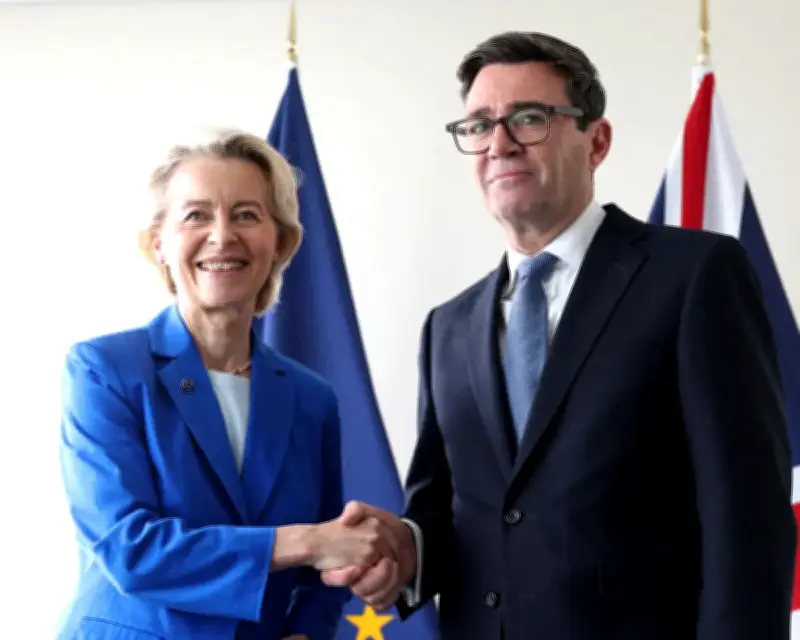
Andy Burnham has said Brexit has “done more harm than good” and pledged to launch a major review of the UK’s relationship with the EU, opening the door to a potential referendum over rejoining the union.
Speaking at Labour’s party conference, the Prime Minister said he would “lay out options” around the time of the next EU-UK summit, due to be held at the end of November or soon after. While he didn’t specify options, he did not explicitly rule out rejoining.
Burnham’s EU remarks
“Brexit hasn’t given us control,” he said, arguing the UK had not just lost control of immigration – contrary to what Brexiters had promised – but also over the economy.
“I will take the opportunity around the summit to lay out to you, to lay out to the country, what I believe the different options are for Britain’s long term relationship with our European partners,” he said. “There are different options and I will see if we can find consensus around one, which will give us clarity about our position and the future of the continent that we live in.”
Significance and stakes
Going beyond Starmer’s reset ambitions is a risky move and will test Burnham’s ability to sell any closer relationship with the EU to a country still bruised by Brexit. In the 10 years since the Brexit referendum, the UK has drifted from its nearest trading bloc, with exports to the EU dropping, travel restrictions for British passport holders, and potential new red tape for employers sending staff to the continent on short-term contracts.
Keir Starmer’s red lines of not rejoining the single market or customs union could now also be up for discussion within Labour’s ranks in the coming weeks. “I would be stunned if Starmer’s red lines are in the next manifesto,” said Joël Reland, senior research fellow at UK in a Changing Europe.
Options on the table
Rejoining the EU would require a referendum in the UK and potentially years of de-Brexit negotiations, plus cast iron guarantees from Brussels that the UK wouldn’t walk out again. It would mean a return to freedom of movement but also total freedom to trade, adding a potential 3-5% to GDP, according to UKICE’s analysis.
Switzerland, not an EU member, struck a deal last year cementing its “frictionless access” to the single market, access to the EU’s electricity market, space programmes, Erasmus, and the Digital Europe research programme, in exchange for free movement of people and paying €375m (£322m) a year into EU funds. The EU previously offered the UK a Swiss-style deal, rejected by Boris Johnson because it required regulatory alignment and free movement.
Joining Norway and Liechtenstein in the European Economic Area could add 2-3% to growth but would mean joining the single market and accepting EU immigration again. The single market brings four freedoms: movement of labour, capital, services, and goods.
Political context and timing
Labour already sees the relationship with the EU as a point of difference with Reform UK, but has felt nervous of handing Nigel Farage free political capital by suggesting Brexit could be reversed. Sources say there is now a recognition in the Labour party that the offer to the public has got to be bigger than the current reset.
Burnham has said he wants to have the conversation about the options over the next two months to coincide with the delayed EU-UK summit to be held in Brussels, perhaps at the end of November. This article was amended on 30 September 2026 to correct an earlier version that incorrectly said joining the EEA would also require joining the customs union.




