
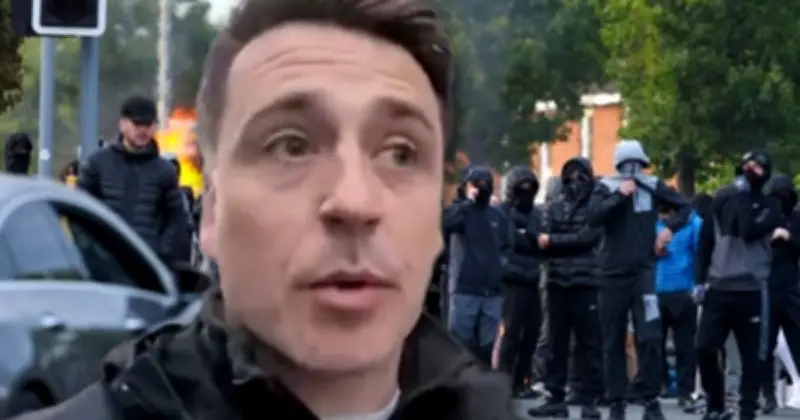
The shocking reason Belfast rioters knew which houses contained foreign families has been revealed: neighbours pointed them out. Tuesday night's riots in Belfast were reminiscent of the Troubles, leaving locals wondering whether events of the past could return.
By Conor Wilson, News Reporter 09:56, Thu, Jun 11, 2026 Updated: 10:14, Thu, Jun 11, 2026
Belfast: Express reporter Conor Wilson at scene of disorder. The morning after smelt like charred metal and burning rubbish bins as Belfast tries to make sense of violent scenes across the city. On Tuesday night, protests following the attempted murder of a man in the city saw houses set alight with families inside as anger over immigration spilt over into scenes reminiscent of the Troubles.
Comparisons with the Troubles are often made too lazily whenever there is civil unrest in the province. But this time, they were not being reached by outsiders. They were being made by people who live in these communities, and who remember what violence once did to them.
Walking down the Shankill Road or Newtownards Road on Wednesday, many residents looked shell-shocked as they passed boarded-up houses with fire-damaged walls, as if they were struggling to come to terms with what was to come in the short term and what it meant for their community in the long run. Dozens of people old enough to remember the riots of the late 20th century surveyed the damage with the look of battle-hardened soldiers, shocked not by the violence and destruction, which they had seen before, but by seeing it again in 2026.
One resident of one of the most damaged streets told the Daily Express that the houses opposite her were targeted because they contained a Romanian family. How did the mob know they contained a Romanian family? Because their neighbours pointed out the house. She said: “They were pointed out by the young fellas by other people living on the street because they were occupied by Romanian people - Two families with small children.” She added: “The lads were also handed hairspray and whatnot to allow them to set fires off, and once they got inside the house, it just went crazy as they were able to drag cushions into the cars (to set alight).”
These are the kinds of actions that happen over the course of half an hour that cause wounds that exist for generations. The residents' recollection tallies with my own in another area of the city, where residents caught up with one another before heading into their own streets to cause terror and violence that could have been fatal. How do these communities reconcile the actions of Tuesday night? Those who stood in doorways, desperate to help but powerless to do so, must now live side by side with those who would have thought little of taking the life of a neighbour whose only crime was not to be British.
Excitement was the primary emotion among rioters, not anger. Some will explain the scenes as a response to a barbaric attack, but it was more than that. People were angry — and anyone who has seen the footage of the original incident will understand why. But from where I was standing, the motivation of many of those smashing windows and lighting matches was not righteous anger. It was opportunism. In some cases, it looked like excitement. The orchestrators needed little excuse to tear up their community and were more than happy to do so under the pretence of responding to a vicious attack. Those fanning the flames on social media knew that only the smallest spark was required, and so it proved.
Northern Ireland has come so far in the years since the Good Friday Agreement, and the potential for the nation to be dragged back into its past will surely be at the forefront of authorities' efforts to reduce tensions and deter lawlessness. Threats of custodial sentences might have some impact, but it will be limited at best. Belfast has a short fuse, making it susceptible to online grifters who seek division. The issues are systemic and deep-rooted and require strategic leadership to lengthen the fuse and stop immigration from becoming an issue that turns Northern Ireland into the worst version of itself.




