
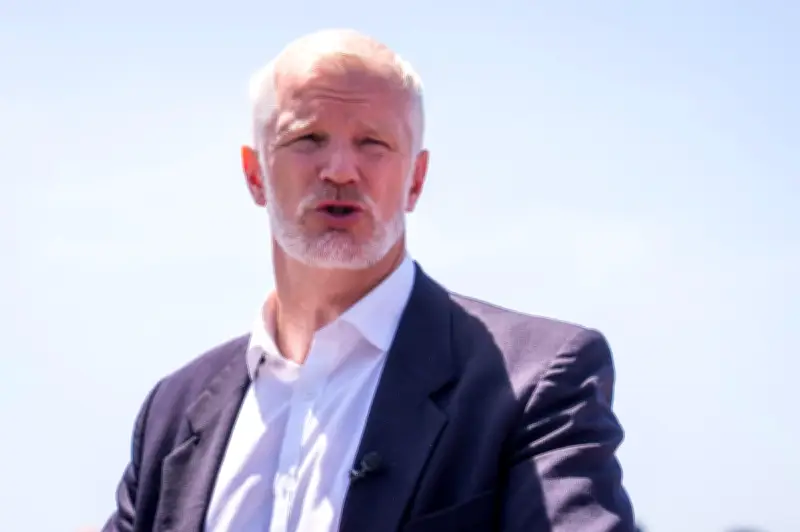
Labour MP Al Carns has stepped down from his role as Armed Forces Minister just hours after a TV interview in which he appeared to suggest he would resign if unhappy with the government’s defence spending plan. His resignation came shortly after Defence Secretary John Healey also left his post over the same issue.
In an interview with Sky News on Thursday, Carns stated that the government needed to secure the “right financial settlement for defence” and described the defence investment plan as “as transformative as it can be.” However, he gave no indication during the interview of his intention to resign less than an hour later.
Resignation Letter Details
In his resignation letter, Carns wrote: “We are asking our Armed Forces to operate in a more dangerous world on a budget written for a calmer one.” He claimed the Defence Investment Plan was neither transformative nor sufficiently funded. Carns, a former Royal Marines commando and decorated special forces commander, offered a scathing critique of Downing Street's leadership, stating that “the machinery of government itself has been left to decay” and that departments were fighting each other instead of solving problems.
Pamela Nash also resigned from her post as a parliamentary assistant to John Healey.
Full Text of Carns’ Resignation Letter
Prime Minister
It has been the privilege of my life to serve this country, first in uniform and then in government. I have said that there are issues facing this Department that do not lend themselves to easy answers, and that there needs to be agreement throughout the government about the scale of the challenges we face. It has become clear to me that the change I had pushed for is not going to come. Given the situation, I have decided to resign as Minister for the Armed Forces.
We face a more unstable and dangerous world than at any point in recent decades, and having spent most of my adult life in uniform, I understand what public service in such a moment demands. It is for this very reason I cannot continue.
I have watched, as a Marine, what war looks like now. I have spoken to those who have seen it up close in Ukraine. The lesson is uncomfortable and it is unambiguous. The character of conflict is changing faster than our procurement can keep up with. We are still purchasing capability suitable for the last war while our adversaries arm for the next one. Platforms that cost billions can be defeated by systems that cost thousands. Any serious Defence Investment Plan has to start from that reality.
While I had no hand in the Defence Investment Plan, that distance does allow me to say plainly that it is not built for the threat we face. It is neither transformative enough nor sufficiently funded. We are asking our Armed Forces to operate in a more dangerous world on a budget written for a calmer one.
I have sat in the rooms, seen the assessments, and spoken to the commanders who will be asked to do more with less, and I cannot in good conscience stand at the dispatch box and defend a level of investment I know to be inadequate to the task. A serious country funds its defence to meet the threat it actually faces, not the threat it wishes it faced.
The same instinct, that serious problems can be managed rather than faced, runs through the Northern Ireland Legacy Bill. I have worked to fix the Bill from the inside, but it remains unfit for purpose. It risks failing the very veterans it claims to protect. Men and women I served with, those I buried friends alongside, people who did their duty under conditions most individuals in Westminster will never have to imagine.
I set out the changes I believed were necessary, and the lines which I could not in good conscience go beyond. Those lines have not been accepted. I have run out of room to argue this case honourably from inside government. A serving minister cannot ask fellow veterans to trust a process he no longer trusts himself.
These two failures are the same failure. We ask soldiers to fight for this country. In return, we owe them the kit to do the job and the loyalty to stand by them when it's done. We are failing on both.
The same failure of seriousness runs through how this country treats the people it asks the most of, in uniform and out of it. Too many working people in this country feel insecure even when they are doing everything right. They work hard, contribute, pay their taxes, and still feel one setback away from trouble. Public confidence in our institutions is weakening, and politics increasingly looks performative while everyday life gets harder.
The machinery of government itself has been left to decay. Decisions that should take days, take months. Departments fight each other instead of the problem. Officials and ministers who know the truth are not always rewarded for telling it. We are trying to govern a more dangerous world with processes designed for a calmer one, and the gap is now showing in the things that matter most.
National resilience is about more than defence in the narrow sense. A strong country is not simply one with capable armed forces. It is one where working people feel economically secure, public services function, energy is resilient, communities are stable, and young people can see a future worth working towards. If my resignation accelerates the transition towards resolution, then the impact will far outweigh the act. We need a new way of governing and we need it now.
For my own part, I will keep arguing for a politics rooted in resilience, seriousness, and national renewal. For a country where working people can once again feel secure about the future. And for the service personnel and veterans this government still has a duty to. The deal this country makes with the people who serve it, in uniform, in classrooms, on building sites, is broken. I'm going to spend my time on the backbenches trying to fix it. I'll keep fighting for the people I served with. I hope this government will too.
Yours sincerely, Al Carns DSO OBE MC MP
Member of Parliament for Birmingham Selly Oak




