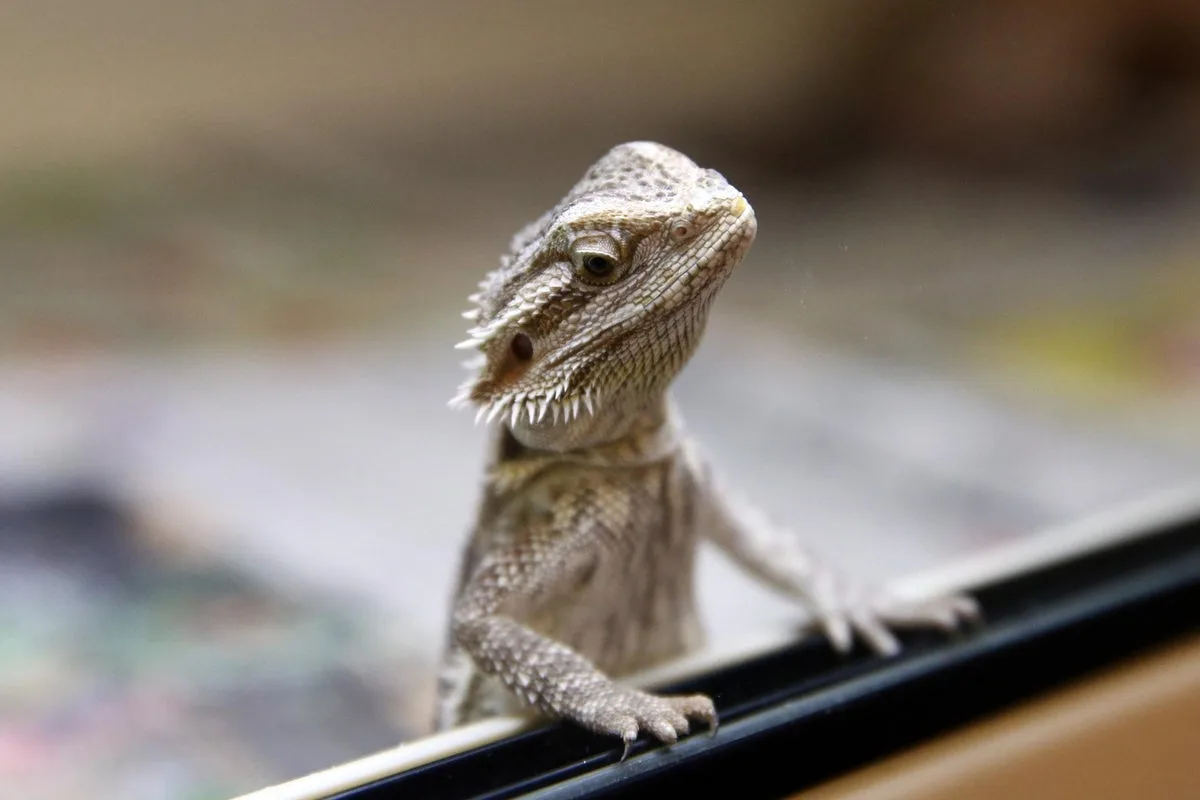
Pet reptiles often exhibit a behaviour known as “glass surfing,” where they repeatedly run, dig, swim or climb against the walls of their enclosure. While it may initially seem endearing, it can become distressing if it persists, sometimes leading to injuries such as rubbed-off scales or bleeding. Scientists classify this as a type of repetitive behaviour, similar to pacing in captive polar bears.
Research by our lab on bearded dragons, one of the world’s most popular pet reptiles, has shed light on the reasons behind this behaviour. We found that lizards direct their repetitive actions disproportionately toward the only “door” in their enclosure, and when that door is partially obscured, they focus even more on the transparent portion. This supports the theory that glass surfing stems from a motivation to escape.
Common triggers for this escape drive include enclosures that are too hot, small, or boring. Increasing the size or complexity of the habitat can often reduce the behaviour, but not always. Interestingly, we discovered that defecation was 15 times more likely to occur during periods of repetitive barrier interaction, suggesting that bearded dragons may prefer to eliminate away from their sleeping and eating areas.
We also observed seasonal and sex differences: female bearded dragons rubbed against enclosure barriers more in spring than in winter, and more than males at any time. This may reflect natural roaming behaviour in spring, whereas males can still patrol their territory inside the tank. Unlike in mammalian carnivores, feeding did not correlate with the behaviour, possibly because adult bearded dragons are less active foragers.
To mitigate glass surfing, understanding the species’ natural habitat is key. For female dragons, regularly rearranging items inside the enclosure may simulate exploration and reduce escape motivation. However, there is no one-size-fits-all solution, and further research is needed to fully understand repetitive behaviours in reptiles.