Centuries before wellness influencers existed, Benjamin Franklin published an annual pamphlet of life advice under the pseudonym Poor Richard, minting maxims like “Diligence is the mother of good luck” and “Fish and visitors stink after three days.” In his autobiography, he detailed a daily routine and enumerated 13 virtues he believed were necessary for a good life, including temperance, silence, frugality, industry, tranquility, and “Humility: Imitate Jesus and Socrates.”
Franklin’s efforts appear to have paid off. “He lived to 84, which is a good age for the 18th century,” says Joseph Adelman, history professor and co-host of the Ben Franklin’s World podcast. Adelman describes Franklin as an “inveterate improver,” constantly tinkering at the margins of his own habits. This perpetual quest for optimization was considered eccentric at the time, says Adelman. Franklin dabbled with vegetarianism long before it was common, recalling in his autobiography, “My refusing to eat flesh occasioned an inconveniency, and I was frequently chided for my singularity.”
Preparing to Be Benjamin Franklin
To begin the experiment, a copy of Franklin’s autobiography was purchased. The work is a pleasant read and funnier than expected, including a scene where Franklin acquires too many bread rolls from a baker and runs into his future father-in-law, one roll under each arm and one in his mouth. “I made a most awkward, ridiculous appearance,” he says.
Historians confirm Franklin’s emphasis on health. “We forget how vital and healthy [Franklin] was into his 50s,” says Rae Katherine Eighmey, food historian and author of Stirring the Pot with Benjamin Franklin: A Founding Father’s Culinary Adventures. Franklin stressed regular physical activity, especially for sedentary jobs, and paid close attention to food, drink, and the effects of alcohol. The latter was notable at a time when diets were rich in alcohol and it was considered healthy to take a shot of liquor first thing in the morning, says Sarah Lohman, food historian and author.
Over the years, Franklin suffered from gout, psoriasis, pleurisy and bladder stones. But according to Adelman, “he does seem to have been, all things told, for an 18th-century white man, relatively healthy.”
A Day Following Franklin's Routine
Franklin awoke most days at 5am. His morning routine lasted about two hours, consisting of: “Rise, wash, and address Powerful Goodness! [Ed note: his version of God/a higher power] Contrive day’s business, and take the resolution of the day; prosecute the present study, and breakfast.”
The reporter set an alarm for 7am, a personal version of 5am. Franklin enjoyed “air baths,” which Eighmey says entailed “sitting naked shortly after arising in front of an open window.” This was skipped due to neighbors. Breakfast was the reporter's usual wheat cereal with yogurt and berries, though Franklin's favorite was fresh bread cubes tossed in melted butter, toasted, then dropped in a bowl of hot wheat cereal and topped with more butter.
From 8am to 11am, Franklin worked. The reporter did the same, finding success in work calls and Slack jokes. Franklin took a two-hour lunch every day, as lunch was the biggest meal of the day in his time. His favorite foods included potatoes, parmesan and apples. The reporter had beef and potato stew followed by an apple.
Exercise and Evening Routine
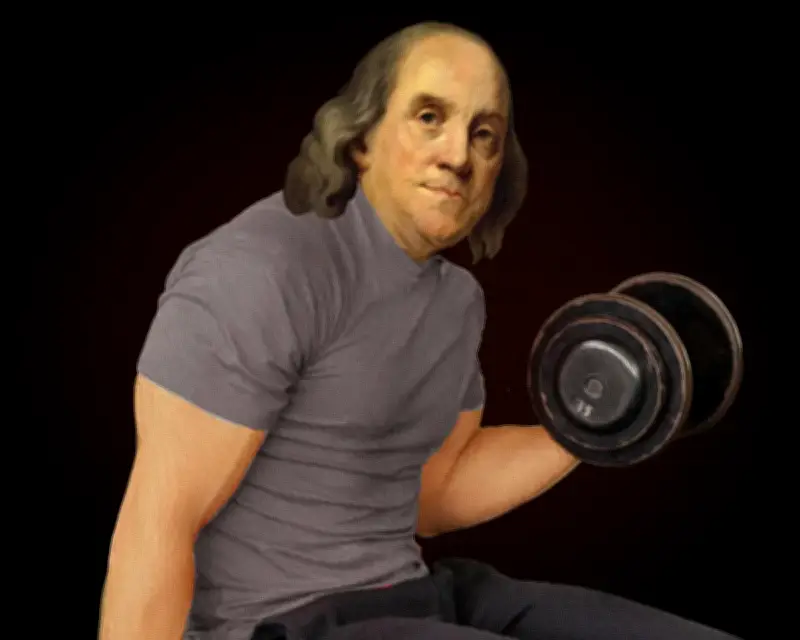
Physical activity was important to Franklin. He once wrote to his son, William, that dumbbells contain “a great quantity of exercise in a handful of minutes.” Franklin said he would do 40 swings with them, gripping one weight in each hand and swinging them back and forth by his sides. The exercise is now known as “skier swings,” and various fitness blogs recommend it, as long as you keep the weight low. The reporter tired out after 30 reps.
Franklin's evening routine from 6pm to 10pm was: “Put things in their places, supper, music, or diversion, or conversation; examination of the day.” A 1998 excavation of his terrace house in London uncovered a pit full of over 1200 human and animal bones, apparently from an anatomy school run by William Hewson, the son-in-law of Franklin's landlady. Franklin described the anatomist as an “excellent young man.”
Evaluating the day, the reporter's strengths were “order,” “frugality” and “cleanliness.” Weaknesses were “temperance,” “silence” and “humility.” Franklin himself wrote in his autobiography: “I was surprised to find myself so much fuller of faults than I imagined.”
Being mindful of what you eat, getting enough exercise and focusing on personal growth are as helpful today as they were 250 years ago. Today, instead of wildly swinging around dumbbells, Franklin might be following a customized strength training plan.