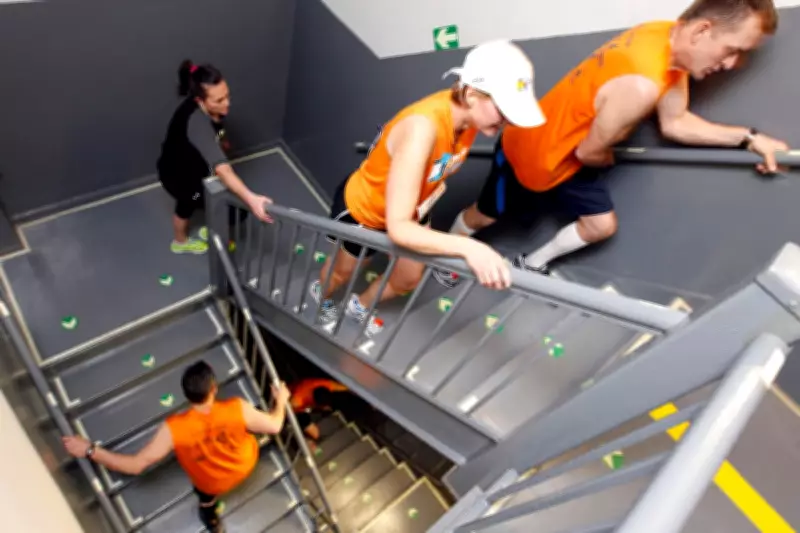
Stair climbers remain dedicated to their fitness routines, even when confronted by security personnel who may view their activities with suspicion. Climbing stairs has become increasingly recommended in exercise guidelines, yet finding suitable locations for this activity can prove difficult.
The Dedication of Stair Climbers
Tom McGee began climbing stairs for exercise two decades ago as part of his strategy to quit smoking. The 69-year-old market researcher from near Chicago has faced numerous challenges, particularly when using hotel stairwells. "I've gotten kicked out of about every hotel in the city," McGee revealed. His experience reflects a broader issue where office tower managers frequently restrict stairwell access, creating obstacles for regular climbers.
Substantial Health Benefits
Dr. Luis Rodriguez, a semi-retired pediatric pulmonologist who participates in stair-climbing events, enthusiastically endorses the practice. "You are working your legs. You are working your heart. You are working your lungs," explained Rodriguez, 66. "You can get a lot more benefit than just walking, because gravity is working against you."

Scientific research supports these claims, indicating that climbing stairs for four minutes provides benefits roughly equivalent to ten minutes of brisk walking or twenty minutes of slower walking. Federal physical activity guidelines were updated in 2018 to promote short-burst activities like taking stairs between floors at work. These guidelines emphasize that such activities accumulate throughout the day, offering health improvements even without traditional workouts.
"Many people don't realize that they don't have to exercise all in one bout for it to be effective," noted Stella Volpe, an exercise expert from Virginia Tech. Jennifer Gay, a public health researcher at the University of Georgia, added that stair climbing can enhance mental health and increase feelings of energy for many individuals. Experts recommend consulting doctors before beginning climbing regimens for those with potential stair-related difficulties.
Building Owners' Liability Concerns
The American Lung Association organizes "Fight for Air" fundraising events each spring in office towers nationwide. While these events are generally enjoyable, the name references both the breathlessness climbers experience and lung disease challenges. However, landlords often prove less accommodating due to liability fears.
Some legal advisors warn property owners about potential liability if individuals trip or slip on staircases. Conditions like poor lighting, liquid on steps, or broken handrails can become grounds for lawsuits following injuries. Consequently, many building managers restrict stairwells to emergency use only.
A 2018 study of hospital emergency department visits concluded that over one million stair-related injuries occur annually in the United States, with broken bones more prevalent among older individuals. Women accounted for more than 60% of those injured. Despite these statistics, Gay emphasized that climbing stairs presents minimal injury risk, though descending stairs can be riskier. She added that building managers "can't make it a one-way street."
Health advocates have campaigned for improved stair access for over a decade. In 2013, ChangeLab Solutions, a California-based health policy nonprofit, issued a resource guide urging property owners to open stairwells, arguing they pose no greater liability risk than other common areas. Gay and colleagues estimate that 60% of U.S. workers occupy multistory buildings with stairwells, though statistics on access restrictions remain unavailable.
Creative Solutions for Access
Many climbing enthusiasts share stories about difficulties finding accessible staircases. Lisa Bai, a New York real estate professional, cannot use her office building stairs. "It would seem like an easy way to get some exercise, but sometimes it's not," she explained.
Bai and others find alternative methods. Fitness equipment like StairMaster machines can simulate stair climbing, though tower climb participants note they lack the real activity's arduousness. Those without easy home or public access must employ creativity.

Carmen Erickson and Vivian Dawson, Detroit suburban residents, have met approximately three times weekly for nearly a decade to climb stairs, typically in nearby parks. Travel presents greater challenges. When vacationing together, they deliberately book top-floor hotel rooms to access stairs and seek hills or hospital parking decks. They've also secured after-hours access to one building's stairwells by signing waivers and checking in with security.
"If you connect with the right people and tell them what they're doing and agree to the rules, it hasn't really been a problem for us," said Erickson, 53. Dawson, 64, added: "You have to really want to do it."
The Associated Press Health and Science Department receives support from the Howard Hughes Medical Institute's Department of Science Education and the Robert Wood Johnson Foundation. The AP maintains sole responsibility for all content.