

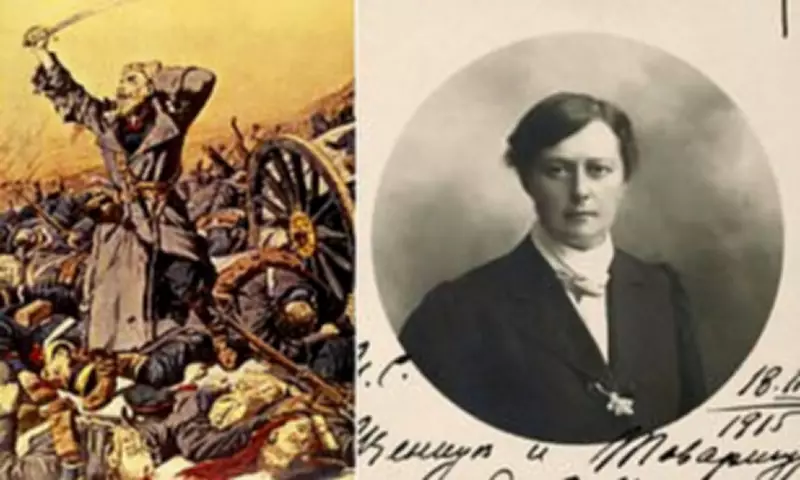
One day in 1915, Rasputin, that disreputable monk-mystic, burst into the St Petersburg hospital founded by his besotted patron, Empress Alexandra of Russia. The grubby charlatan announced that he had come to perform a miracle and started to pray ostentatiously over a dangerously ill patient. But he had reckoned without the tall woman standing quietly in the corner.
Dr Vera Gedroits was Russia's only female surgeon, a colossus of a woman who had saved countless soldiers' lives on the battlefield. Calmly deploying skills she had honed over decades, Gedroits – who also happened to be a princess – chose to override Rasputin's self-serving mumbo jumbo and calmly frogmarched the mad monk to the ward door before throwing him into the dark stairwell. You could call it a boss move.
A Heroine for Our Times
In this thrilling biography, Miranda Seymour tells the astounding story of Vera Gedroits, Russia's first female professor of surgery and a Ukrainian heroine. On paper Vera's background sounds grand – her father, Prince Ignatius Gedroits, was a Lithuanian noble. But he was also a bully and a libertine who could be relied upon to get maidservants pregnant. Vera's mother was a suicidal alcoholic. Her beloved grandma kept the village school and was the first person to believe in the fearsomely intelligent little girl who insisted on cropping her hair and wearing boys' clothes.

The death rate in the village was high: typhus, consumption and diphtheria cut down the impoverished inhabitants in swathes. Vera lost a favourite cousin to typhus and was then forced to watch as her beloved younger brother Sergei died from the same disease. At that moment she vowed to become a doctor and dedicate herself to saving the lives of the poor and needy.
Early Career and Revolutionary Ties
She persuaded her parents to let her attend college in St Petersburg, where she became involved in revolutionary student politics. To escape the police's radar, she slipped away to Lausanne, intending to study under Cesar Roux, one of the great surgeons of the age. It says a lot about Vera's self-belief that she turned up in Switzerland without bothering to first secure a place at the university.
It didn't take long for Roux to recognise Vera's outstanding talent. He made her his assistant, promoting her over scores of clever young male doctors. Inevitably, there was jealousy. During one chemistry session two male students 'accidentally' spilled acid on Vera's skirt. Not that she was bothered. 'After working with students in Petersburg,' Vera recorded with a shrug, 'I'm used to it.' When it was time for her to return home, Roux presented Vera with a set of Swiss-engineered surgical tools – the sort of precision equipment that would never have been available in her next job.
Pioneering Surgery in Russia
Seymour paints a wonderful picture of Vera's work at the Maltsov cement plant, stitching together limbs broken by the machinery and amputating those that could not be saved. She was one of the first Russian medics to insist on a sterile operating environment, and the results speak for themselves: by 1902 she had performed 200 operations without a single fatality.
As a lifelong radical, albeit one who proudly used her title of 'Princess', Vera was astonished in 1909 to receive a summons from Tsarina Alexandra to become the attending physician to her four daughters. Vera's previous work, which included operating on the battlefield during the Russo-Japanese war, hardly fitted her to be a court flunkey. But Alexandra, who had grown up enraptured by stories of Florence Nightingale, insisted that Vera train her and the young Grand Duchesses to become nurses, now that Russia seemed to be heading into a world war.
Etiquette decreed that 'the Princess' was allowed to correct her royal pupils only in private, never in front of onlookers. And in publicity photos, the strapping Dr Gedroits was expected to sit down, so as not to appear to outrank the diminutive Romanovas.

War and Revolution
By the time wounded soldiers started arriving daily from the Eastern Front in 1915, Vera had refined her expertise in abdominal trauma, and embarked on pioneering reconstructive facial surgery. Brave men who arrived with shattered jaws and only the stump of a tongue left the hospital with a good chance of being able to speak again. Over the months of shared patriotic duty, the bonds between Vera and her royal assistants deepened, even though by now she always dressed in men's suits, used male pronouns and chain-smoked roll-ups.
Despite being a life-long radical and anti-monarchist, when Vera received the news in March 1917 that the royal family had been put under house arrest prior to being murdered, she broke down in tears. And yet, on receiving smuggled Easter greetings from the tsarina and her daughters, she was careful not to write back. Vera knew that any whisper of collaboration with the old imperial authorities would destroy her career and even her life under the new communist regime. In August 1917, she was appointed to the executive panel of the Sanitary Council, in charge of reforming Russian healthcare.
Later Years and Legacy
Once Stalin gained power in 1922, it was clear that Vera's luck couldn't last. She moved with her life partner, Countess Maria Nirod, to Ukraine, a country bravely resisting Kremlin domination from Moscow. In 1929 Vera and Maria, now living openly as a married couple, were arrested and thrown in prison for several months. Seymour doesn't know what they endured there – the sources are sketchy – but suspects it was horrible. Only the intervention from a high-up official whose life Vera had once saved got them their freedom. Even then Vera refused to be defeated. Within months she was working as a professor of surgery at several Kyiv hospitals. Sadly, she died in 1932 from cancer, but in 2023, the city named a street in her honour to recognise her extraordinary humanitarian service to Ukraine.
Miranda Seymour has discovered a heroine for our own times. Vera Gedroits was caught up in the geo-political disasters of her age yet refused to despair or play it safe. Proud of her extraordinary skills, and joyously non-conformist, she resisted any political bullying, whether from Right or Left, putting her own life on the line in the process. And just in case her name sounds vaguely familiar, Mel Giedroyc of 'Mel and Sue' is indeed a member of her proud extended family.





